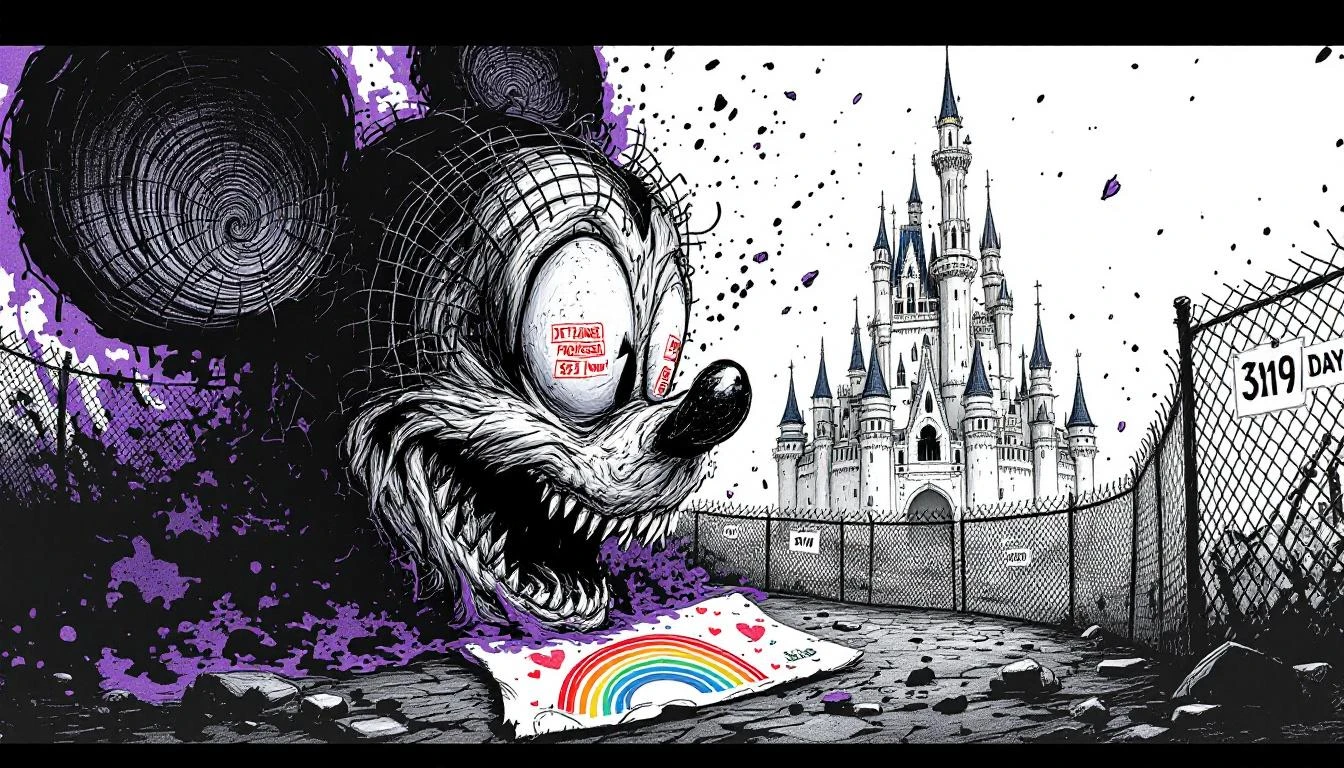
The Magic Kingdom's Dark Ride: How ICE Turned Mickey Mouse Into Kafka's Jailer
When the Happiest Place on Earth Meets the Cruelest
Somewhere in the fever dream that is America, a nine-year-old girl decorated her testimony of government captivity with rainbows and hearts. Maria Antonia Guerra Montoya drew a portrait of herself and her mother wearing detention uniforms and government-issued ID badges—the kind of cheerful crayon artwork that belongs on a refrigerator door, not in a federal case file about 113 days of state-sanctioned family imprisonment.
The crime? Planning to see Mickey Mouse.
The Bait-and-Switch Republic
Here's how it works in the land of the free: A mother flies from New York to Florida to meet her daughter, who has traveled from Colombia. Their itinerary includes Space Mountain, probably some overpriced turkey legs, maybe a photo with Goofy. You know—the American Dream™, available for just $109 per day plus parking.
ICE had other plans. Different kind of ride entirely. No FastPass for this attraction.
They intercepted the mother at the airport and—in a bureaucratic masterstroke that would make Orwell weep—used the nine-year-old child as bait to detain her mother. Then they shipped both of them 1,200 miles to Dilley, Texas, to the nation's only operating detention center for immigrant families. Because nothing says "family values" like using children as leverage in an enforcement operation.
The Dilley Industrial Complex
Dilley, Texas—population 4,000—hosts a private immigration detention facility that processes families like Amazon processes returns. Operated by CoreCivic (formerly Corrections Corporation of America, because rebranding is cheaper than reform), this facility represents the perfect marriage of cruelty and capitalism.
The business model is elegant in its sociopathy: The government pays private contractors roughly $319 per person per day to warehouse families seeking asylum. That's $638 per day for Maria and her mother. Over 113 days, that's $72,094 of taxpayer money to prevent a child from seeing Cinderella's Castle.
For comparison, a week at Disney's Grand Floridian Resort—their most expensive hotel—runs about $5,000. The government could have put them up there for three weeks and still saved $57,000.
But efficiency was never the point. The cruelty is the point.
The Theater of Deterrence
Immigration enforcement has become America's longest-running theatrical production—part security theater, part morality play, part medieval pageant. The script demands villains, and nine-year-olds clutching Disney brochures apparently qualify.
The parents at Dilley told ProPublica their stories. More than three dozen children wrote letters—on notebook paper, in crayon, decorated with the kind of hopeful imagery that children use to process trauma they shouldn't have to understand.
One child drew rainbows. Another drew hearts. Maria drew herself and her mother in matching detention uniforms, their ID badges carefully rendered, because even in captivity, a nine-year-old's attention to detail is exquisite.
These letters are now evidence. Legal documents. Exhibits in the case against American exceptionalism.
The Magic Kingdom's Shadow
Disney World's official tagline: "Where Dreams Come True."
Dilley's unofficial tagline: "Where Dreams Are Processed, Denied, and Appealed in Triplicate."
The distance between Orlando and Dilley is 1,200 miles. The distance between the myth of America and its reality is immeasurable.
Consider the symbolism: Disney World—the ultimate monument to manufactured joy, where every sidewalk is pressure-washed, every employee is "cast," and every experience is "magical"—exists in the same nation that detains children for wanting to visit it. The same country that built a $21 billion theme park empire can't figure out how to process an asylum claim without traumatizing children.
Or rather: won't figure it out. Because the system isn't broken. It's working exactly as designed.
The Grift Underneath
Follow the money, and you'll find the usual suspects: CoreCivic, with its portfolio of detention facilities and its healthy lobbying budget. Immigration and Customs Enforcement, with its ballooning budget and its mission creep. Politicians in both parties who've discovered that "border security" is the most reliable applause line in American politics.
The private prison industry has spent millions lobbying for stricter immigration enforcement. They've donated to campaigns. They've written model legislation. They've convinced politicians that the appropriate response to families seeking asylum is to cage them in the Texas desert and bill taxpayers $319 per person per day for the privilege.
It's a protection racket with a federal budget.
The Bureaucratic Labyrinth
Maria and her mother spent 113 days in detention. Not 113 days awaiting trial—they weren't accused of a crime. Not 113 days for any administrative reason that couldn't have been resolved with an ankle monitor and a court date.
Just 113 days because the system could. Because deterrence requires suffering. Because cruelty, when systematized and bureaucratized, becomes policy.
During those 113 days, Maria missed the start of school. She missed her friends. She missed normalcy. She gained a graduate education in American hypocrisy—the kind of curriculum that no child should have to study.
Her mother missed work, missed rent payments, missed the ordinary indignities of freedom that we all take for granted until they're stripped away.
What they didn't miss: daily reminders that they were unwelcome, unworthy, and expendable.
The Letters From Dilley
ProPublica received more than three dozen letters from children detained at Dilley. Read them if you can stomach it. Read about the fear, the confusion, the boredom punctuated by terror. Read about children asking why they're locked up when they haven't done anything wrong—a question that adults can't answer without lying or admitting something worse than lying.
The letters are decorated with hearts and rainbows because children still believe in beauty, even when surrounded by ugliness. They draw pictures of families together because they can't comprehend why families would be torn apart. They write about wanting to go home because they still believe in the existence of home.
These letters are more damning than any investigative report, more powerful than any congressional testimony. They're evidence written in crayon of a nation that has lost its moral compass so completely that it can't find its way back even when children draw maps.
The Mouse That Roared
Disney, for its part, has remained silent on the matter. The corporation that built an empire on family entertainment has nothing to say about families being detained while trying to visit its parks.
Then again, Disney has always been skilled at separating image from reality. They've perfected the art of the facade—Main Street USA, a idealized version of small-town America that never actually existed. Cinderella's Castle, a monument to European aristocracy marketed as aspirational rather than oppressive. It's a Kingdom, for God's sake—they literally branded their product as monarchy and sold it as freedom.
So perhaps it's fitting that the journey to Disney World should reveal the facade of American justice: the idea that we're a nation of laws (we are—but laws written by those with money to influence them), that we welcome the tired and poor (we do—into detention), that we value families (we do—at $319 per person per day).
The Banality of Evil, Dilley Edition
The guards at Dilley probably aren't monsters. They're probably decent people working a job in a town without many jobs. They probably go home to their own families, kiss their own children, and sleep soundly.
That's what makes it so much worse.
Hannah Arendt wrote about the banality of evil—how ordinary people, following ordinary procedures, can perpetrate extraordinary horrors simply by doing their jobs. Dilley is banality industrialized. It's evil with direct deposit. It's cruelty with a human resources department.
No one had to make a conscious decision to be monstrous. They just had to show up for their shift, follow protocol, and process the families through the system. The system does the rest.
The system is the monster.
The Kafkaesque Grotesque
Kafka wrote about a man arrested and prosecuted without ever learning his crime. He called it fiction.
America looked at that and thought: "We can do better. What if we arrested children?"
Maria's "crime" was wanting to see her mother. Her mother's "crime" was existing while immigrant. The punishment was 113 days in a private facility that profits from their suffering.
There was no trial. No jury. No conviction. Just detention, because the law allows it and profit encourages it.
The Castle at the end of this particular Main Street isn't made of fiberglass and paint. It's made of concrete and razor wire. And instead of a princess waiting inside, there's just a bureaucrat with a stamp and a stack of denial forms.
The Bill Comes Due
Here's what we paid for with our tax dollars:
- $72,094 to detain a mother and daughter who wanted to visit Disney World
- Trauma that will ripple through generations
- A nine-year-old's crayon testimony of American cruelty
- Another data point in the case against American exceptionalism
- Profits for CoreCivic shareholders
Here's what we didn't get:
- Security (they were never a threat)
- Justice (they committed no crime)
- Deterrence (desperate people aren't deterred by cruelty; they're just traumatized by it)
- Our humanity back
The Dream Deferred
Langston Hughes asked what happens to a dream deferred. Does it dry up like a raisin in the sun? Does it explode?
Maria can answer that now. A dream deferred becomes a letter written on notebook paper, decorated with rainbows that couldn't possibly exist in the Texas detention center where she spent four months of her childhood.
A dream deferred becomes a portrait of herself and her mother in matching uniforms, their ID badges carefully drawn because even in describing imprisonment, children try to get the details right.
A dream deferred becomes evidence in a ProPublica investigation that most Americans will scroll past on their way to checking their own vacation plans.
The Reckoning We're Avoiding
We can't claim ignorance anymore. The letters have been published. The investigation is public. We know exactly what's being done in our names, with our money, under our flag.
We know that a nine-year-old wanted to see Mickey Mouse and instead saw the inside of a detention facility for 113 days.
We know that private companies are profiting from family separation.
We know that the cruelty is the point, the deterrence is the goal, and the trauma is collateral damage that no one in power cares enough to prevent.
What we don't know—what we're afraid to ask—is what kind of country does this to children and calls it justice.
The Magic Kingdom's True Magic
The real magic of Disney World isn't the animatronics or the fireworks or the carefully choreographed parades. It's the ability to make people forget, for just a moment, what kind of world exists outside the gates.
Inside: wonder, joy, manufactured happiness.
Outside: detention centers, family separation, children writing testimony in crayon.
The magic is the forgetting. The magic is the distance we maintain between the fantasy and the reality.
Maria wanted to cross that threshold. She wanted to enter the Magic Kingdom and experience the manufactured joy that America exports better than any other country.
Instead, she learned the truth that the Magic Kingdom conceals: America has always been better at building facades than facing reality. We're better at manufacturing joy than delivering justice. We're better at selling dreams than honoring them.
The Oracle's Verdict
The distance from Colombia to Dilley, Texas is about 2,500 miles.
The distance from Dilley to Orlando is about 1,200 miles.
The distance from the America we claim to be to the America we actually are is infinite.
Maria decorated her testimony with rainbows and hearts because she's nine years old and still believes in beauty. In ten years, when the trauma has calcified into memory, when the nightmares have dulled into background anxiety, when she's old enough to fully understand what was done to her and why—will she still draw rainbows?
Or will she draw what she's learned: that America's castles are made of concrete, its magic kingdoms are surrounded by razor wire, and its dreams come true only if you're born on the right side of an imaginary line.
Welcome to the Happiest Place on Earth.
Bring your ID badge. You'll be wearing it for a while.
The Oracle Also Sees...
The Ghost Network: How Insurance Companies Discovered They Could Charge You for Mental Health Care They Never Intended to Provide
An insurer ran a 'ghost network' of non-existent mental health providers for years, got caught, and settled for pocket change. The system isn't broken—it's working exactly as designed.
United for National Integrity Equality & Democracy Action Committee: When Your Acronym Is Longer Than Your Principles
A PAC with a name longer than a Victorian novel's subtitle and principles thinner than its filing paperwork joins the grand tradition of virtue-signaling cash vacuums.
PAC FOR POPULIST CONSERVATISM: When the Revolution Needs a Tax ID Number
The PAC FOR POPULIST CONSERVATISM files with the FEC, proving once again that nothing says 'grassroots uprising' quite like proper regulatory compliance and a D.C. law firm.