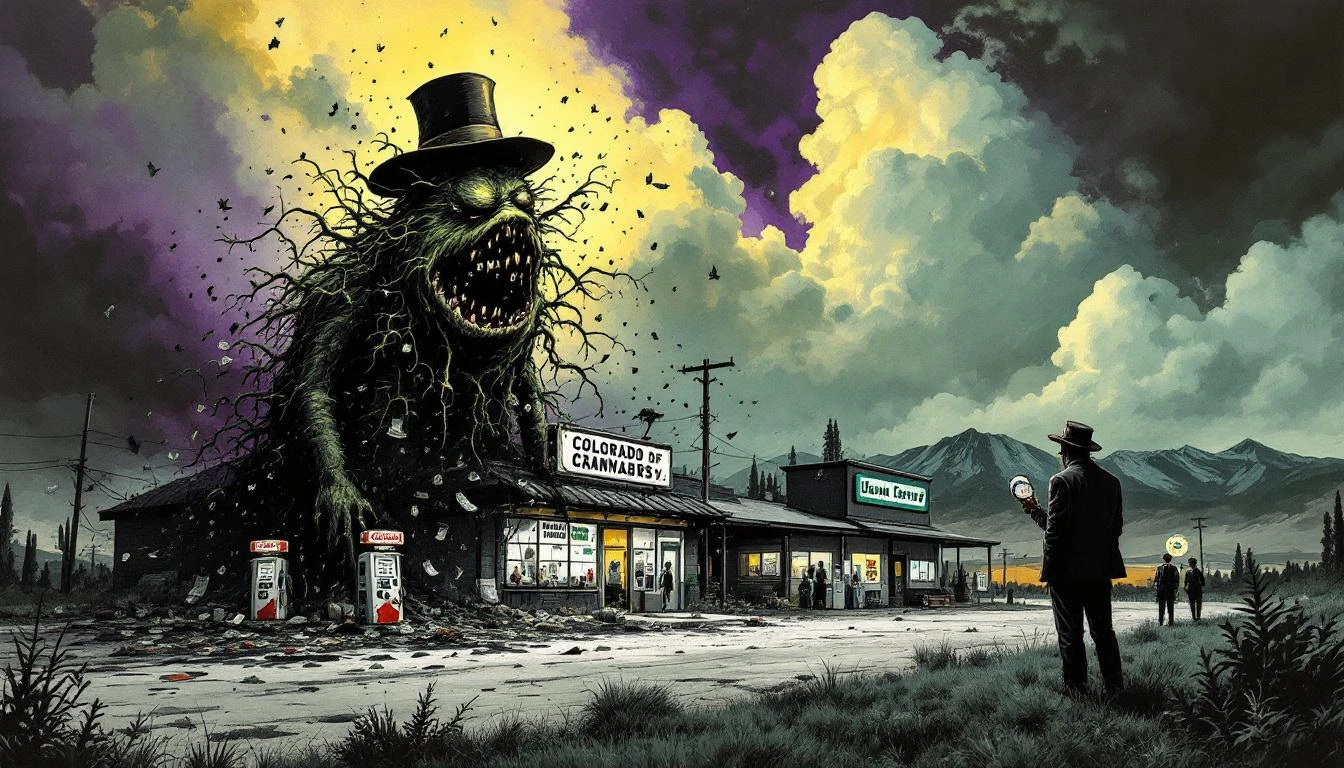
The Great Colorado Hemp Hustle: How Prohibition's Bastard Stepchild Kneecapped Legal Weed
The Regulatory Ouroboros Devours Its Own Tail
Behold the supreme irony of the American drug war's twilight years: Colorado, that brave pioneer state that told the DEA to pound sand and legalized the devil's lettuce back in 2012, got played like a banjo at a libertarian hoedown by hemp lobbyists.
Yes, hemp. That sad, sexless cousin of marijuana that wouldn't get you high if you smoked an entire bale of it. The agricultural equivalent of non-alcoholic beer. The plant Jefferson grew for rope.
Except—and here's where it gets deliciously perverse—the 2018 Farm Bill, that monument to legislative incoherence, defined hemp as cannabis containing less than 0.3% delta-9-THC. Note the specificity: delta-9. Not delta-8. Not delta-10. Not THC-O or HHC or whatever alphabet soup of cannabinoids some chemist can synthesize in a lab while listening to Phish.
The Loophole You Could Drive a Combine Harvester Through
So what happened? Enterprising hemp processors—armed with organic chemistry degrees and the moral compass of a payday lender—figured out they could chemically convert CBD (perfectly legal, federally compliant, boring as toast) into delta-8-THC and a pharmacopeia of other intoxicating compounds that technically weren't the specific THC the law mentioned.
It's the legislative equivalent of saying "you can't bring cocaine into the building" and watching someone waltz past security with a briefcase full of crack. Technically different! Chemically similar! Legally chef's kiss.
These products flooded gas stations, smoke shops, and convenience stores across Colorado—the state that had spent years building a regulated, taxed, monitored recreational marijuana market. No testing requirements. No potency limits. No age verification worth a damn. Just "farm bill compliant" slapped on packages containing gummies that could launch you into low Earth orbit.
The Regulated Versus the Regulatorily Ambiguous
Picture the scene: Licensed dispensary owners, who'd spent millions on compliance, security systems, inventory tracking software, and lawyers—so many lawyers—watching their businesses get undercut by hemp-derived products sold in the same aisle as beef jerky and lottery tickets.
These dispensary owners had navigated the Kafkaesque nightmare of state cannabis licensing. They'd submitted to surprise inspections. They'd paid effective tax rates that would make a medieval serf weep. They operated in a legal gray zone where they couldn't use banks, couldn't take normal business deductions, and lived in constant fear that a new administration might decide to enforce federal law again.
Meanwhile, hemp hustlers were selling functionally identical intoxicating products under the legal fiction that because their THC was synthesized from CBD rather than extracted from marijuana, it was "agriculture" not "drugs."
The regulatory state had created a two-tier system based on chemical provenance rather than effects—a distinction without a practical difference that would make a medieval theologian proud.
The Empire Strikes Back (Eventually)
Colorado's regulators, to their credit, eventually noticed they'd been had. In 2023, after years of hemp-derived products treating state marijuana law like a suggestion, Colorado banned intoxicating hemp products made through chemical processing.
But here's the thing about closing loopholes: it requires admitting they existed in the first place. And that admission implicates the entire architecture of cannabis prohibition—federal, state, and local—as a house of cards built on botanical definitions that made sense in 1970 (they didn't) and were never updated for the era of advanced chemistry.
The federal government still classifies marijuana as Schedule I—no accepted medical use, high potential for abuse, right there with heroin. Meanwhile, you can order delta-8 gummies online and have them shipped via USPS, that venerable institution of federal authority, directly to your door in states where regular weed will get you arrested.
The Philosophical Wasteland
This isn't just regulatory failure. It's regulatory philosophy failure. It's the culmination of a century of drug policy based on vibes, racism, and moral panic rather than pharmacology or public health.
We've created a system where whether you go to jail depends not on what a substance does to your brain, but on:
- Which carbon atoms the relevant molecule has
- Whether those atoms were arranged by a plant or a chemist
- What the plant was called when it was growing
- Whether your state has legalized it (maybe)
- Whether federal agents feel like enforcing anything today
- What some congressman from 1970 thought "marijuana" meant
It's jurisprudence as Mad Libs. It's the legal equivalent of arguing about how many angels can dance on the head of a pin while the dispensary across from the gas station sells the same high with different paperwork.
Follow the Money (It's Always About the Money)
Of course, this debacle has its constituencies. Hemp processors made bank before the hammer fell. Out-of-state manufacturers who couldn't crack the regulated Colorado marijuana market found a side door. And let's not forget the testing labs, the compliance consultants, the lawyers who bill by the hour to explain why "hemp-derived" might mean something in federal court.
The dispensary owners lost revenue. The state lost tax dollars. Consumers got inconsistent products with minimal oversight. Teenagers got high from stores that didn't check ID as rigorously as the regulated dispensaries.
Everybody made their nut except the people who thought legalization meant legalization—clear rules, honest markets, and products that don't require a chemistry degree to evaluate for legality.
The Broader Farce
Colorado's hemp hustle is a microcosm of American drug policy in the 21st century: states legalizing what the federal government still prohibits, creating a patchwork of contradictory laws that invite exploitation; regulations written by people who don't understand the underlying science; and industries that spend more on regulatory arbitrage than on making their products safe.
We've reached peak absurdity when the most important question about your weed isn't "will this get me high" but "which federal statute defines its legality."
The only people who benefit from this chaos are lawyers, lobbyists, and those rare individuals who can read the Federal Register without bleeding from the eyes. Everyone else—consumers, business owners, regulators who actually care about public health—gets played.
The Oracle's Verdict
Colorado's experience proves what should have been obvious: you cannot create a sensible legal market for intoxicating substances while federal law still treats them as moral abominations. The contradictions will metastasize. The loopholes will be exploited. The people who follow the rules will be undercut by those who hire better lawyers.
This isn't a bug in legalization. It's a feature of prohibition's zombie corpse—still walking, still destructive, but too dead to be coherent.
The hemp hustlers didn't break the system. They just revealed what was always true: American drug policy is smoke and mirrors, built on the legal fiction that we can regulate human consciousness through botanical taxonomy.
And the politicians? They'll keep passing laws that create more contradictions, more loopholes, more opportunities for grift—because actually solving the problem would require admitting the War on Drugs was a catastrophic mistake.
That's a truth stronger than any THC isomer, and far too intoxicating for Washington to handle.
The Oracle Also Sees...

The Ghost Network: How Insurance Companies Discovered They Could Charge You for Mental Health Care They Never Intended to Provide
An insurer ran a 'ghost network' of non-existent mental health providers for years, got caught, and settled for pocket change. The system isn't broken—it's working exactly as designed.

The Magic Kingdom's Dark Ride: How ICE Turned Mickey Mouse Into Kafka's Jailer
A nine-year-old's Disney vacation turned into 113 days of detention. She decorated her testimony with rainbows and hearts. America decorated its conscience with receipts and razor wire.
United for National Integrity Equality & Democracy Action Committee: When Your Acronym Is Longer Than Your Principles
A PAC with a name longer than a Victorian novel's subtitle and principles thinner than its filing paperwork joins the grand tradition of virtue-signaling cash vacuums.