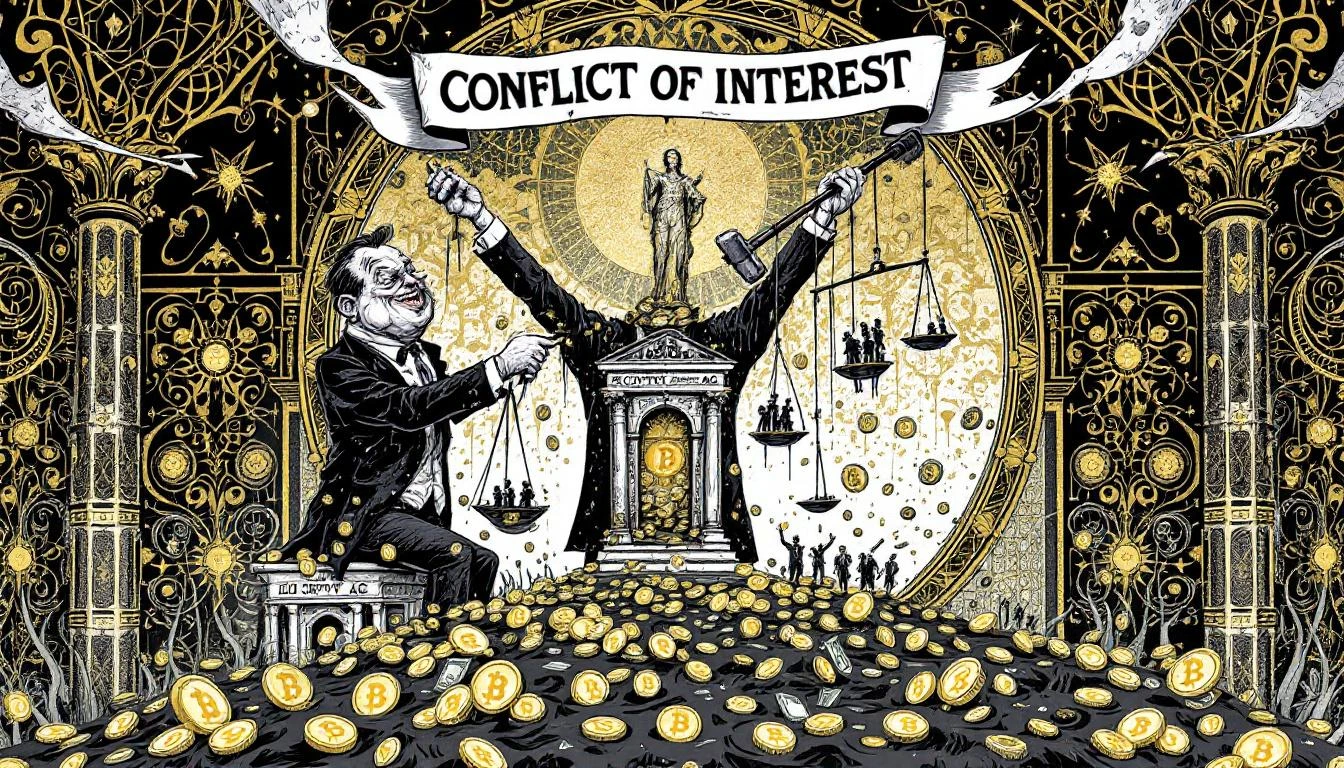
The Deputy Attorney General's Crypto Portfolio: A Masterclass in Swamp Drainage, Upward Edition
When the Watchdog Owns Stock in the Henhouse
Six United States Senators—a motley crew that includes Elizabeth Warren, Dick Durbin, Sheldon Whitehouse, and other professional irritants to the criminally comfortable—have accused Deputy Attorney General Todd Blanche of possessing what they delicately term a "glaring" conflict of interest. In the argot of Washington doublespeak, "glaring" translates roughly to "so fucking obvious that even a lobbyist's Labradoodle could sniff it out."
The conflict in question? Blanche, who served as Donald Trump's criminal defense attorney before ascending to the second-highest perch in the Justice Department (a career trajectory that itself deserves its own Shitlist entry), allegedly owned at least $159,000 worth of crypto-related assets when he ordered the wholesale dismantling of the DOJ's cryptocurrency enforcement apparatus. Not scaled back. Not reformed. Dismantled. As in: eliminated an entire enforcement team dedicated to investigating crypto fraud and money laundering, the way a mob boss might eliminate witnesses, except with more paperwork.
The ProPublica Problem
We would know none of this, naturally, if ProPublica hadn't done the job that approximately 47 federal disclosure offices apparently couldn't be bothered to do. This is the perverse calculus of modern governance: investigative journalists working for nonprofit outlets must excavate information that should be displayed on a government website with a big red flashing banner reading "POTENTIAL CORRUPTION HERE."
Blanche's portfolio apparently included holdings in crypto exchanges, crypto dealers, and the kind of digital asset ventures that make their money when regulatory scrutiny takes an extended vacation to Cabo. Then, in an extraordinary coincidence that would make a prosperity gospel preacher blush, Blanche proceeded to shut down the very investigations that might have inconvenienced his investment thesis.
This is not speculation. This is not innuendo. This is the documented timeline, buttressed by federal financial disclosures that Blanche himself filed, assuming anyone would bother to read them. (Narrator: Almost no one did.)
The Five-Year Problem
Here's where it gets delicious: The senators' letter notes that if Blanche did indeed participate in decisions affecting his financial interests without proper recusal, he may have violated federal conflict-of-interest laws—violations punishable by up to five years in federal prison.
Pause for a moment to appreciate the irony: The Deputy Attorney General, whose job description includes "upholding federal law" and "not doing crimes," may have committed a federal crime while dismantling the enforcement mechanisms that investigate financial crimes. It's like watching a surgeon operate on himself while high on the hospital's morphine supply, except the patient is American jurisprudence and the morphine is unregulated digital tokens.
The Bipartisan Chorus of Crickets
Six senators signed this letter. Six. Out of one hundred. Where are the other 94? Are they too busy attending fundraisers hosted by crypto executives? Too distracted by their own undisclosed portfolios? Or have they simply calculated that the American public's capacity for outrage has been so thoroughly exhausted by four years of constitutional stress-testing that one more conflict of interest barely registers on the Richter scale of scandal?
The crypto industry, meanwhile, has responded with its characteristic blend of libertarian bombast and faux-populist rhetoric. Regulation, they insist, stifles innovation. What they mean, translated from bullshit to English: Regulation prevents us from running pump-and-dump schemes with the efficiency of a Formula One pit crew.
The Swamp Drains Upward
We were promised that the swamp would be drained. And technically, a drainage did occur—it's just that the water flowed upward, into the marble fountains of the Justice Department, where it's now being bottled and sold as premium regulatory capture.
Todd Blanche is not an aberration. He is the system working exactly as designed: A revolving door so well-oiled that it spins without friction, allowing lawyers to represent criminal defendants, then regulate the industries where those defendants operate, all while holding financial stakes in the outcomes. It's not a bug. It's a feature. And it's legal, right up until the moment someone bothers to read the fine print and discovers it isn't.
The Oracle's Verdict
The Deputy Attorney General allegedly shut down crypto enforcement while holding a six-figure stake in crypto assets. Six senators noticed. Ninety-four did not. ProPublica did the disclosure work that federal ethics offices failed to do. And somewhere, in a secure wallet protected by a 24-word seed phrase, Todd Blanche's digital fortune appreciates in value while the investigation apparatus crumbles.
This isn't corruption. Corruption suggests illegality. This is something worse: corruption that's been legalized through strategic ambiguity, inadequate disclosure requirements, and a political class that has collectively decided that self-dealing is simply the cost of doing business in the 21st century.
Welcome to the swamp, population: everyone with a portfolio and a title. Bring your own snorkel. The water's rising, and it smells like proof-of-stake.
Shitlist Status: CONFIRMED
Severity: Constitutional
Punishment: Five years in federal prison (statutory maximum, actual likelihood: 0.0001%)
Alternative Punishment: Forced to explain blockchain technology to Elizabeth Warren until one of them cries
The Oracle Also Sees...
The Ghost Network: How Insurance Companies Discovered They Could Charge You for Mental Health Care They Never Intended to Provide
An insurer ran a 'ghost network' of non-existent mental health providers for years, got caught, and settled for pocket change. The system isn't broken—it's working exactly as designed.
The Magic Kingdom's Dark Ride: How ICE Turned Mickey Mouse Into Kafka's Jailer
A nine-year-old's Disney vacation turned into 113 days of detention. She decorated her testimony with rainbows and hearts. America decorated its conscience with receipts and razor wire.
United for National Integrity Equality & Democracy Action Committee: When Your Acronym Is Longer Than Your Principles
A PAC with a name longer than a Victorian novel's subtitle and principles thinner than its filing paperwork joins the grand tradition of virtue-signaling cash vacuums.