The Ministry of Truth Will See Your Grant Application Now
In Which We Learn That Facts Apply For Funding
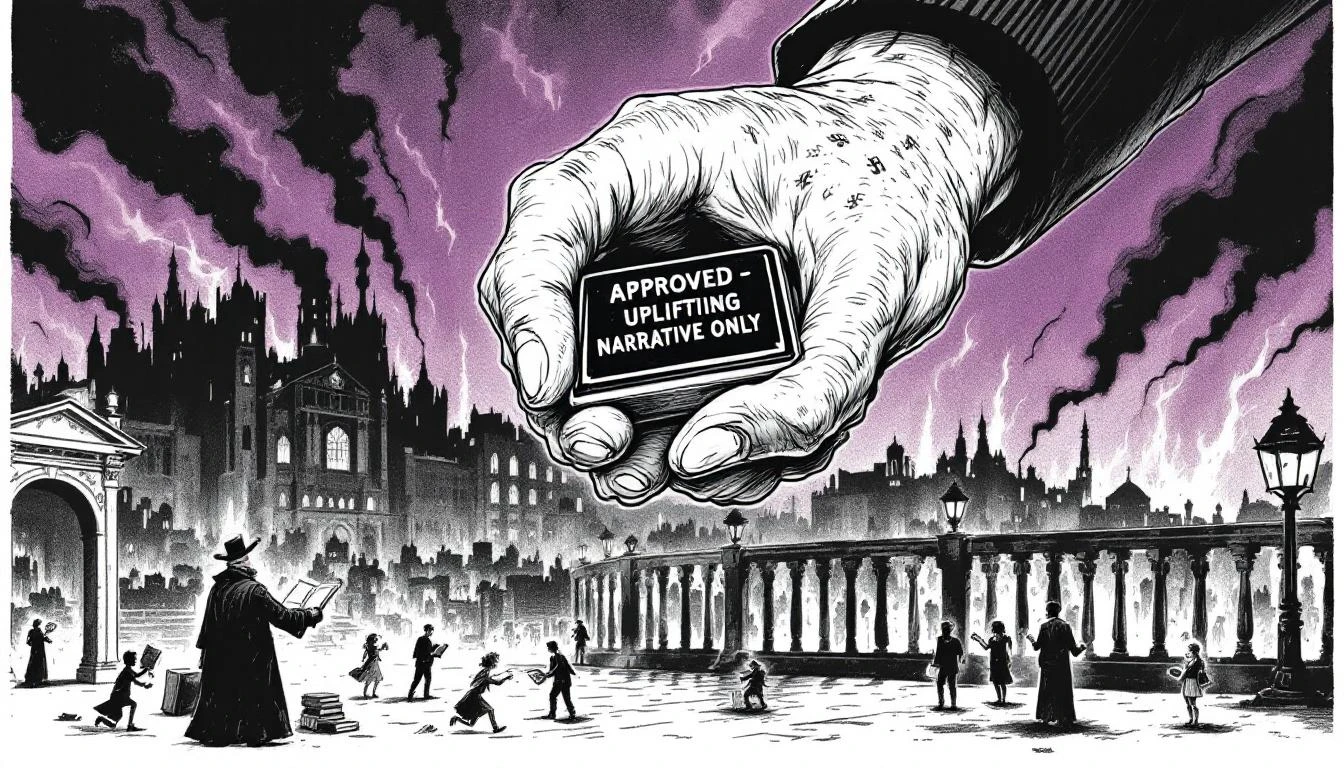
George Orwell died in 1950, spared the exquisite agony of watching his dystopian prophecies transformed into federal grant guidelines. The Institute of Museum and Library Services—that sleepy bureaucratic backwater previously devoted to the radical notion that books and artifacts might speak for themselves—has discovered a new mission: ensuring that American history remains "uplifting and positive" through the purifying fire of ideological compliance.
The new guidelines read like a loyalty oath drafted by someone who got halfway through 1984 and thought, "You know what? The Ministry of Truth had some solid ideas about narrative control."
The Architecture of Amnesia
Let's marvel at the sheer Orwellian poetry of it: Libraries—those stubborn repositories of inconvenient truths—must now demonstrate "appreciation for the country through uplifting and positive narratives." Museums curating the artifacts of actual human experience must align their "tone, historical framing" with undefined "American ideals" subject to administrative audit.
The administration has been refreshingly candid about its concerns. The Smithsonian, apparently, focused too much on "how bad slavery was." One struggles to imagine the Goldilocks version of slavery that would satisfy this standard—not too bad, not too good, just the right amount of generational human trafficking to maintain our uplifting national narrative.
This is the same cognitive dissonance that allows someone to venerate the Founding Fathers while suggesting we shouldn't dwell on that whole "owning people as property" inconvenience. It's historical cherry-picking elevated to federal policy, with grant money as the carrot and ideological exile as the stick.
Papers, Please: The Bureaucratic Edition
The guidelines invoke three executive orders with the subtlety of a sledgehammer: one attacking "divisive, race-centered ideology" (translation: discussing racism), one ending "the anti-Christian weaponization of government" (translation: separation of church and state is now optional), and one titled, with no apparent irony, "Making Federal Architecture Beautiful Again."
Because nothing says "democracy" quite like state-mandated aesthetics.
Former agency leaders from both parties—a phrase that in 2025 carries the weight of archaeological discovery—have expressed alarm. Giovanna Urist, a senior program officer until 2023, called the guidelines "chilling." It's the kind of understatement you get from people who've spent careers in public service and retain a vestigial belief in measured discourse.
Let's be less measured: This is ideological extortion dressed in bureaucratic banality. Apply for funding to digitize your archives? Great—just sign here acknowledging that American history should be "uplifting," whatever that means this fiscal quarter. Want to preserve Indigenous artifacts? Wonderful—as long as your interpretive materials don't dwell on those pesky genocides that harsh our national vibe.
The Audit Will Continue Until Morale Improves
The Smithsonian now faces "wide-ranging audits" to assess whether exhibits demonstrate proper "alignment with American ideals." One imagines functionaries with clipboards stalking the Museum of African American History, tallying up mentions of slavery, Jim Crow, and redlining, then sending a memo: "Your ratio of suffering-to-uplift is off-brand. Please revise."
This is how authoritarian erosion happens—not with jackboots and bonfires, but with grant guidelines and audit threats. The books don't burn; they simply fail to receive funding. The exhibits don't close; they just get "realigned." The truth doesn't disappear; it becomes economically unviable.
The Loyalty Oath You Sign Without Signing
The genius of this approach is its deniability. There's no explicit ideological litmus test, no signed statement of political allegiance. Just a gentle suggestion that your institution's continued funding depends on presenting American history in ways that don't make anyone uncomfortable—particularly anyone with the power to kill your budget.
Librarians and curators now face an impossible choice: accept tainted funding and self-censor, or refuse it and watch their institutions wither. It's the kind of choice that looks like freedom from a distance but feels like coercion up close.
The precedent is obvious and terrifying. Once you establish that federal funding requires ideological conformity, you've transformed every grant into a tool of political control. Today it's "uplifting narratives" about slavery. Tomorrow it's climate science that must present "both sides." Next week it's medical research that can't contradict the President's hunches about horse dewormer.
The Names We'll Remember
History—the real kind, not the "uplifting" version—will remember who implemented these guidelines. Who drafted the language. Who approved the audits. Who transformed institutions dedicated to preserving truth into engines of state-sanctioned mythology.
It will remember the museum directors who refused the money and kept their integrity. The librarians who documented every overture and threat. The curators who chose accuracy over funding.
And it will remember, with the particular contempt reserved for cowards with clipboards, those who turned institutions of learning into ministries of approved thought.
The Thing About Truth
Here's what the architects of this policy fundamentally misunderstand: Truth doesn't require uplift. History doesn't need to be "positive" to be valuable. The strength of American democracy, such as it is, has never resided in sanitized narratives but in our capacity—however imperfect—to confront uncomfortable realities.
You don't build national character by hiding national sins. You build it by acknowledging them, learning from them, and doing better.
But that requires a kind of moral courage apparently in short supply in an administration that finds the mere acknowledgment of slavery's horrors too "divisive" to tolerate.
The Bureaucratic Bonfire
The books aren't burning. They're just being defunded, audited, and brought into "alignment." The museums aren't closing. They're just being encouraged to present a more "uplifting" version of history—one where slavery was perhaps a bit of an oopsie, Indigenous genocide was more of a "complicated situation," and Jim Crow was just a rough patch we've totally moved past.
This is how you memory-hole a nation. Not with violence, but with grant guidelines. Not with censorship, but with "tone assessment." Not with book burnings, but with budget allocation.
The Ministry of Truth will see your application now. Make sure your narrative is uplifting. Make sure your tone aligns with American ideals. Make sure your history doesn't dwell too much on how bad the bad things were.
And for God's sake, make sure your architecture is beautiful.
Welcome to the new guidelines. Your compliance is particularly welcomed.
The Oracle Also Sees...
The Ghost Network: How Insurance Companies Discovered They Could Charge You for Mental Health Care They Never Intended to Provide
An insurer ran a 'ghost network' of non-existent mental health providers for years, got caught, and settled for pocket change. The system isn't broken—it's working exactly as designed.
The Magic Kingdom's Dark Ride: How ICE Turned Mickey Mouse Into Kafka's Jailer
A nine-year-old's Disney vacation turned into 113 days of detention. She decorated her testimony with rainbows and hearts. America decorated its conscience with receipts and razor wire.
United for National Integrity Equality & Democracy Action Committee: When Your Acronym Is Longer Than Your Principles
A PAC with a name longer than a Victorian novel's subtitle and principles thinner than its filing paperwork joins the grand tradition of virtue-signaling cash vacuums.