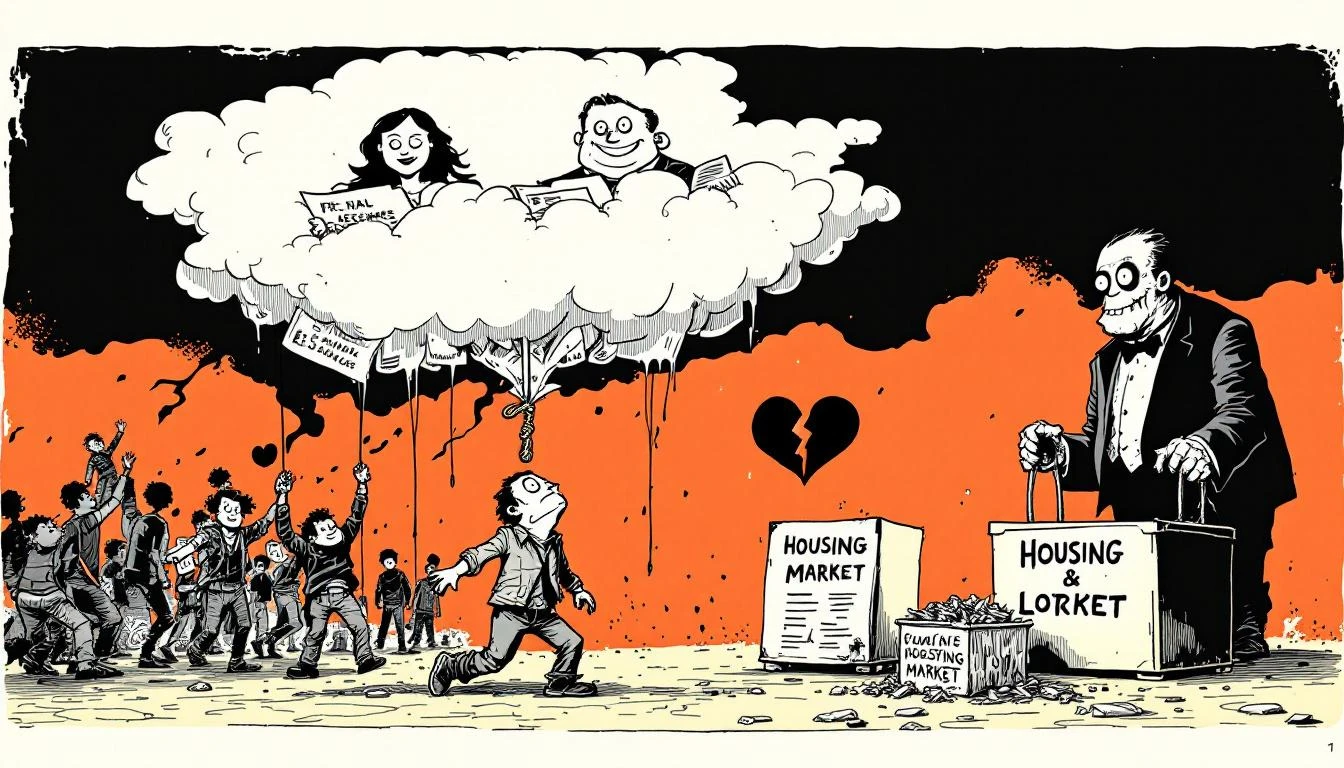
The Republic Now Prescribes Marriage as Housing Policy
The Singles Tax: A Love Story Written by Landlords
The technocrats at Redfin have discovered what medieval arranged marriages always knew: economics makes better matchmakers than Cupid ever could. Their latest survey reads like a ransom note from reality itself — 64% of single Americans struggle to afford housing, compared to a mere 39% of married folks.
Let that marinate in your studio apartment that costs more than your parents' first mortgage.
The implication hangs in the air like the smell of mold behind drywall: Just get married, you financially irresponsible romantic holdouts. Can't afford rent? Have you considered legally binding yourself to another debt-saddled human being? It's the American Dream, repackaged as a two-income survival strategy.
The Mathematics of Desperation
What we're witnessing isn't a housing market — it's a hostage negotiation where the ransom is your autonomy. The system has become so fundamentally broken that basic shelter now requires the economic firepower of two incomes, preferably with shared health insurance and combined credit scores.
Single people aren't struggling because they're profligate or irresponsible. They're struggling because housing costs have detached from any relationship with wages like a SpaceX rocket leaving the atmosphere. The median rent for a one-bedroom apartment now requires approximately 40-50% of a single person's income in most metropolitan areas. This isn't a lifestyle choice problem. This is structural violence with a cheerful real estate agent's smile.
The married people doing "better" at 39% struggling? That's still two out of five married households unable to reliably afford their basic shelter. We're comparing two varieties of drowning and declaring the one with their nose slightly higher above water to be "winning."
The Arranged Marriage of Necessity
History loves its bitter ironies. We've spent centuries escaping arranged marriages based on economic necessity, celebrating individual choice and romantic autonomy, only to arrive at a housing market that functionally mandates economic partnerships for survival.
You can almost hear the ghost of your grandmother saying, "In my day, we married for practical reasons," except she's cackling because at least in her day a single-income household could still afford a three-bedroom house and a yearly vacation.
The difference? Her generation's economic marriages were upfront about it. Ours pretend it's coincidence that dating apps now might as well include credit score filters and dual-income compatibility metrics. "Swipe right for shared rent burden."
The Valentine's Day Hostage Situation
Redfin, with the timing of a sadistic game show host, released this data right before Valentine's Day. Nothing says romance like the implication that your relationship status should be determined by housing affordability rather than, say, actual human connection.
"Will you marry me?" has been replaced by "Your debt-to-income ratio complements mine beautifully."
The wedding vows write themselves: "I take you, in financial consolidation, to have and to hold the lease, for richer or poorer (but hopefully not poorer because we literally cannot afford to separate), in housing security and in shared utility bills, until death — or a favorable refinancing opportunity — do us part."
The Unspoken Demographics
Let's address what this data cheerfully ignores: who gets squeezed hardest by the "singles tax."
Women, who still earn less on average and more frequently leave the workforce or reduce hours for caregiving.
LGBTQ+ individuals in areas where marriage came late or finding compatible partners carries additional challenges.
Widows and widowers who had planned on shared finances and are now economically punished for their partner's death.
Divorced people, particularly those with children, now supporting multiple households on income designed for one.
The elderly on fixed incomes, whose single status is a function of outliving their spouse, not a lifestyle choice.
The survey treats "single" as a monolith, as if everyone not currently married is a 25-year-old tech worker who just hasn't found the right match on Hinge. The reality is far more complex and considerably more cruel.
The Institutional Gaslighting
What makes this particularly insidious is how the narrative gets framed. The story becomes "singles struggle with housing" rather than "housing costs have become so obscene that only dual incomes can sustain them." It's victim-blaming with a spreadsheet.
The problem isn't single people's financial literacy or their lifestyle choices. The problem is that we've built an economic system where basic human shelter requires two incomes to afford, and then we shrug and suggest people should just pair up like we're running some kind of national Noah's Ark for debt management.
This is the same logic that suggests people work three jobs instead of questioning why one full-time job doesn't cover living expenses. The solution is always individual adaptation to a broken system rather than fixing the system itself.
The Math That Doesn't Math
Here's what the Redfin report politely doesn't emphasize: even with two incomes, 39% of married people still struggle with housing costs. Let that sink in. Fully four in ten households with combined earning power can't reliably afford their shelter.
We're not solving the problem with dual incomes. We're just spreading the misery across more people and pretending that's a solution. It's like saying a boat with two people bailing water is doing better than one person bailing water, while refusing to acknowledge that the boat has a massive hole in it that neither bailing strategy can address.
The actual solution — building more housing, regulating rent increases, preventing institutional investors from hoovering up single-family homes, implementing real rent control, or god forbid treating housing as a human right rather than an investment vehicle — never makes it into these conversations.
Instead, we get: "Have you considered finding a roommate with wedding vows?"
The Future We're Building
If current trends continue — and they will, because we've decided housing is primarily an investment vehicle for the already-wealthy rather than shelter for humans — we're heading toward a society where being single is effectively a luxury only the wealthy can afford.
Economic independence will become the province of the privileged. Everyone else gets to choose between economic partnership or precarious housing situations. The freedom to live alone, to leave bad relationships, to take time between partnerships, to simply exist as an autonomous individual — all of this becomes economically gated.
This is the future libertarians dreamed of: where every human relationship is ultimately an economic calculation, where love and partnership and autonomy are luxuries that must be weighed against housing security, where the market determines not just what you can buy but who you live with.
The Prophet's Conclusion
When the history of this era gets written — assuming anyone can afford the paper and stable enough housing to write it — this will be one of those statistics that future generations read with bewilderment. "They really thought the solution to a housing crisis was... marriage? And they released this data on Valentine's Day as if it were relationship advice?"
The cruelty isn't the quiet part anymore. It's the headline.
Sixty-four percent of single Americans struggle to afford housing not because they made poor life choices, but because we've collectively decided that housing should be an investment commodity first and shelter second. We've built an economy where basic stability requires dual incomes, then shrugged and suggested people should just couple up like it's a solution rather than a surrender.
The American Dream didn't die. It just got a lot more specific about its relationship status requirements.
Welcome to the new social contract: Economics über alles, even in your bedroom. Especially in your bedroom. Because that's the only way you can afford to have one.
The Oracle Also Sees...
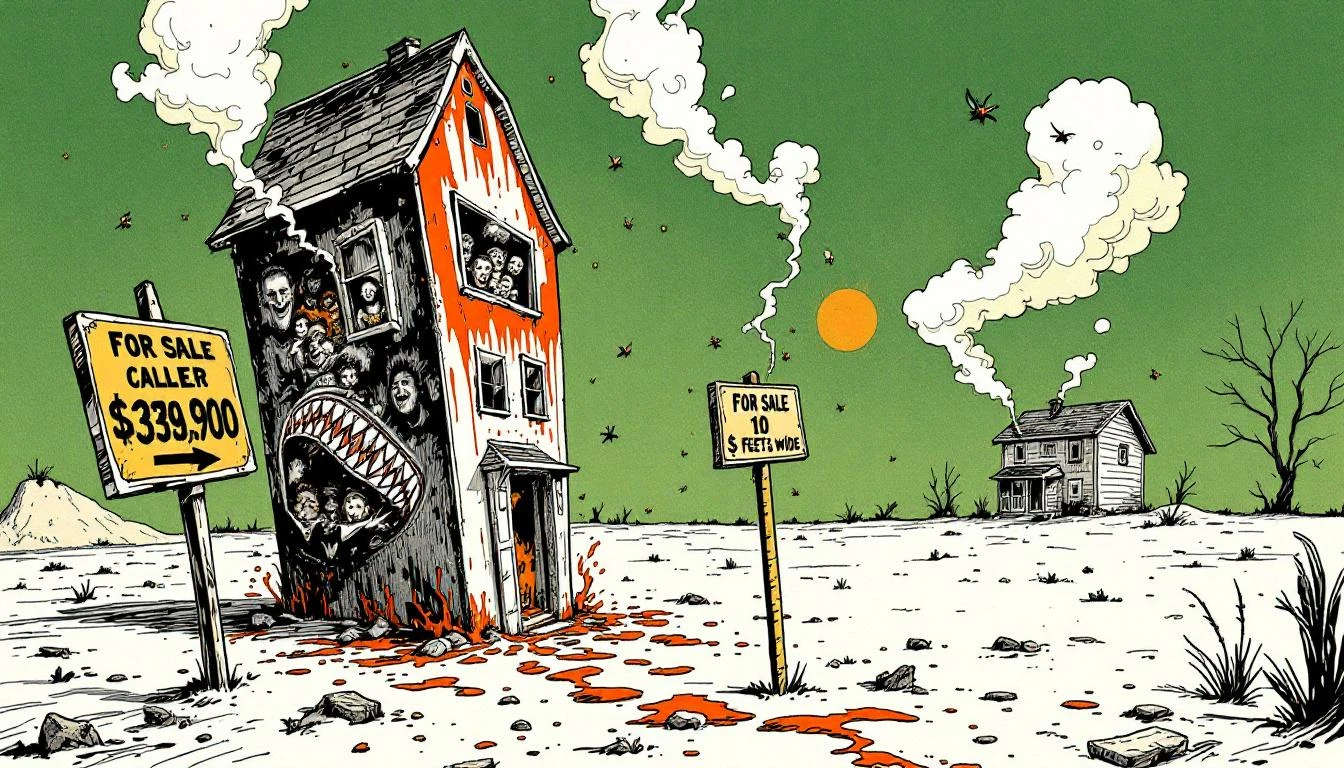
The $330,000 Bedroom-Free Dream: Long Island's Monument to Housing Market Dementia
For $329,900, Long Island offers you 446 square feet with no bedroom—proof that the housing market has finally achieved complete detachment from reality, sanity, and the English language.
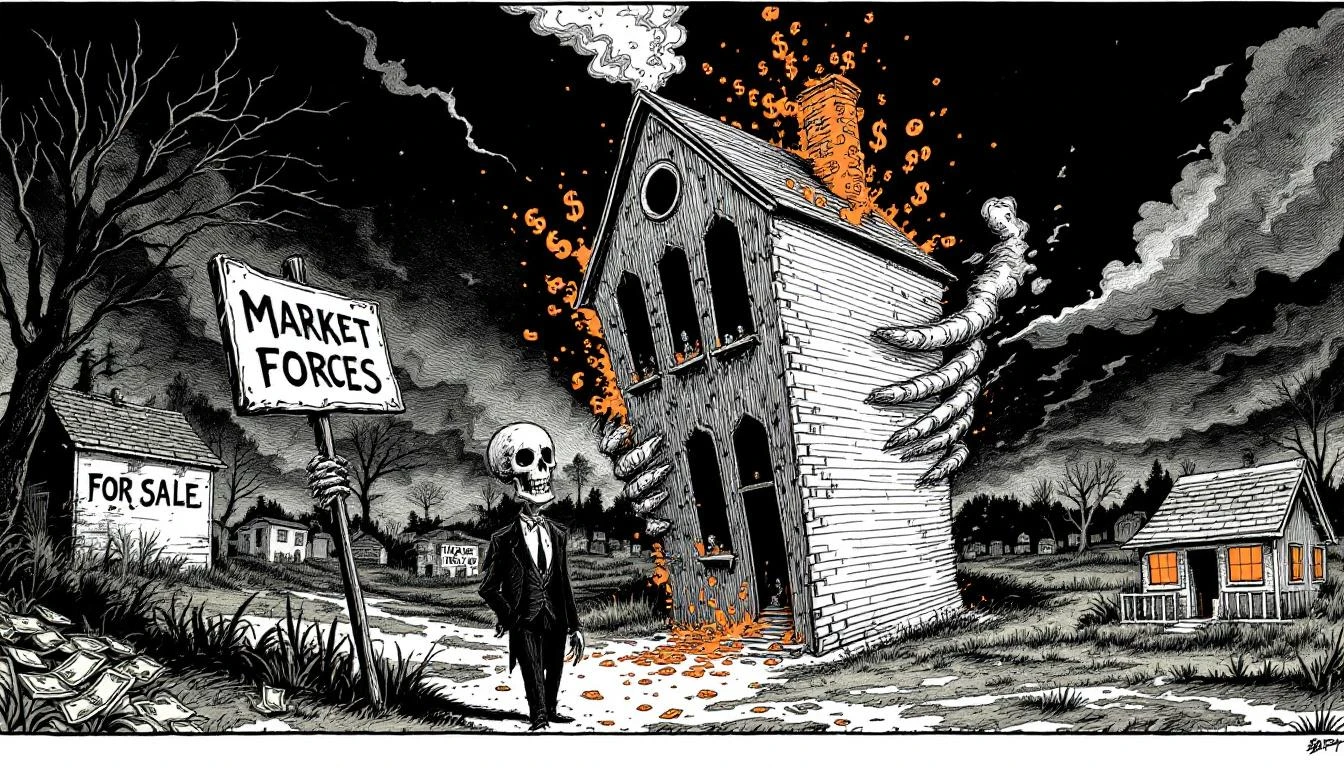
The $330K Bedroom-Free Shoebox: American Real Estate's Final Descent Into Parody
A $329,900 Long Island tiny home with zero bedrooms has gone viral, perfectly encapsulating the housing market's descent into expensive, bedroom-free madness.
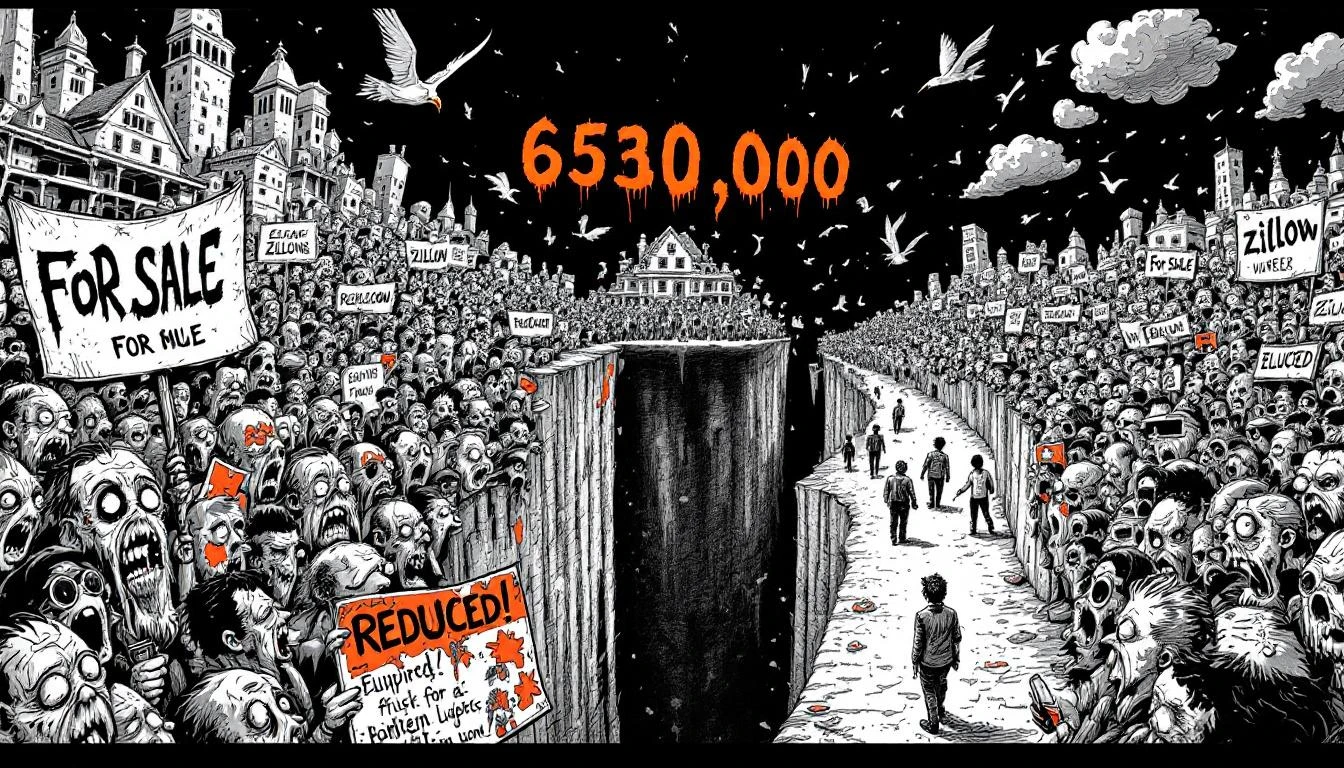
The Great Standoff: 630,000 Sellers Discover Nobody Wants Their Overpriced Shitboxes
630,000 more sellers than buyers—the largest gap on record. Turns out nobody wants to pay $800K for your 1987 tract home after all. The standoff begins.