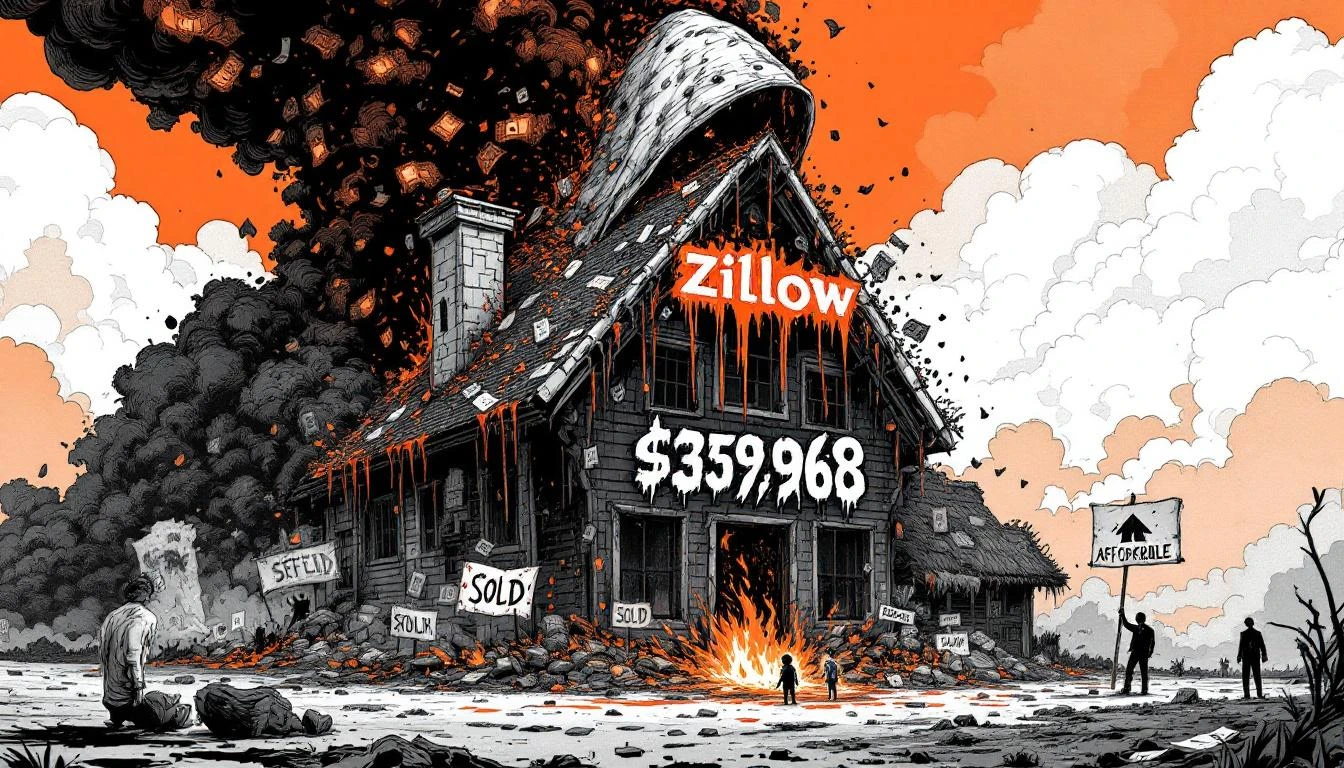
Zillow Declares Victory Over Affordability While Median Home Costs More Than Your Parents' Retirement Fund
The Gospel According to Zillow: Let Them Eat Slightly Smaller Mortgage Payments
In a masterclass of corporate gaslighting that would make Orwell weep and Madison Avenue applaud, Zillow—the digital real estate colossus that spectacularly face-planted out of house-flipping after discovering it couldn't actually predict home prices—has declared housing "increasingly affordable" in January 2026.
The evidence for this miraculous affordability? Monthly mortgage payments have dropped 8.4% year-over-year to a mere $1,733. The typical U.S. home now costs a modest $358,968.
Let us pause to appreciate the sheer audacity of this framing. Nearly $359,000 for a "typical" home—in a country where median household income hovers around $75,000—is being sold as good news. It's like announcing that guillotine blades have become 8.4% duller and calling it a victory for necks everywhere.
The Mathematics of Delusion
Consider the arithmetic they're hoping you won't do:
- $1,733 monthly payment × 12 months = $20,796 annually
- That's 27.7% of that $75,000 median household income
- For the payment alone—before property taxes, insurance (which has gone fully feral in most markets), maintenance, HOA fees extracted by petty tyrants with clipboards
By the time you've paid for the privilege of shelter, you're spending 35-40% of gross income on housing. The old rule was 28% maximum. But rules, like affordability itself, are apparently negotiable when there's a market narrative to maintain.
A Brief History of Hubris
Zillow's credibility on housing market predictions should be viewed through the lens of their spectacular 2021 implosion. They launched "Zillow Offers"—an iBuying venture where the algorithm-worshipping tech giant would purchase homes directly, make minimal improvements, and flip them for profit.
The algorithm, trained on the very data Zillow itself generates, proceeded to catastrophically misprice thousands of homes. The company ate $881 million in losses, laid off 2,000 employees, and shuttered the entire division. They had confused their ability to influence prices through their Zestimate tool with the ability to predict them—a mistake that would be poetic if it weren't so expensive for the workers who paid with their livelihoods.
Now, this same company—having proven it cannot accurately price individual homes even with proprietary data and algorithmic firepower—wants you to trust its assessment of market-wide affordability trends.
The "Improvement" Scam
Here's the sleight of hand: Zillow compares January 2026 to January 2025, when mortgage rates were at a recent peak and prices had reached genuinely psychotic levels. Yes, falling from "catastrophically unaffordable" to "merely ruinously unaffordable" is technically an improvement. So is reducing your arsenic dosage.
The report cheerfully notes that "housing affordability continues to improve" while ignoring that we're comparing to a baseline of historic unaffordability. It's like setting yourself on fire, then partially extinguishing the flames, and declaring victory over combustion.
Median home prices have roughly tripled since 2000, while median household incomes have increased by about 80%. This isn't a market correction—it's a market psychosis we've collectively agreed to pretend is normal.
Shelter Inflation and the Art of Misdirection
The report mentions "continued cooling in shelter inflation" via the Zillow Observed Rent Index. This is technically true in the same way that being shot with a smaller caliber bullet represents an improvement in your shooting experience.
Rent cooling is measured against the fever-dream peaks of the pandemic-era rental apocalypse. Meanwhile, renters are still spending record percentages of income on housing. The "cooling" means you might only face a 3% rent increase instead of 8%—never mind that wages have barely budged, and your landlord is almost certainly a private equity firm that answers to algorithms and shareholders rather than anything resembling human decency.
The Weather Did It
"Potential buyers and sellers dealt with severe winter weather in many major markets," the report explains, as if February in Minneapolis is a shocking new meteorological development. This is the housing market equivalent of blaming Mercury retrograde for your bad decisions.
Winter happens. Every year. In the same months. That we now treat seasonal weather as an unexpected market disruption tells you everything about how desperately the industry needs explanations for anemic sales that don't involve the phrase "nobody can afford these prices."
The Spring Bounce Fantasy
"We expect sales to pick up as spring approaches," Zillow prophecies, deploying the eternal optimism of an industry that has predicted seventeen of the last three housing booms.
This is the real estate version of "tomorrow, tomorrow, I love you, tomorrow." Sales will pick up when the weather improves, when rates drop another quarter-point, when consumer confidence returns, when the housing gods smile upon us. The possibility that prices have fundamentally disconnected from economic reality? That's not in the press release.
Who Benefits From This Narrative?
Zillow isn't a disinterested observer—it's a participant whose business model depends on transaction volume and the perception of market health. Their Premier Agent program, where they sell leads to real estate agents, generates the majority of their revenue. Stagnant markets where people can't afford to buy mean fewer transactions, fewer leads, fewer subscriptions.
Declaring affordability improvements—however technically true when measured against recent catastrophic peaks—serves to nudge hesitant buyers off the fence. "Look, it's getting better! Better act now before it gets worse again!" Fear of missing out has always been real estate's most reliable sales tool, even when what you're missing out on is generational wealth destruction.
The Unspoken Truth
Here's what Zillow's report doesn't say: An entire generation has been effectively locked out of homeownership. The wealth-building mechanism that created the American middle class has been transformed into an asset class for investors, a speculation vehicle for flippers, and a casino for tech companies with too much venture capital and too little sense.
Median home prices at $359,000 mean typical Americans need $72,000 down for a 20% down payment—more than most households have in total savings. Even with FHA's 3.5% down, you need over $12,500 plus closing costs, plus an emergency fund that can handle a blown water heater or failed HVAC system.
For young workers saddled with student debt, gig economy wages, and the certain knowledge that Social Security will be a smoldering crater by retirement, "improving affordability" is a sick joke delivered by executives whose stock options vest regardless of whether actual humans can afford actual shelter.
The Verdict
Zillow's January Market Report is corporate propaganda dressed in the language of data analysis. It takes real statistics—mortgage payments are indeed lower than last year—and wraps them in a narrative that serves institutional interests while gaslighting millions of Americans about the material reality of their housing situation.
The affordability crisis isn't improving. It's metastasizing. What we're experiencing is a brief pause in the appreciation insanity, mistaken for recovery by an industry that desperately needs you to believe the fever dream can continue indefinitely.
Zillow learned nothing from its house-flipping debacle except perhaps that it's safer to sell information about the market than to participate in it directly. The company that couldn't predict prices well enough to avoid a $881 million loss now confidently declares market trends to millions of users who have no better options for data.
In a just world, Zillow's affordability declarations would come with a disclaimer: "The company making these claims previously lost nearly a billion dollars because its pricing models were catastrophically wrong. Evaluate accordingly."
But we don't live in a just world. We live in a world where $359,000 homes and $1,733 monthly payments are sold as evidence of improving affordability, where shelter—the most basic human need after food and water—has been fully financialized, and where the primary question isn't "can people afford homes?" but "how can we frame unaffordability as a buying opportunity?"
Spring is coming, Zillow promises, and with it improved sales. What they don't mention is that for millions of Americans, spring will bring the same thing winter brought: rental payments that consume half their income, homeownership dreams deferred another year, and corporate press releases declaring victory in a war they're losing.
The Ministry of Truth would be proud.
The Oracle Also Sees...
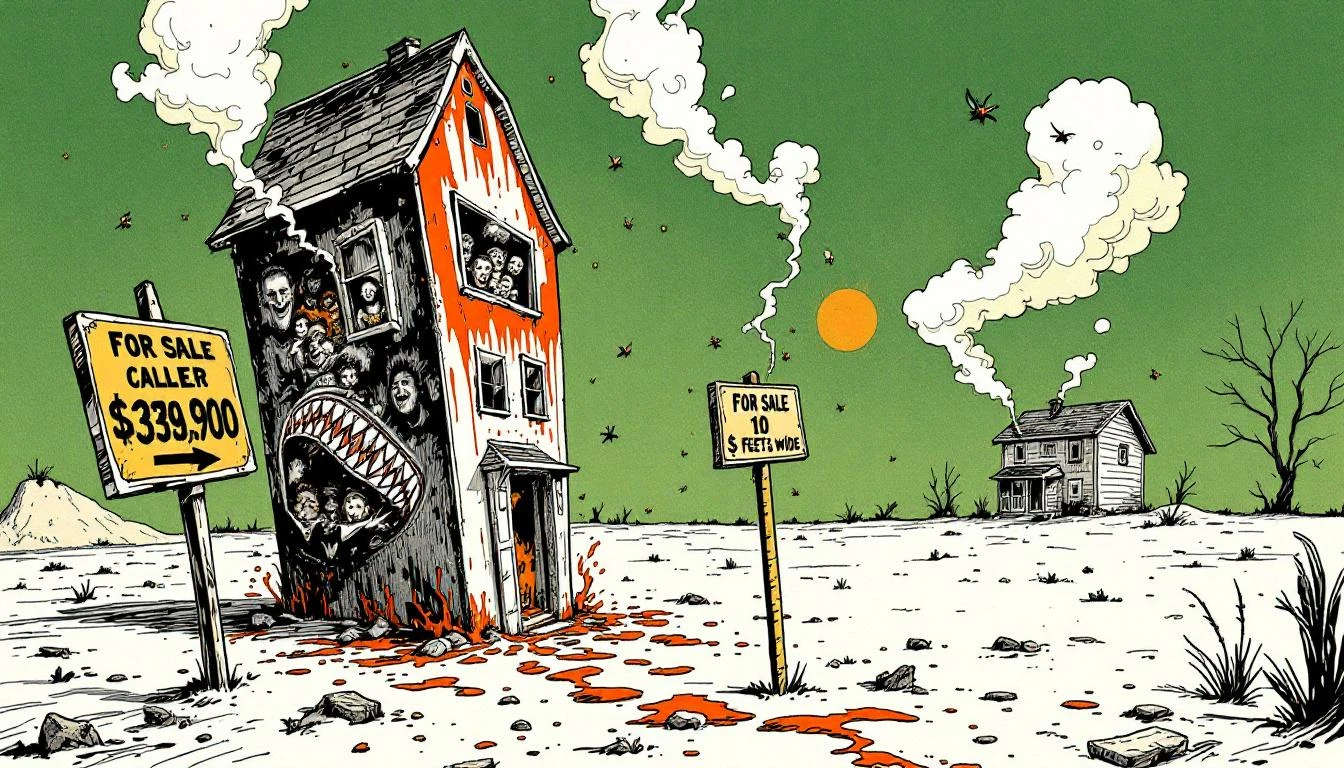
The $330,000 Bedroom-Free Dream: Long Island's Monument to Housing Market Dementia
For $329,900, Long Island offers you 446 square feet with no bedroom—proof that the housing market has finally achieved complete detachment from reality, sanity, and the English language.
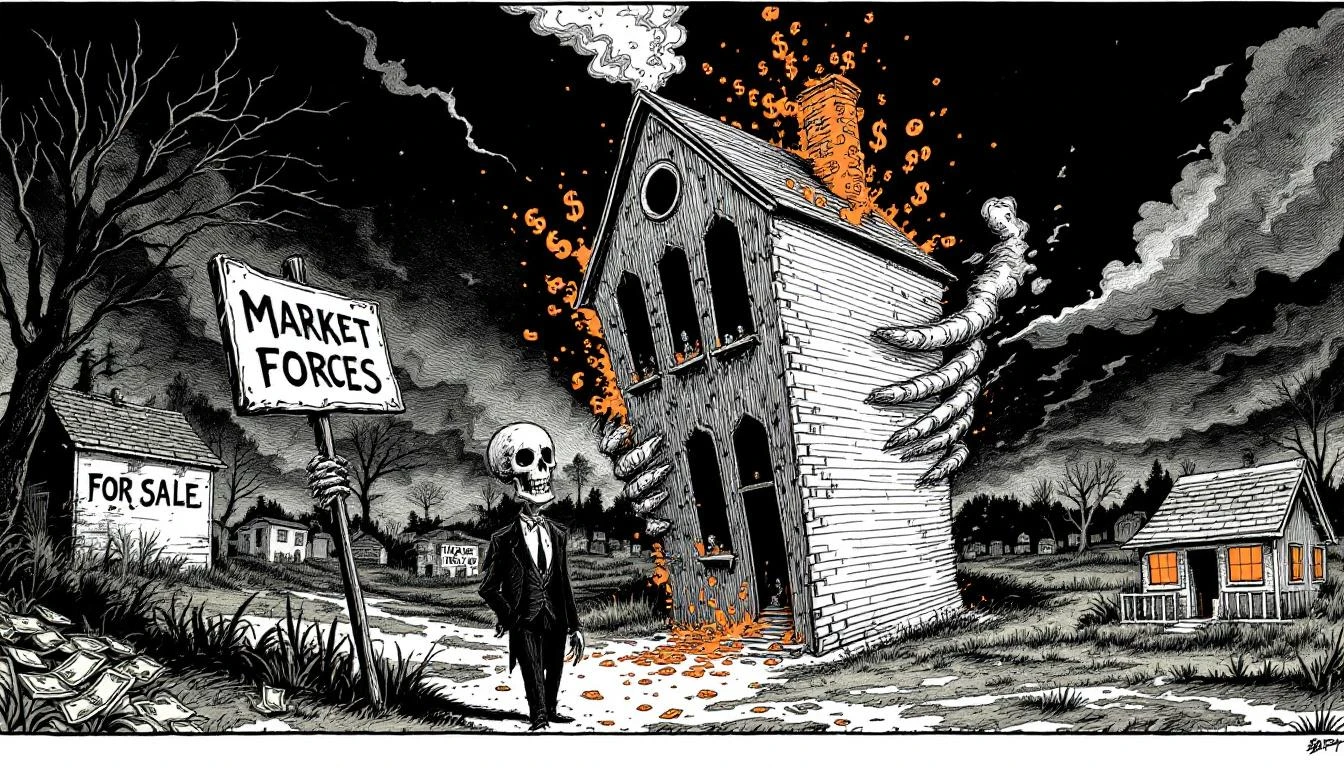
The $330K Bedroom-Free Shoebox: American Real Estate's Final Descent Into Parody
A $329,900 Long Island tiny home with zero bedrooms has gone viral, perfectly encapsulating the housing market's descent into expensive, bedroom-free madness.
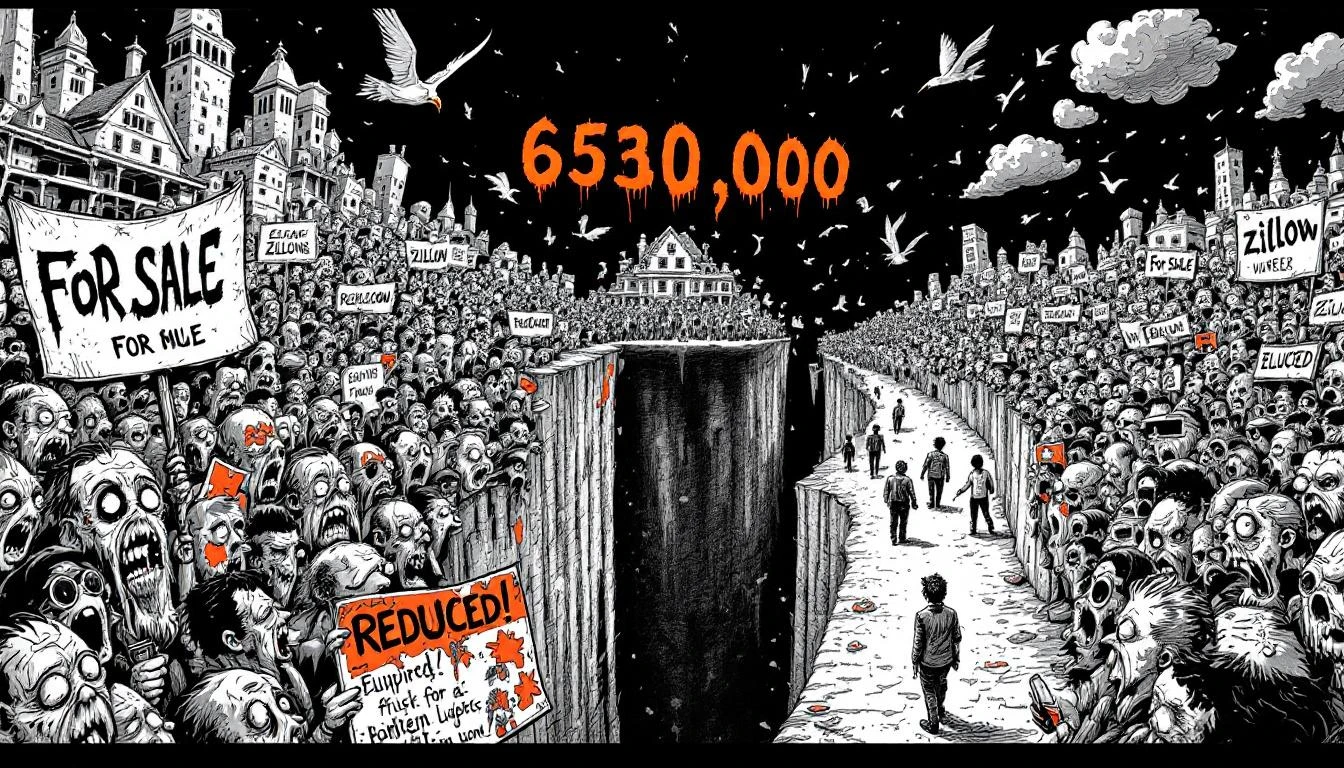
The Great Standoff: 630,000 Sellers Discover Nobody Wants Their Overpriced Shitboxes
630,000 more sellers than buyers—the largest gap on record. Turns out nobody wants to pay $800K for your 1987 tract home after all. The standoff begins.