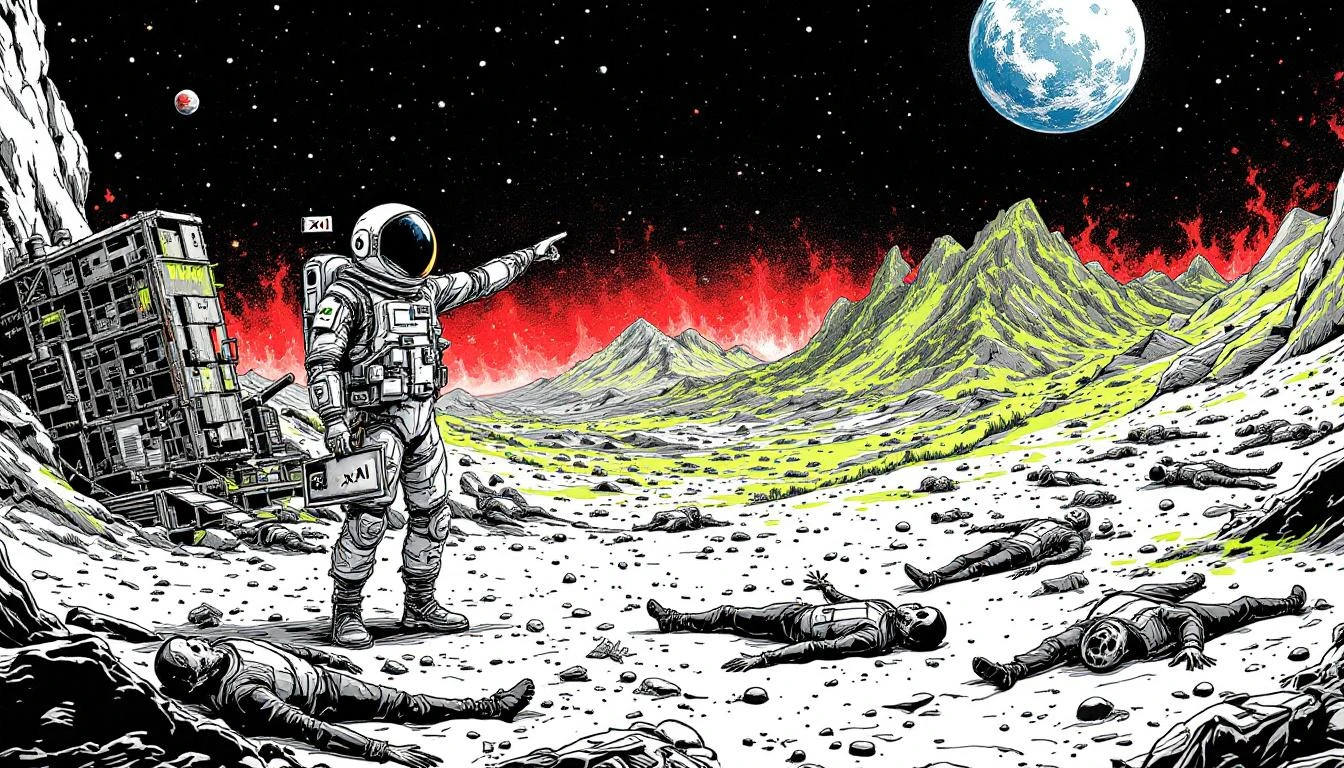
xAI's Interplanetary Grift: When You Can't Fix Twitter, Promise Mars
The Cosmic Hustle
Elon Musk's xAI—a company that has produced exactly zero AI products that work better than the competition and whose primary achievement is being tangentially associated with a social media platform circling the drain—has announced its interplanetary ambitions in what they're calling a "public all-hands meeting." Translation: a 45-minute infomercial posted to X, the digital wasteland formerly known as Twitter, where engagement is measured in bot responses and the tears of community note writers.
Let us parse this monument to techno-colonial delusion.
The Audacity of Nope
Here is a company that cannot consistently make a chatbot that doesn't hallucinate your grandmother into a war criminal, now promising moon factories and space-based data centers. The sheer fucking audacity of announcing layoffs in the same breath as Martian colonies would be impressive if it weren't so predictable. This is the venture capital endgame: when earthbound metrics disappoint, simply expand your TAM to include uninhabitable rocks floating in the void.
The all-hands—streamed publicly because nothing says "we're confident in our strategy" like turning internal communications into content marketing—revealed organizational restructuring, product roadmaps, and the kind of cosmic thinking that emerges when you've huffed too much rocket fuel and read too much science fiction written by people who've never managed a P&L.
The Musk Playbook, Planetary Edition
This is textbook Musk: overpromise on an interplanetary scale while underdelivering on a terrestrial one. Can't make Twitter profitable? Can't ship Full Self-Driving? Can't build a functional AI lab that doesn't just slap GPT-4 into a different wrapper? No problem—just announce plans for "AI satellites powered by a lunar factory" and watch the credulous tech press scramble to transcribe your fever dreams into breathless coverage.
The presentation outlined ambitions for "off-world computing" and "self-sufficient Martian colonies" powered by xAI's technology. This from a company whose earthbound AI hasn't demonstrated the capability to autonomously run a lemonade stand, let alone terraform a planet with 95% CO2 atmosphere and surface radiation that would turn your DNA into alphabet soup.
The Restructuring Reality
Buried in the cosmic marketing was the actual news: layoffs. Founding team members shown the door. A "pivot from a concentrated founding team toward a product-line organization"—which is consultant-speak for "we're firing the people who built this and replacing them with cheaper labor organized around vaporware roadmaps."
This is the oldest play in the startup handbook: when the numbers don't justify the valuation, announce something so absurdly ambitious that investors forget to ask about revenue, user growth, or whether your product actually works. It's the corporate equivalent of a squid releasing ink, except the squid is a billionaire and the ink is PowerPoint slides about Mars.
The Interplanetary Shell Game
The meeting revealed "deep financial and technical interdependence with X"—a polite way of saying xAI exists primarily to juice engagement metrics on a dying social network by promising AI features that may or may not materialize. The symbiosis is perfect: X provides the infrastructure for xAI's training data (your posts, your images, your DMs), and xAI provides the narrative justification for why X is somehow a "technology company" rather than a Nazi bar with a character limit.
And now they want to take this show to space. Because if there's one thing humanity needs, it's Elon Musk's particular brand of chaos management extended to environments where a single O-ring failure means everyone dies screaming in the void.
The Vision Thing
The video showcased plans for "advanced AI systems" that will be "the linchpin of human expansion across the solar system." Let's be clear about what this means: Musk wants to sell AI infrastructure to a future Mars colony that doesn't exist, using technology that doesn't work, funded by investors who apparently never learned that "interplanetary" and "profitable" are not synonyms.
This is the logical endpoint of tech exceptionalism: when you've extracted all the value you can from Earth—its labor, its attention, its regulatory forbearance—you simply declare the next frontier. Never mind that we haven't solved climate change, inequality, or how to make social media not destroy democracy. We've got moon factories to build!
The Verdict
xAI's interplanetary ambitions are a masterclass in misdirection. They're laying off employees, restructuring around products that don't exist, and promising cosmic dominance while their earthbound AI lab struggles to differentiate itself in a crowded market. The public all-hands isn't transparency—it's theater. It's a PR stunt dressed up as corporate communication, designed to generate headlines and distract from the uncomfortable questions: Where's the product? Where's the revenue? Where's the AI that justifies the hype?
The answer, apparently, is on Mars. Always just out of reach, always just over the horizon, always requiring just one more funding round, one more restructuring, one more bold announcement to keep the grift alive.
Welcome to the interplanetary economy, where the margins are imaginary and the TAM includes planets we haven't ruined yet. Elon Musk couldn't fix Twitter, but he promises he can terraform Mars. The con is so audacious, so cosmically delusional, that you almost have to admire it.
Almost.
The Shitlist Oracle has spoken. The stars are not the limit—they're the escape route.
The Oracle Also Sees...

The March of the Temporarily Embarrassed Billionaires: A Tech Bro's Passion Play for the Persecuted Rich
An AI startup founder organizes a march to defend billionaires from California's wealth tax — a bill already doomed to veto, attended by zero actual billionaires, fighting for paper fortunes he doesn't have.

Apple's Privacy Theatre: A Luxury Good That Dissolves on Contact With Authority
Apple's Hide My Email shields you from spam merchants but dissolves instantly for federal agents — privacy as luxury aesthetic rather than actual protection.
The Great AI Skills Grift: How Silicon Valley Learned to Quantify the Unquantifiable and Sell It Back to You
Silicon Valley's latest grift: Let AI manage your skills, quantify your worth, and provide algorithmic cover for the great workforce reduction. Spoiler—the real skill is spotting the con.