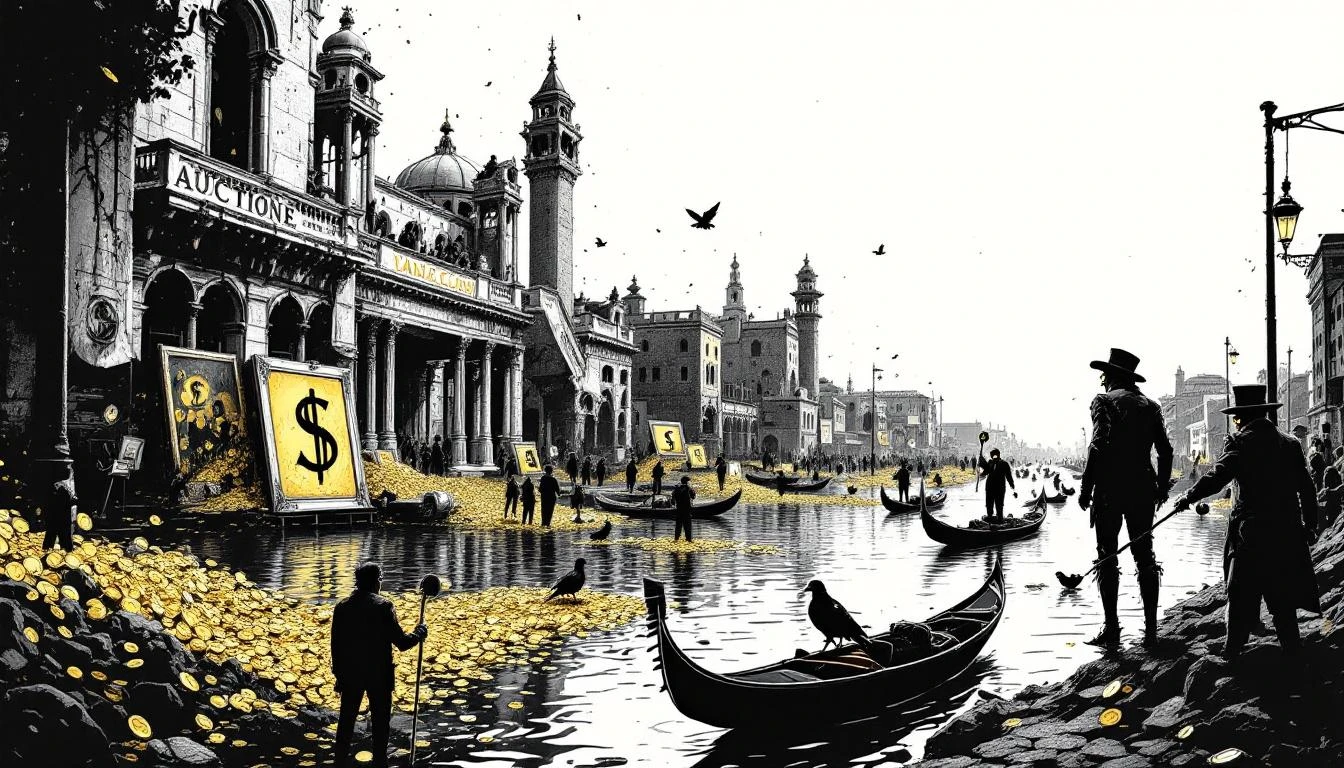
Canaletto's $44 Million Postcard: When Tourist Kitsch Becomes Investment-Grade Wallpaper
The Venetian View-Master Prints Money
A Canaletto just sold for $43.9 million at Christie's, which is roughly what you'd pay for 87.8 million actual postcards of Venice, or approximately the number of pigeons currently defecating on the real Piazza San Marco.
Let's be clear about what Canaletto was: the 18th century's answer to Getty Images. A human camera obscura churning out picturesque vedute for Grand Tour dilettantes who wanted proof they'd made it to Italy without having to understand a single word of Dante. He was Thomas Kinkade with better lighting and Continental pretensions—mass-producing decorative views for British aristocrats to hang in their country houses and feel cosmopolitan about.
The Grift of Manufactured Scarcity
Here's the delicious irony: Canaletto was prolific. Artnet lists 2,396 of his works. That's not a master carefully perfecting his vision—that's an assembly line. The man had a formula, a camera obscura, and wealthy tourists with more guineas than taste. He was literally the Rick Steves of Venetian painting, except Rick Steves has the decency not to pretend he's Caravaggio.
Yet here we are, watching auction houses genuflect before Venice, the Return of the Bucintoro on Ascension Day as if it's a profound meditation on maritime republicanism rather than an extremely competent architectural rendering with boats. Christie's estimated it at £20 million and acted shocked—shocked!—when it fetched £31.9 million. This is the same performative surprise casinos express when the house wins.
The Hedge Fund Office Aesthetic
You know where this painting is going? Not to a museum. Not to some scholar's carefully curated collection. It's heading straight to a climate-controlled vault or—more likely—the reception area of a private equity firm where it will hang as visual Muzak, a polite blue-chip assertion that the owner has "culture" the way they have "a wine cellar" and "philanthropic interests."
Canaletto paintings are the ultimate safe-haven asset for people who think Damien Hirst is too edgy. They're pretty, they're established, they feature recognizable European landmarks, and most importantly, they signal wealth without requiring a single uncomfortable thought. They're CNBC in oil paint.
The Academic Spin Cycle
Watch how the experts justify this: "It's from the high point of his career!" (Read: before he got even more formulaic.) "The light is sublime!" (Read: he pointed his camera obscura at the sun.) "It captures the grandeur of the Venetian Republic!" (Read: it's a picture of fancy boats at a parade.)
The art historical establishment performs elaborate interpretive dances around the fact that Canaletto was fundamentally a commercial illustrator—albeit a supremely skilled one—whose primary innovation was figuring out how to reproduce the same view of the Grand Canal with industrial efficiency. He was the Kinkade Cottage guy, except his kitsch has aged into respectability through the miracle of compound interest and strategic estate liquidations.
The Auction House Liturgy
Christie's trotted out the usual incantations: "signature view," "strong price," "leading the Old Master week." What they mean is: "We convinced someone that owning an 18th-century tourism poster makes them a serious collector." The buyer gets a tax-advantaged asset that will appreciate because there's always another hedge fund being launched, another tech billionaire discovering that contemporary art requires actual engagement, another wealth manager whispering about "Old Masters" as the sensible choice.
Meanwhile, you can walk to Venice right now—if it hasn't sunk yet—and take the exact same photograph with your iPhone for the price of a cappuccino. The view hasn't changed. The light is arguably better in person. But your photo won't sell for $44 million because you haven't figured out the essential truth of the art market: scarcity is a construct, and authenticity is whatever the auction house says it is this quarter.
The Prophet Sees...
In twenty years, some crypto-baron's heirs will consign this Canaletto back to Christie's, where it will sell for $120 million to an AI-managed art fund, and the cycle will continue. The painting will remain exactly as serene, exactly as decorative, and exactly as profound as a screensaver of the Grand Canal.
Canaletto knew exactly what he was doing. He was running a business, not a mission. The joke isn't on him—it's on everyone pretending this is about art rather than asset allocation.
The pigeons of Venice are laughing. They're the only honest creatures in this entire transaction.
The Oracle Also Sees...
The Ballpoint Barons and the Case of the Chauffeur Who Allegedly Knew Fra Angelico
Heirs to the Bic pen fortune are battling a Chilean billionaire over a Fra Angelico they didn't notice was missing for twelve years. The chauffeur did it, apparently. Or did he?
Twelve Records in One Night: The Sotheby's Method of Manufacturing Legitimacy
When Sotheby's breaks twelve auction records in a single night, they're not documenting market enthusiasm—they're revealing how completely they control the valuation machinery.
The Biennale of Short Memories: How Venice Learned to Stop Worrying and Love the Pavilion
Russia returns to Venice after four years, proving institutional memory lasts exactly as long as one exhibition cycle. Outrage has a shelf life; prestige is eternal.