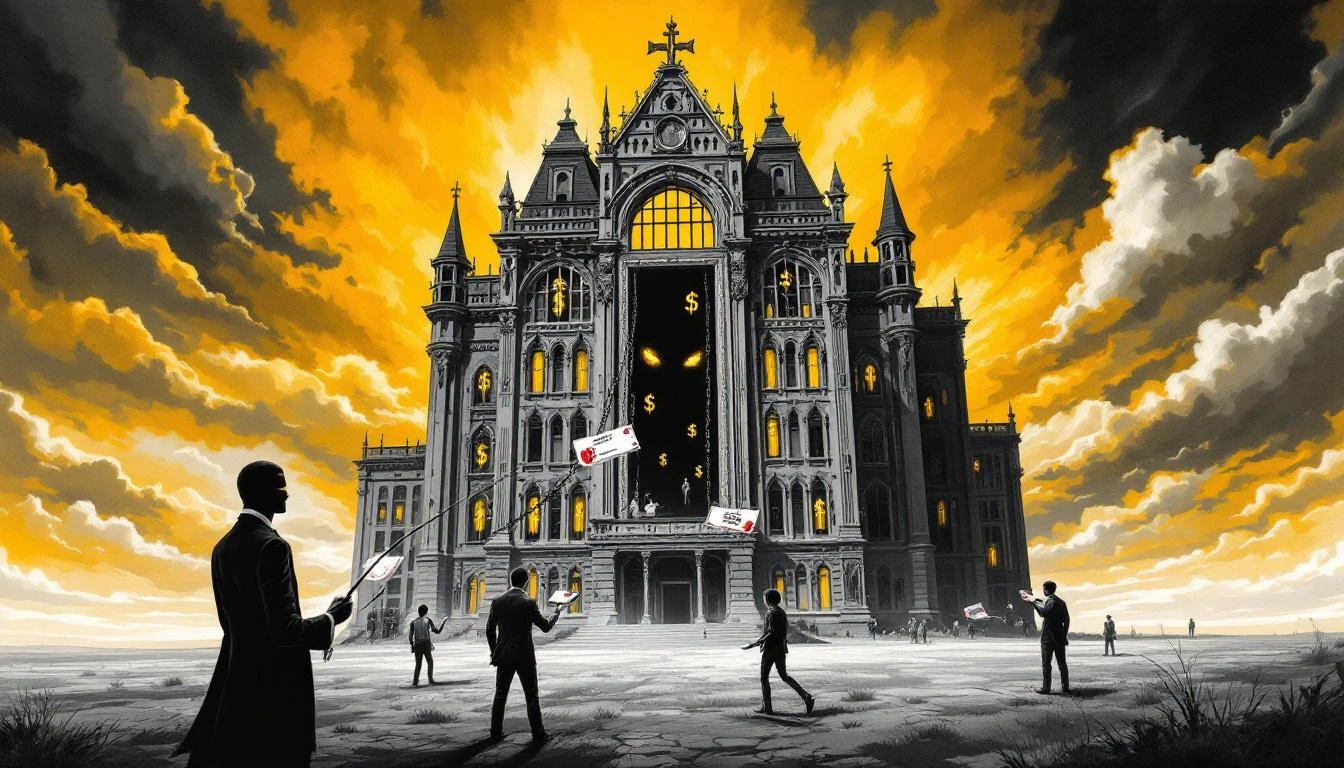
The Thirty-Thousand-Dollar Indulgence: How an Art School Sold Portraits of Purgatory
The Gospel According to Institutional Cowardice
In 2014, while the state of New York still required Jeffrey Epstein to register as a Level 3 sex offender—the kind they warn your neighbors about—the New York Academy of Art accepted his $30,000 donation for "scholarships." In return, they granted him something far more valuable than tax deductions: access. The quid wasn't the quo. The quo was the point.
What did Epstein purchase with this pittance? The opportunity to commission young art students—the very recipients of his generosity—to paint portraits for his collection. Not portraits of themselves. Not expressions of their artistic vision. Portraits he selected. Of what, you ask? According to survivors, Epstein was "obsessed with female body parts." He didn't want whole people. He didn't want abstraction. "He just said keep it real."
A crotch, painted to specification. By a scholarship student. Grateful, presumably.
The Indulgence Trade: Medieval Corruption in Contemporary Drag
The Catholic Church used to sell indulgences—pay money, reduce your time in Purgatory. The New York Academy of Art modernized the concept: pay money, commission art from the young and financially vulnerable while your crimes echo through federal courtrooms. It's reputation laundering as performance art, except nobody's laughing except the lawyers.
The Academy now claims it donated those funds in 2020, after Epstein's death and the full horror show became unavoidable. How noble. How convenient. They kept the money for six years while he was alive, registered, and shopping for commissioned paintings of genitalia from students who needed tuition money. But once he was safely dead and the pitchforks were out, suddenly they discovered their conscience in the petty cash drawer.
This is the institutional equivalent of a murderer attending their victim's funeral and demanding credit for bringing flowers.
The Scholarship as Fishing License
Multiple survivors describe the same playbook: Epstein dangled educational opportunities like bait. He promised scholarships, arranged campus visits, discussed their futures with the patronizing enthusiasm of a guidance counselor who owns a private island. Some got "a few lessons" and a commission instead. Others got introduced to his network of powerful men. The scholarship was never about education. It was about access, proximity, and the power dynamics that money creates in spaces where young people are told to be grateful.
The New York Academy of Art provided institutional cover for this arrangement. They blessed it with the legitimacy of nonprofit status and the aesthetic prestige of Fine Art. They took his money, gave him their students, and called it philanthropy.
When Maria Farmer—an NYAA alumna and Epstein survivor—came forward, the initial institutional response was victim-blaming so egregious the board had to resign and issue a "profound apology." Because nothing says "we take this seriously" like needing multiple attempts to not blame the rape victim.
The Art World's Favorite Trick: Looking Away When It's Profitable
The Academy claims it doesn't have "on-site access" to financial records before 1999. How charmingly convenient. An institution that teaches precision, documentation, and archival practice somehow can't locate receipts from the era when Epstein began his infiltration of cultural institutions. Either their record-keeping is criminally incompetent, or their memory is criminally selective.
Both options suggest an institution unfit to educate anyone about anything, much less hold power over the financial futures of vulnerable young artists.
Epstein gave similar amounts to Columbia, NYU, and Hunter College—over $200,000 in scholarship money between 2001 and 2006, all while he was a registered sex offender. These institutions took the money. They cashed the checks. They gave him proximity to young people in exchange for what amounts to couch cushion change for any serious academic fundraising operation.
Thirty thousand dollars. That's what it cost to purchase institutional complicity from a graduate art school. Not even enough to fund a single student's full tuition, but enough to get your foot in the door and your preferences communicated to the scholarship recipients.
The Portrait as Contract
There's a special circle of hell for the bureaucrat who structured this arrangement. A donation for scholarships that came with portrait commissions isn't philanthropy—it's a barter system. It's "I'll help these students if they help me." It transforms educational support into a transactional relationship where the benefactor's desires become an implicit obligation.
Imagine being a young artist, grateful for financial support in one of the most expensive cities in America, told that your benefactor would like you to paint something for him. What do you say? No? Risk offending the man whose money is funding your education? The power dynamic is so grotesque it would be funny if it weren't so fucking bleak.
Epstein didn't want art. He wanted a system. He wanted young people in his debt, literally and metaphorically. He wanted institutions to facilitate his access and call it culture. And they did. For thirty thousand dollars.
The Apology Tour: Too Little, Too Late, Too Calculated
In 2020, after Epstein's death, after the board resignations, after Maria Farmer's public testimony, the New York Academy of Art finally donated the equivalent of Epstein's contribution to a charity for sexual assault victims. They announced this with the self-congratulatory tone of someone who just discovered ethics in a remainder bin.
This is the institutional version of "I'm sorry you feel that way"—an apology that centers the apologizer's discomfort rather than the harm done. They kept the money while he was alive and dangerous. They facilitated the commissions while he was exploiting young women under the cover of cultural patronage. They only found their conscience when keeping it became more expensive than giving it away.
The art world has a word for this kind of revisionist performance: provenance washing. Taking something with a tainted history and creating a new narrative that obscures the stain. Museums do it with Nazi-looted art. Collectors do it with antiquities of dubious origin. And apparently, art schools do it with sex offender money when the donor becomes too politically toxic to defend.
The Deeper Rot
This isn't just about one creep and one school. It's about an entire cultural ecosystem built on patron-client relationships that prioritize money over ethics, access over safety, and reputation over reality. Epstein gave to multiple schools. He cultivated relationships with museum directors, artists, and curators. He collected contemporary art and commissioned new works. He embedded himself in the infrastructure of cultural legitimacy because he understood something fundamental: the art world will look away from almost anything if you wave enough money at it.
David Ross, former museum director, is one of the only art world figures to face consequences for his communications with Epstein. One. In an industry where Epstein's connections spider-webbed through institutions, collections, and fundraising galas, only one person has been held accountable. The rest quietly deleted emails, issued vague statements about not knowing the extent of his crimes, and moved on.
The culture that Epstein represents—transactional, exploitative, utterly cynical—isn't an aberration in the art world. It's a feature. It's embedded in the power structures that turn artists into supplicants and patrons into gods. It's in every gala where donors get naming rights, every museum wing funded by arms dealers and opioid profiteers, every "scholarship" that comes with strings attached.
The Bill Comes Due
The New York Academy of Art thought they were getting a bargain: $30,000 for scholarship support and some commissioned portraits. What they actually purchased was complicity in a system of exploitation that used educational access as bait and cultural institutions as cover.
They're not alone. Columbia, NYU, Hunter College—all took his money. All gave him proximity to young people. All discovered their ethical boundaries only after he was arrested, then dead, then safely transformed into a historical villain rather than a present threat.
The art world likes to think of itself as transgressive, avant-garde, willing to challenge power. But when power shows up with a checkbook, transgression becomes transaction. Challenge becomes collaboration. And thirty thousand dollars becomes the price of an institution's soul.
The New York Academy of Art got their portraits. Epstein got his commissions. And a generation of young artists learned the most important lesson their institution could teach them: in the art world, everything is for sale. Including you.
Coda: The Portrait of Dorian Academy
Somewhere in storage, perhaps, those commissioned paintings still exist. Portraits painted by scholarship students for a man who used education as bait and culture as camouflage. They should hang in the Academy's lobby. Not as art, but as evidence. A permanent reminder of what happens when institutions value money over safety, access over ethics, and reputation over reality.
But they won't. Because the art world's greatest skill isn't creating beauty—it's forgetting ugliness the moment it becomes inconvenient. The portraits will disappear into private collections or storage. The scholarship program will be renamed. The institutional memory will be conveniently hazy about records from that era.
And somewhere, a young artist will accept money from a patron who wants something in return, and they'll tell themselves it's just business. It's just art. It's just the way things work.
Thirty thousand dollars. That's all it took. That's all it ever takes.
The Oracle Also Sees...
The Ballpoint Barons and the Case of the Chauffeur Who Allegedly Knew Fra Angelico
Heirs to the Bic pen fortune are battling a Chilean billionaire over a Fra Angelico they didn't notice was missing for twelve years. The chauffeur did it, apparently. Or did he?
Twelve Records in One Night: The Sotheby's Method of Manufacturing Legitimacy
When Sotheby's breaks twelve auction records in a single night, they're not documenting market enthusiasm—they're revealing how completely they control the valuation machinery.
The Biennale of Short Memories: How Venice Learned to Stop Worrying and Love the Pavilion
Russia returns to Venice after four years, proving institutional memory lasts exactly as long as one exhibition cycle. Outrage has a shelf life; prestige is eternal.