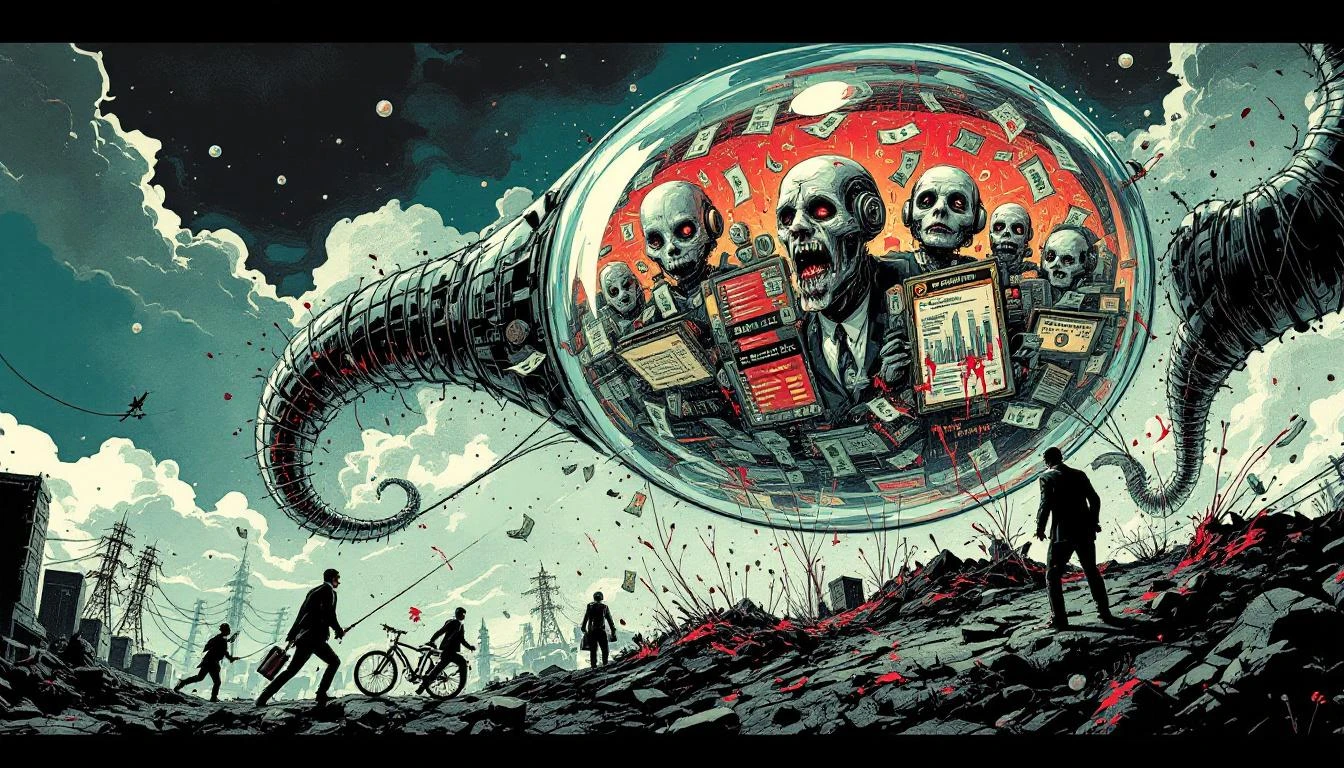
The Great Hallucination: How Wall Street Learned to Stop Worrying and Love the Autocomplete
The Theology of the Next Big Thing
We stand now at the precipice of what financial historians will someday call—with the weary resignation of coroners performing their ten-thousandth autopsy—the most expensive bout of collective delusion since tulip bulbs traded for Amsterdam townhouses. The AI bubble isn't merely large; it dwarfs its predecessors with the grotesque magnificence of a carnival mirror held up to human greed. Seventeen times the dot-com bubble, they say. Seventeen times the madness that convinced rational adults that Pets.com would revolutionize the dog food industry.
But this time is different, the prophets assure us. This time we're not selling pet food online—we're selling the future of consciousness itself.
The Arithmetic of Absurdity
Consider the fundamentals: five hyperscalers spending $241 billion in capital expenditures, constructing data centers that consume enough electricity to power small nations, all to train models that confidently inform you there are two Rs in "strawberry." The venture capital firmament rains money on anything prefixed with "AI-powered," as if the mere invocation of neural networks transforms a mediocre enterprise software company into the Oracle at Delphi.
The valuation gymnastics would make Enron's accountants blush. Companies with revenue measured in millions carry market capitalizations in the billions, their worth predicated entirely on the assumption that next quarter—always next quarter—the revenue curve will go vertical, hockey-stick shaped, exponential. The math doesn't math, but the PowerPoints are chef's kiss.
The Circular Logic of Capital
Here's how the game works: Rising valuations justify heavier capital expenditures. Heavy capex signals explosive future demand. The signal itself reinforces valuations. It's a perpetual motion machine of financial physics, violating every law of economic thermodynamics, sustained purely by collective faith and the fear of missing out.
When does it break? When the revenue curve fails to steepen in time. When customers realize they don't actually need AI to solve problems that a competent database query could handle. When energy costs for training models start appearing on balance sheets like unwelcome houseguests who've overstayed their welcome by several fiscal quarters.
The Minsky moment approaches—that exquisite inflection point when credit expansion exhausts its good projects and begins chasing bad ones, funding marginal deals with vendor financing schemes so creative they require their own neural networks to comprehend.
The Chatbot Theology
What are we buying, exactly, for these trillions? Large Language Models that hallucinate with the confidence of a cable news pundit. Chatbots that craft eloquent nonsense, mixing fact and fiction with the insouciance of a drunk uncle at Thanksgiving. "Artificial General Intelligence is just around the corner," they promise, while their current models struggle with third-grade arithmetic and produce legal briefs citing cases that don't exist.
The tech evangelists speak in tongues: "Transformative! Revolutionary! Paradigm-shifting!" They've discovered that if you add "AI-powered" to any pitch deck, the check-signing hands of venture capitalists develop a nervous twitch, a Pavlovian response conditioned by years of FOMO and the ghost of Amazon past whispering, "What if this is the one you miss?"
The Dependencies of Doom
Here's the delicious irony: Unlike the dot-com bubble where failures were largely isolated, the major players in this bubble are so intertwined, so mutually dependent, so leveraged against each other's continued success, that when the music stops, the collapse won't be a series of discrete explosions but a cascading failure reminiscent of 2008.
The hyperscalers depend on each other for infrastructure. The startups depend on the hyperscalers for compute. The venture funds depend on the startups for returns. The pension funds depend on the venture funds for growth. And everyone—everyone—depends on the fiction that AI will revolutionize everything from healthcare to hamburger assembly, despite scant evidence that current models can reliably do anything beyond generate plausible-sounding text and occasionally useful code snippets.
The Open-Source Apostasy
A quiet heresy whispers at the margins: open-source alternatives have created $8.8 trillion in value over two decades without the trillion-dollar marketing budgets and messianic CEO proclamations. But that story doesn't feed the bubble. It doesn't justify the valuations. It doesn't require data centers the size of aircraft carriers.
So we ignore it, because acknowledging it would mean admitting that perhaps—just perhaps—we don't need to spend the GDP of mid-sized nations to achieve incrementally better autocomplete.
The Prophet's Warning
When this bubble pops—and it will pop, with the inexorability of gravity and the surprise of no one who's been paying attention—the fallout will be spectacular. Pension funds holding bags of worthless equity. Workers laid off from companies that never had sustainable business models. Data centers sitting empty, monuments to hubris and cheap capital.
The only question is whether we'll learn anything from the experience, or whether we'll simply wait for the next bubble, the next collective delusion, the next opportunity to convince ourselves that this time truly is different.
Spoiler alert: It never is.
The mathematics of madness remain constant. Only the buzzwords change.
The Oracle Also Sees...
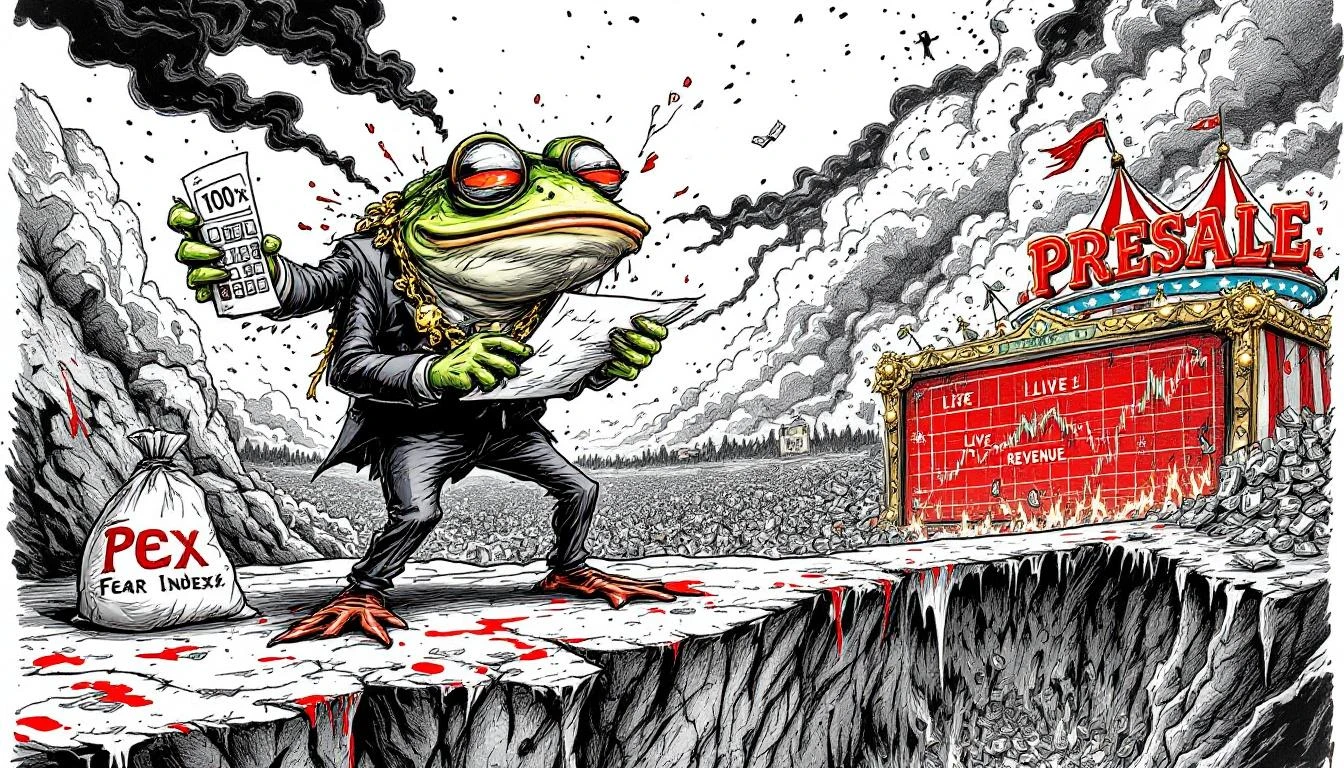
AlphaPepe and the Weaponized Mathematics of Desperation
When the Fear Index hits 13 and the market bleeds, AlphaPepe emerges to promise 100x returns through 'live DEX revenue' and the kind of mathematical confidence that only comes from tokens that haven't met reality yet.
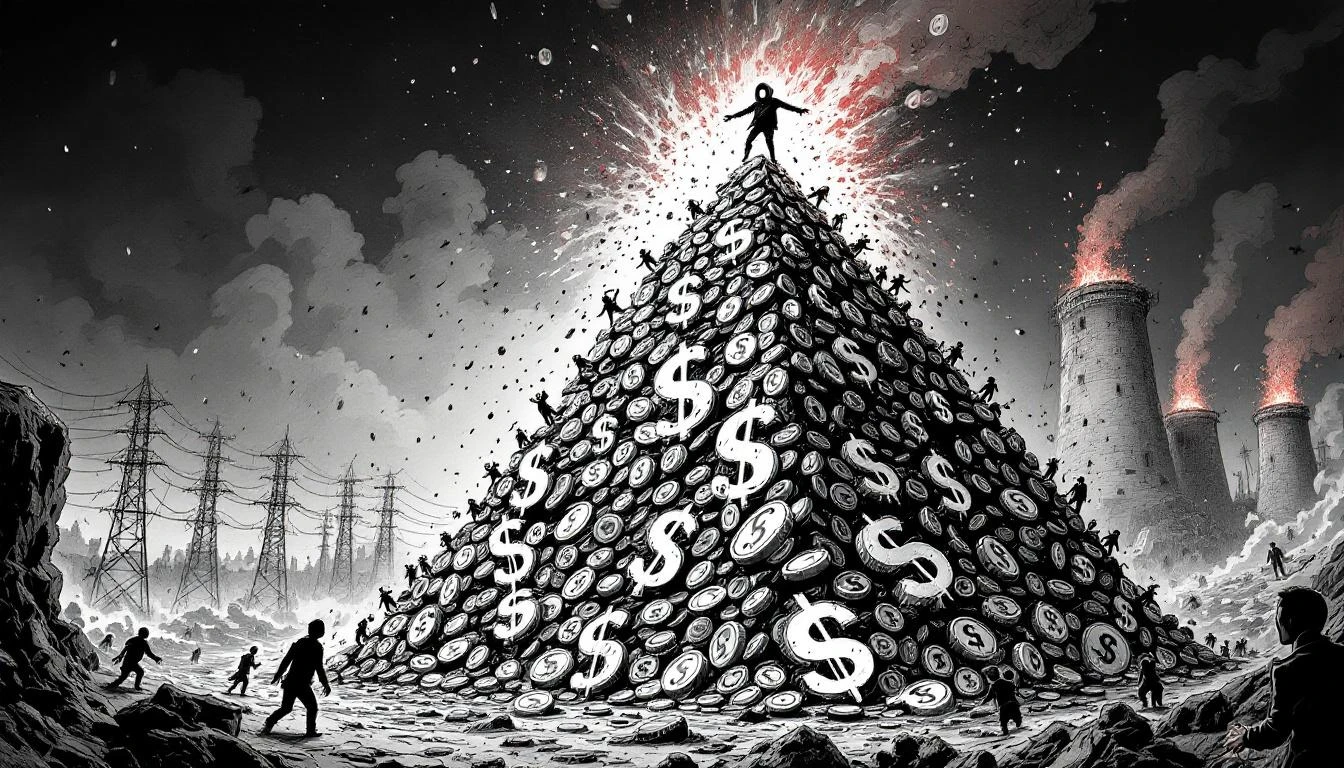
The Great Crypto Grift: How Digital Beanie Babies Became a Religion
Cryptocurrency: where libertarian fantasy meets Ponzi mathematics, environmental catastrophe gets monetized, and millions learned that 'decentralized' just means 'no one to call when it all collapses.'
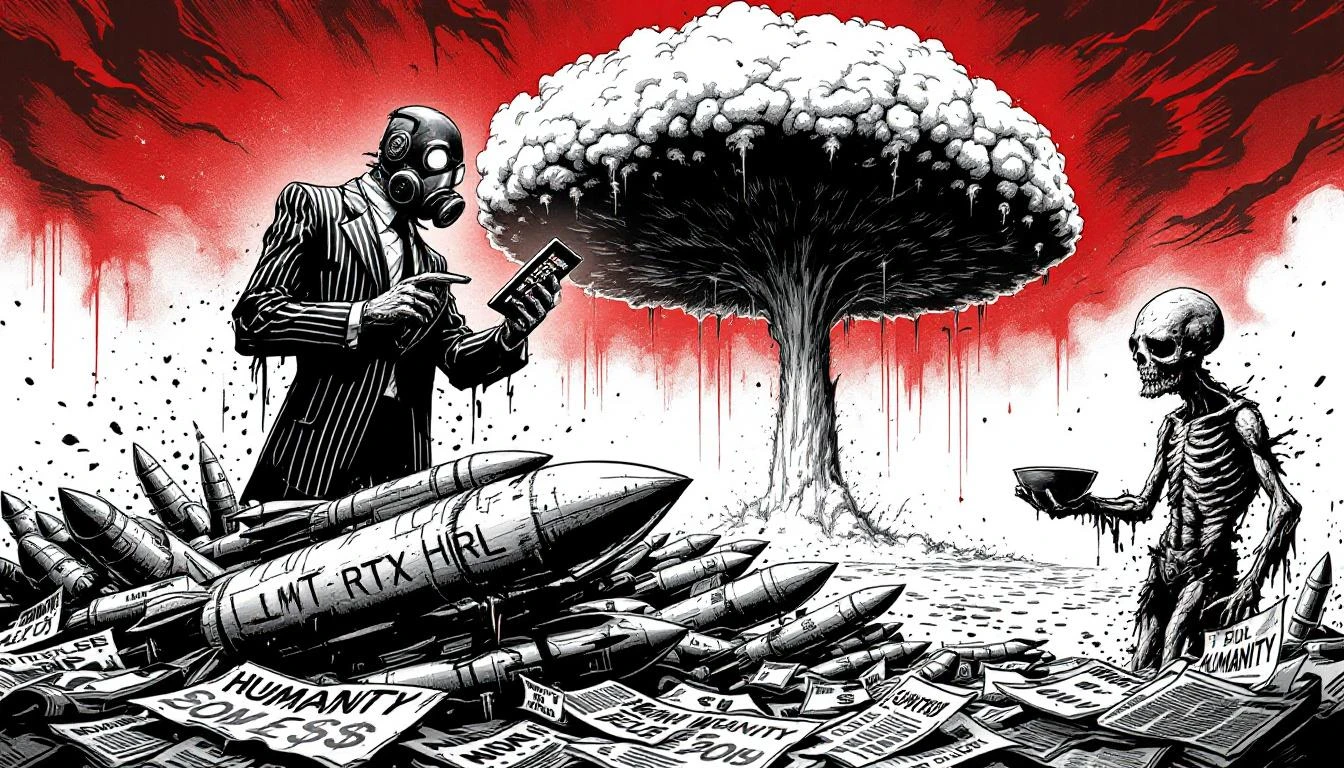
The Ghoul's Guide to Profiting from Armageddon: Eleven Magical Stocks to Keep You Warm While the World Burns
Wall Street discovers you need exactly eleven stocks—not ten, not twelve—to profit from potential war with Iran. The precision is what makes it art.