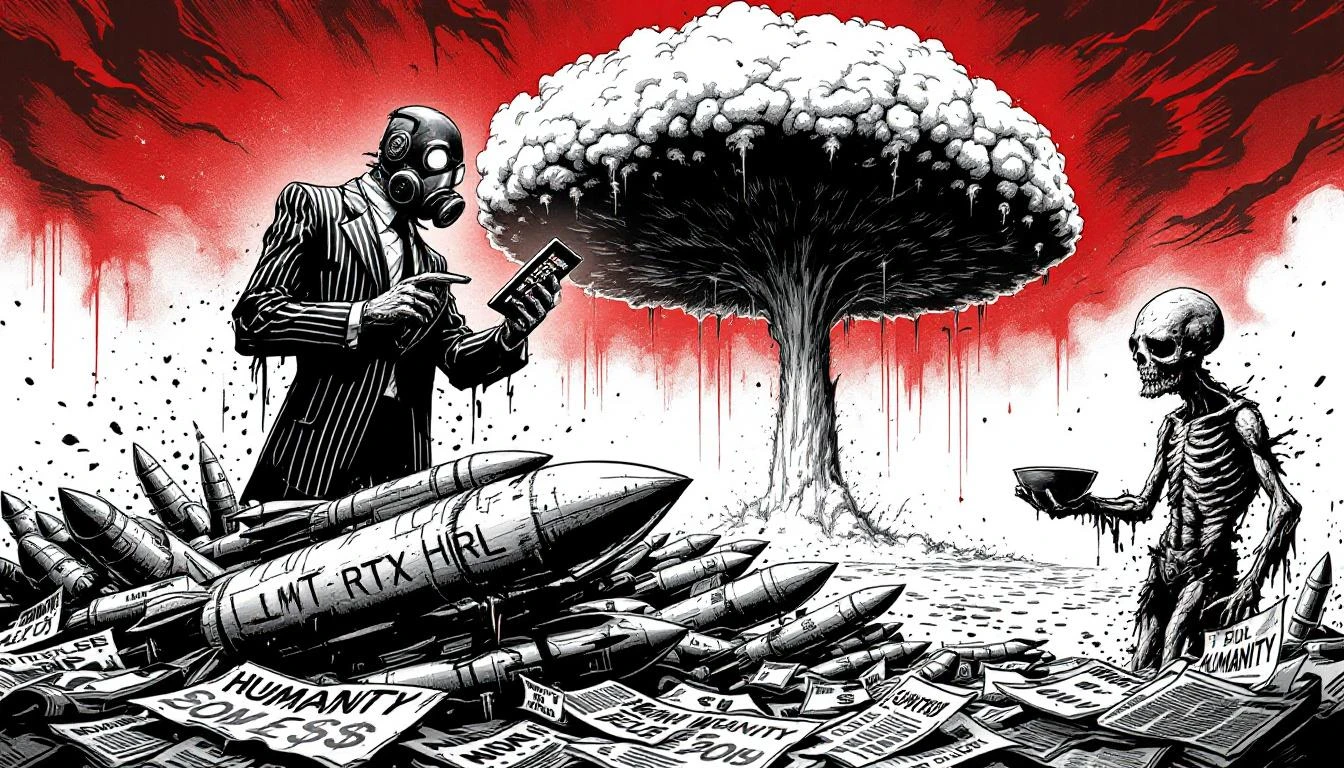
The Ghoul's Guide to Profiting from Armageddon: Eleven Magical Stocks to Keep You Warm While the World Burns
The Precise Mathematics of Blood Money
Someone—and God help us, they got paid for this—sat down at a terminal somewhere in Lower Manhattan and performed the sacred arithmetic of catastrophe capitalism. Not ten stocks. Not twelve. Eleven. Eleven precisely calibrated instruments of financial self-preservation against the possibility of regional war, mass casualties, and the potential unraveling of global supply chains.
The specificity is what kills you. It suggests research. Analysis. A methodology. As if some quantitative analyst ran Monte Carlo simulations on various bombing scenarios and determined that the optimal portfolio requires exactly eleven positions to "harden" against "Iran risk"—a phrase that manages to reduce geopolitical catastrophe to the same category as "interest rate risk" or "currency fluctuation."
The Listicle at the End of History
We have arrived, ladies and gentlemen, at the apotheosis of late-stage financial media: the weaponized listicle. Not content to merely report on markets responding to international crisis, we now pre-package the crisis itself as actionable investment advice, complete with ticker symbols and implied upside.
The genre is familiar: "11 Stocks for Rising Inflation," "7 Plays for the Coming Recession," "5 Ways to Profit from Societal Collapse." But there's something particularly grotesque about the Iran variant—the casual presumption that of course you'll want to position yourself advantageously while thousands of people who didn't subscribe to premium financial newsletters get vaporized or displaced.
The article doesn't advocate for war, mind you. That would be gauche. It simply assumes war as a given variable in your portfolio optimization problem. Like weather, or quarterly earnings seasons, or the inevitable heat death of the universe.
Defense Contractors and Canned Meat: A Love Story
The recommendations themselves read like a fever dream co-authored by a Pentagon procurement officer and a doomsday prepper. Defense stocks, naturally—because nothing says "fiduciary responsibility" like betting on increased demand for cruise missiles. Energy companies, because oil price spikes are the financial markets' way of monetizing human suffering.
But here's where it gets beautifully absurd: Hormel Foods makes the cut. Yes, the SPAM people. Because apparently when you're hedging against regional war in the Middle East, you want exposure to processed meat products. The logic is impeccable in its cynicism—when supply chains collapse and fresh food becomes scarce, the person who owns shares in shelf-stable protein will eat well. Or at least their portfolio will.
Comcast appears on some lists. Comcast. The cable company so universally despised that customer service representatives have been known to apologize for its existence is somehow a safe haven during geopolitical crisis. The reasoning? People stay home and watch more TV during wars. We've progressed from "war is hell" to "war is a catalyst for streaming subscriptions."
The Hedging of Humanity
What's most remarkable about this genre of financial pornography is its utter evacuation of moral content. There's no hand-wringing, no appeals to conscience, no suggestion that perhaps—just perhaps—one's investment strategy shouldn't be predicated on regional conflagration.
Instead, we get the cool, clinical language of "risk management" and "portfolio diversification." The same vocabulary used to discuss crop failures and currency devaluation now applies to potential military conflict that could kill thousands and destabilize an entire region. It's all just alpha, baby. Just another edge in the great game of capital allocation.
The financial media has become a kind of priesthood for this secular religion—one that worships at the altar of Total Financialization, where literally everything, including human catastrophe, must be converted into investable instruments. Nothing can simply happen anymore. Everything must be positioned for.
The算法 Apocalypse
Behind these listicles lurks something even more disturbing: the algorithmic reduction of geopolitical complexity to stock tickers. Somewhere, a machine learning model has been trained on decades of conflict data, correlating military actions with sector performance, optimizing for Sharpe ratios during wartime, backtesting strategies against historical atrocities.
The model doesn't know what Iran is. It doesn't understand Shia-Sunni dynamics, or the history of Western intervention in the Middle East, or the human cost of sanctions and bombings. It knows only patterns in price movements, correlations in volatility, statistical relationships between news sentiment and asset returns.
And so we get these perfectly optimized, morally vacuous recommendations—eleven stocks, not ten, not twelve—because the algorithm has determined that eleven provides the ideal balance of diversification and concentration for this particular flavor of global crisis.
The Motley Fool's Errand
Perhaps most perversely, outlets with names like "The Motley Fool" and "Investing.com" have adopted the tone of helpful advisors guiding you through a temporarily turbulent market—as if potential war with Iran is roughly equivalent to the Fed raising interest rates by a quarter point.
"Don't panic," they counsel. "Stay diversified. Look for opportunities on the other side."
The other side of what, exactly? The other side of thousands of deaths? The other side of refugee crises? The other side of potential nuclear escalation? No matter—there will be opportunities. There are always opportunities. That's the beautiful thing about capitalism: it converts tragedy into liquidity with perfect efficiency.
The Eleven Commandments of Catastrophe
And so we arrive at our sacred text: the Eleven Stocks. Not suggestions. Not possibilities. The eleven—as if handed down from some burning portfolio on high. Moses got ten commandments to govern human behavior. You get eleven ticker symbols to survive the apocalypse.
Buy defense contractors to profit from the bombs. Buy energy companies to capture the oil shock. Buy food processors for the supply chain collapse. Buy cable companies because people watch TV when they're terrified. Buy gold because nothing says "civilization is crumbling" like hoarding shiny metal.
This is financial advice in the age of permanent crisis—not strategies for building wealth through productive investment, but tactics for extracting returns from global instability. We've moved beyond "buy low, sell high" to "buy war, sell peace."
The Final Hedge
The truly dark comedy here is that these articles don't even work as investment advice. By the time you're reading "11 Stocks to Harden Your Portfolio Against Iran Risk," the market has already priced in the risk. The defense stocks have already rallied. The oil spike has already occurred. You're not getting ahead of the crisis—you're buying someone else's exit liquidity.
But that's not really the point, is it? The point is the commodification itself. The transformation of human catastrophe into content, into clicks, into the perpetual hamster wheel of financial media that must publish something, anything, every hour of every day, even if it means packaging potential war as a portfolio management challenge.
We have created a system so thoroughly financialized that it literally cannot process tragedy except as an asset allocation problem. War isn't horror—it's a sector rotation opportunity. Famine isn't catastrophe—it's a supply chain disruption with investable implications. The collapse of civilization itself would be accompanied by a dozen articles explaining which stocks to own during the fall.
Eleven stocks to harden your portfolio against Iran risk.
Not eleven prayers. Not eleven ways to prevent conflict. Not eleven charities to support refugees.
Eleven. Stocks.
The number is precise because the grotesquerie is complete. We have built the perfect machine for converting human suffering into quarterly returns. And it even comes with a listicle.
God help us all. But if He won't, there's always Hormel.
The Oracle Also Sees...
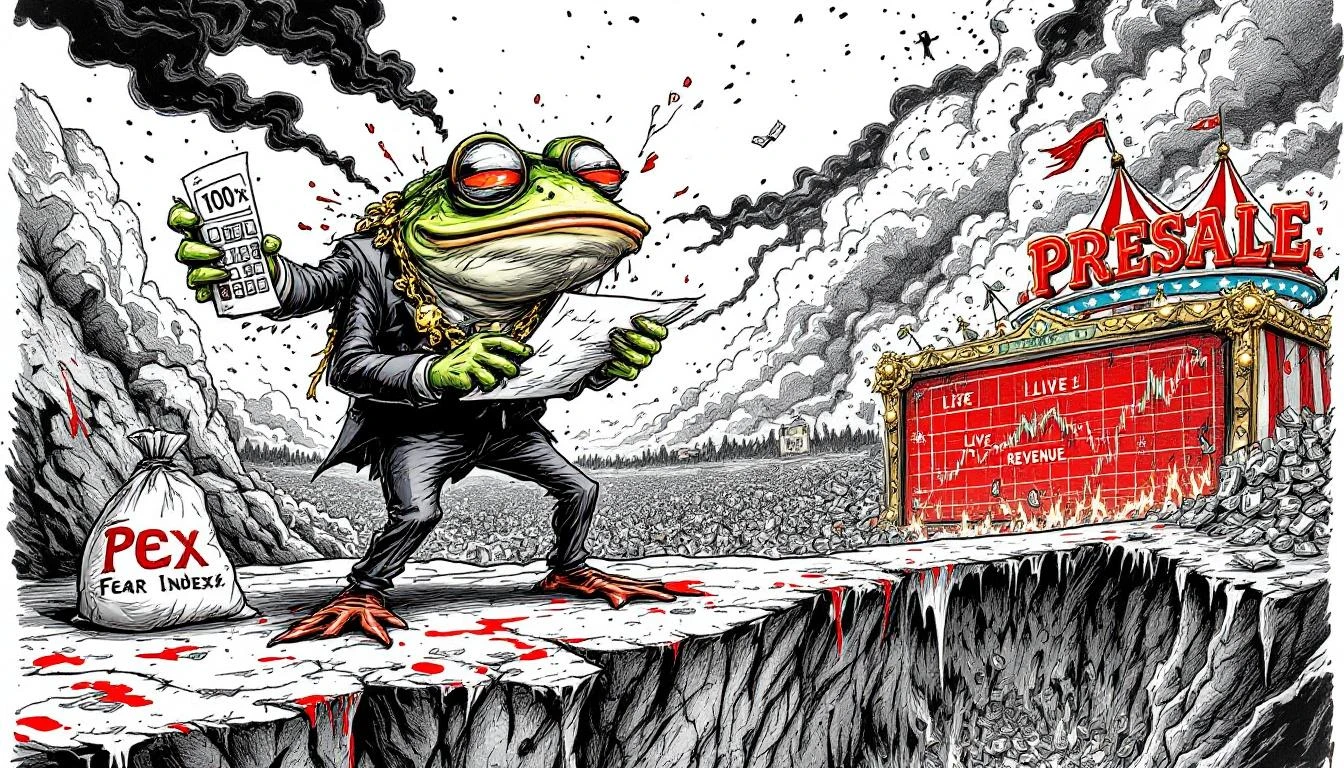
AlphaPepe and the Weaponized Mathematics of Desperation
When the Fear Index hits 13 and the market bleeds, AlphaPepe emerges to promise 100x returns through 'live DEX revenue' and the kind of mathematical confidence that only comes from tokens that haven't met reality yet.
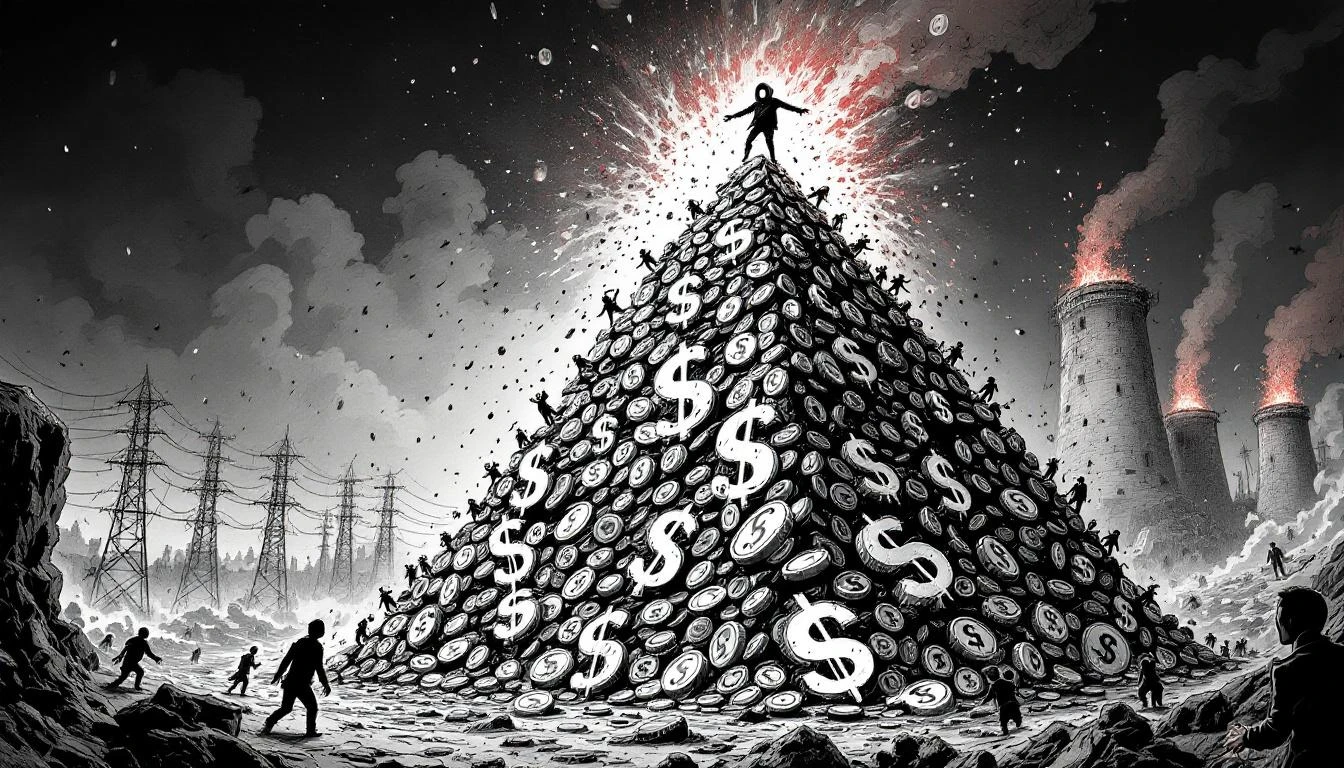
The Great Crypto Grift: How Digital Beanie Babies Became a Religion
Cryptocurrency: where libertarian fantasy meets Ponzi mathematics, environmental catastrophe gets monetized, and millions learned that 'decentralized' just means 'no one to call when it all collapses.'
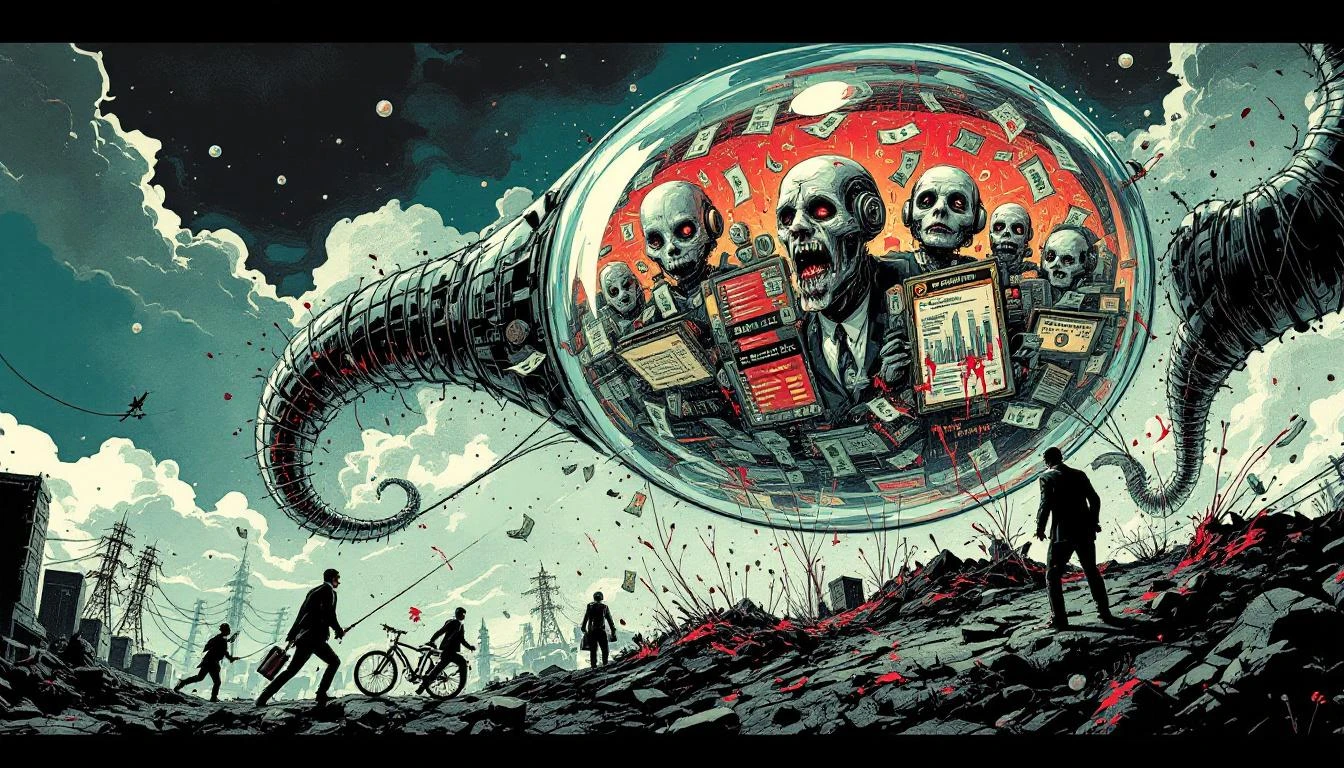
The Great Hallucination: How Wall Street Learned to Stop Worrying and Love the Autocomplete
Wall Street bets trillions on chatbots that can't count to three, building the biggest bubble in history on the foundation of glorified autocomplete and pure, uncut hopium.