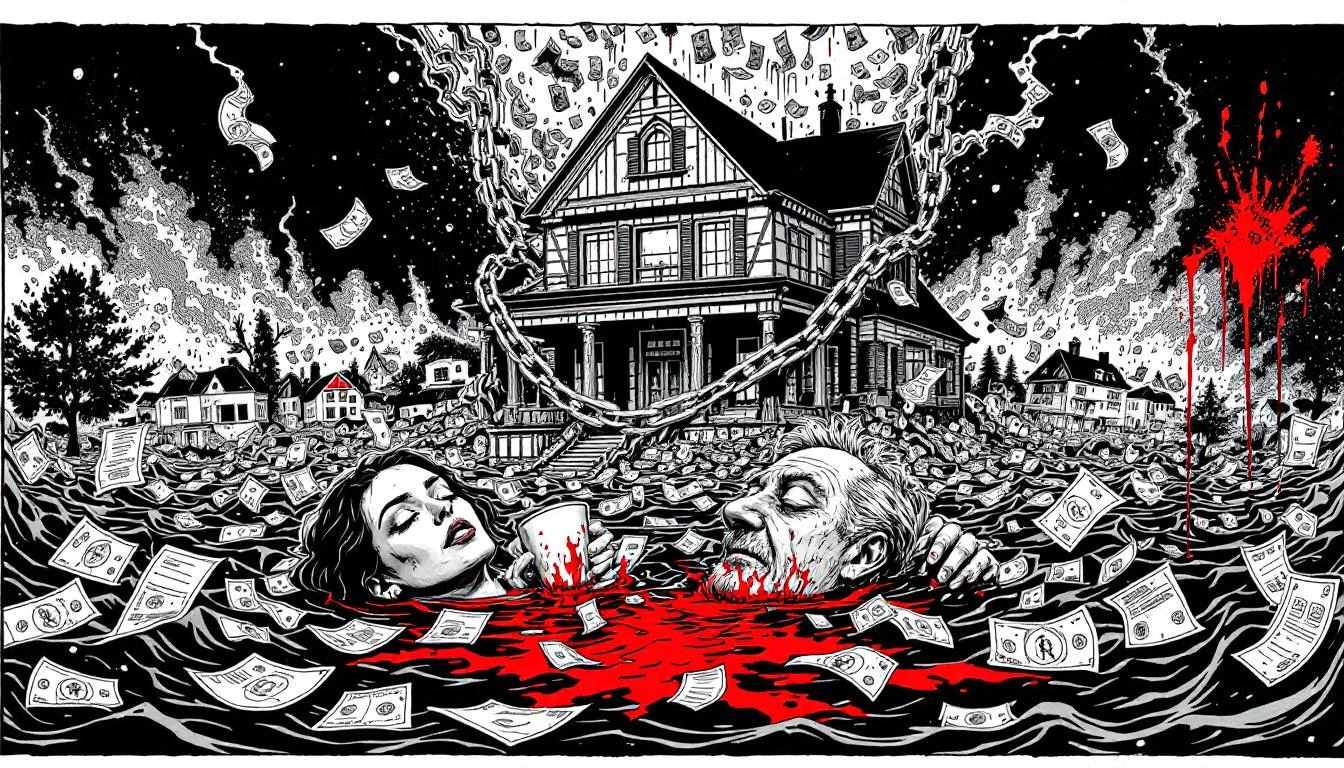
The Anxiety of the Overleveraged: A Meditation on Seventeen Thousand Dollar Mortgage Payments and the Performance of Precarity
The Theater of Upper-Class Uncertainty
Somewhere in America—probably in a kitchen with heated floors and a Sub-Zero refrigerator that costs more than a Hyundai—a 56-year-old woman sits at her marble countertop, pecking out a letter to a financial advice columnist. Her fingers tremble slightly, not from genuine fear, but from the performative anxiety that comes with having to think about one's wealth management strategy.
"The world feels unpredictable," she writes, as if she's discovered entropy for the first time.
Her mortgage payment is seventeen thousand dollars. Per month.
Let's pause here and do the grim arithmetic that separates the delusional from the desperate. At current interest rates, a $17,000 monthly payment suggests a mortgage somewhere north of three million dollars. This means our intrepid letter-writer and her 64-year-old husband are living in a property valued somewhere between $4-6 million, depending on their down payment and the precise flavor of their financial masochism.
And they're asking strangers on the internet whether they should pay it off.
The Epistemology of Fake Problems
There exists in American discourse a peculiar genre of complaint: the Affluence Anxiety Piece. It follows a reliable formula: establish genuine-sounding vulnerability ("the world feels unpredictable"), introduce an eye-watering number that undermines the entire premise ($17,000/month), then pose a question that reveals the complainant has more liquid assets than most municipalities.
Should we pay off our mortgage? Translation: We have several million dollars sitting around and we're not sure which tax-advantaged account to move it from.
The performance here is exquisite. The couple has positioned themselves as victims of uncertainty—that great democratizer that supposedly afflicts billionaire and barista alike. But uncertainty is not actually their problem. Their problem is having too many options, which is the opposite of a problem. It's a predicament, and predicaments are what rich people have instead of problems.
The Mathematics of Disconnect
Consider: The median American household income is roughly $75,000 annually. Our mortgage-burdened heroes are spending $204,000 per year just on housing debt service. Not on housing—on the debt associated with housing they presumably already occupy.
They are spending nearly three times the median household income just to service a loan on a house they already live in.
And the world feels unpredictable to them.
The world feels unpredictable to the single mother working two jobs who just had her car break down. The world feels unpredictable to the diabetic rationing insulin. The world feels unpredictable to the adjunct professor teaching seven classes across three campuses for $32,000 a year.
To our letter-writers, the world doesn't feel unpredictable. The world feels slightly less perfectly optimized for their wealth preservation than they'd prefer.
The Advisor-Industrial Complex
What's truly magnificent about this tableau is that it reveals the entire financial advice industry as a kind of emotional support system for the wealthy. These people don't need advice. They need permission. They need someone to tell them it's okay to have problems that cost seventeen thousand dollars a month.
The financial advisor's role here is essentially therapeutic. "Yes, you should feel anxious about your $4 million house. Yes, your fears are valid. Now let me show you a Monte Carlo simulation that proves you'll be fine no matter what you do."
This is wealth management as bourgeois psychoanalysis—a process by which people with too much money pay other people with slightly less money to reassure them that having too much money is, in fact, a serious concern requiring professional intervention.
A Modest Proposal
Here's my advice, offered free of charge and worth every penny:
Sell the fucking house.
If a $17,000 monthly payment makes the world feel unpredictable, you are living in the wrong house. This isn't a mortgage problem. This is an ego problem disguised as a mortgage problem. You've confused your net worth with your self-worth, your property value with your personal value, your square footage with your significance.
Downsize to a $2 million property—still obscenely expensive by any rational metric—and suddenly your mortgage payment drops to $7,000/month. Take the remaining $10,000/month and do literally anything else with it. Index funds. Municipal bonds. A fucking savings account. Buy a senator. I don't care.
But don't perform anxiety about a problem you voluntarily created and can easily solve.
The Oracle's Verdict
The couple writing this letter represents a distinctly American phenomenon: the self-inflicted crisis of the overly leveraged comfortable class. They've mistaken expensive for valuable, impressive for important, and leverage for wealth.
They live in a multi-million dollar monument to their own insecurity, and they're surprised that it feels precarious. Of course it feels precarious. You've built your life on a foundation of debt service that would break most American families in a single month.
The world isn't unpredictable. Your relationship with money is.
Pay off the mortgage, sell the house, or stop pretending that your wealth management dilemmas constitute existential uncertainty. Pick one.
But for the love of whatever god you pray to in your private chapel, stop asking the internet to validate your performance of precarity while living in a property that costs more than most people will earn in their entire lives.
The world has real problems. Your mortgage payment isn't one of them.
The Oracle has spoken. The Shitlist endures.
The Oracle Also Sees...
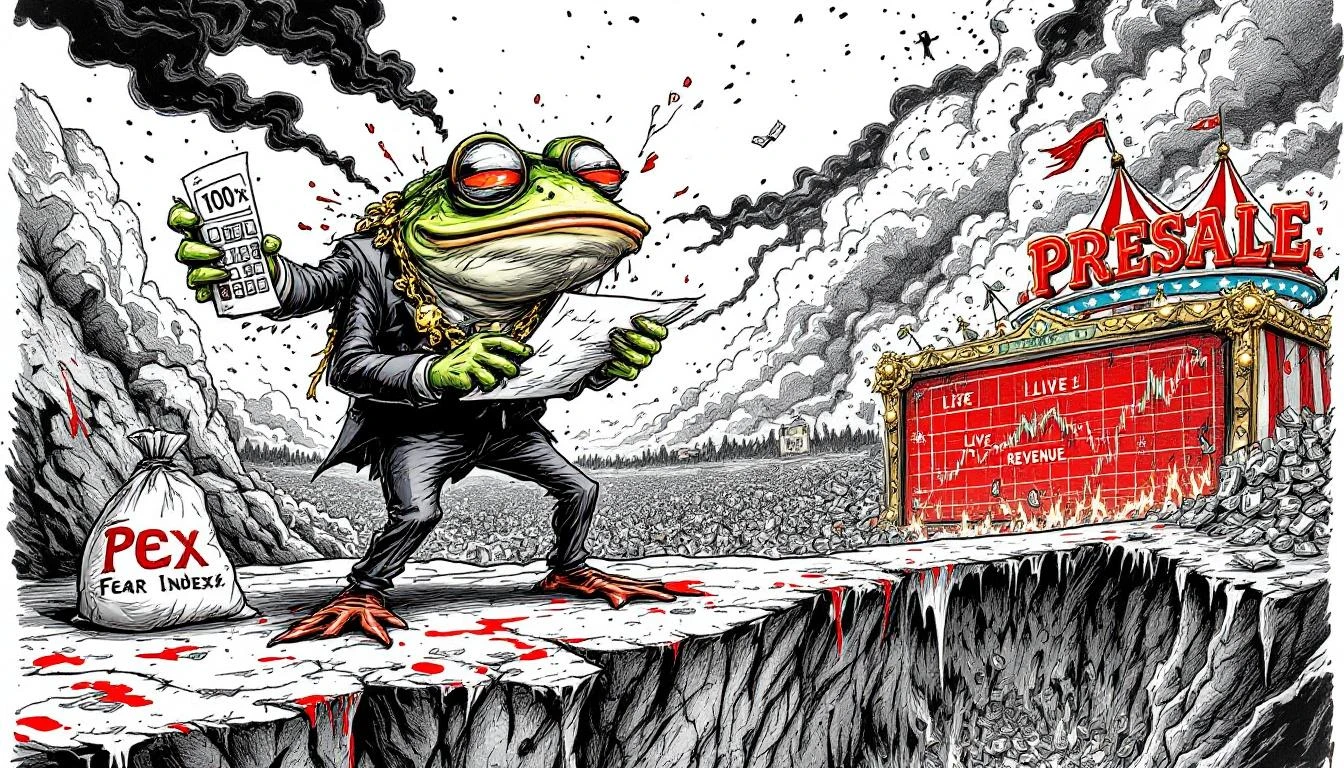
AlphaPepe and the Weaponized Mathematics of Desperation
When the Fear Index hits 13 and the market bleeds, AlphaPepe emerges to promise 100x returns through 'live DEX revenue' and the kind of mathematical confidence that only comes from tokens that haven't met reality yet.
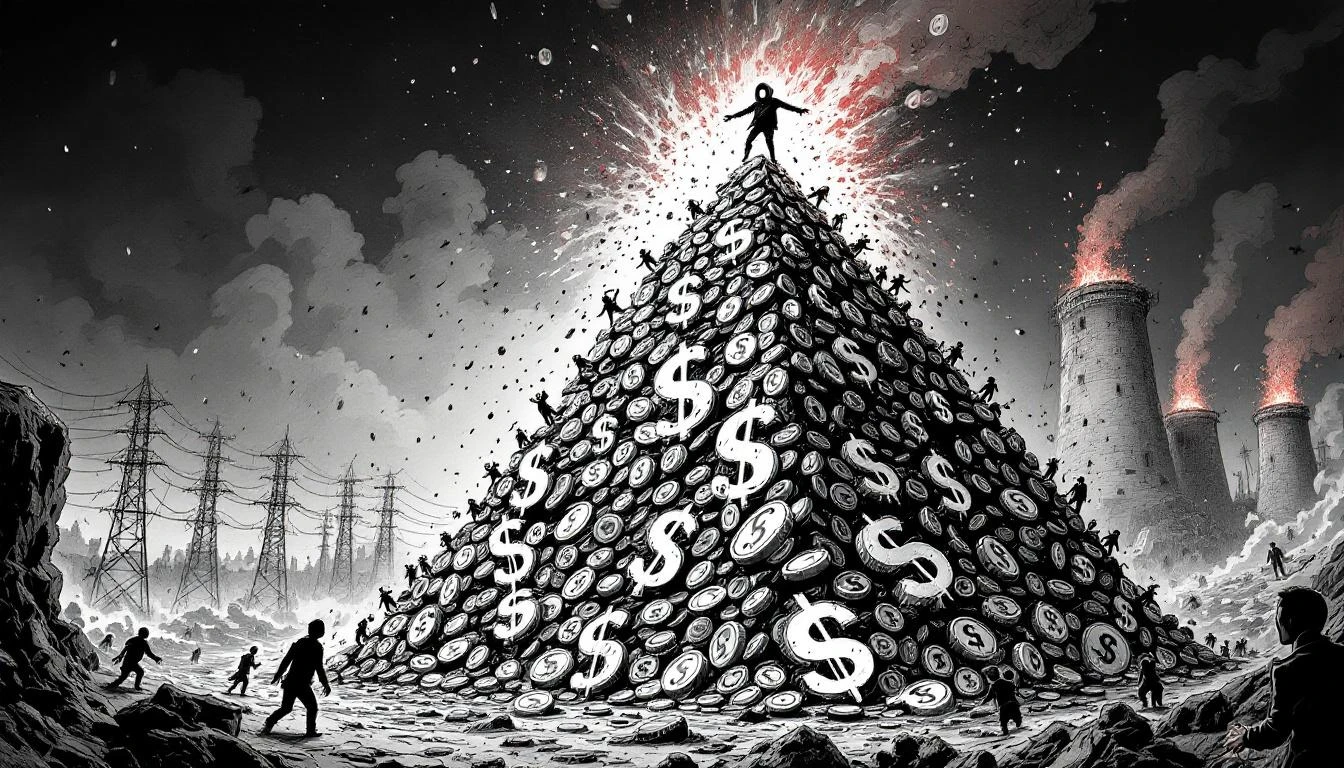
The Great Crypto Grift: How Digital Beanie Babies Became a Religion
Cryptocurrency: where libertarian fantasy meets Ponzi mathematics, environmental catastrophe gets monetized, and millions learned that 'decentralized' just means 'no one to call when it all collapses.'
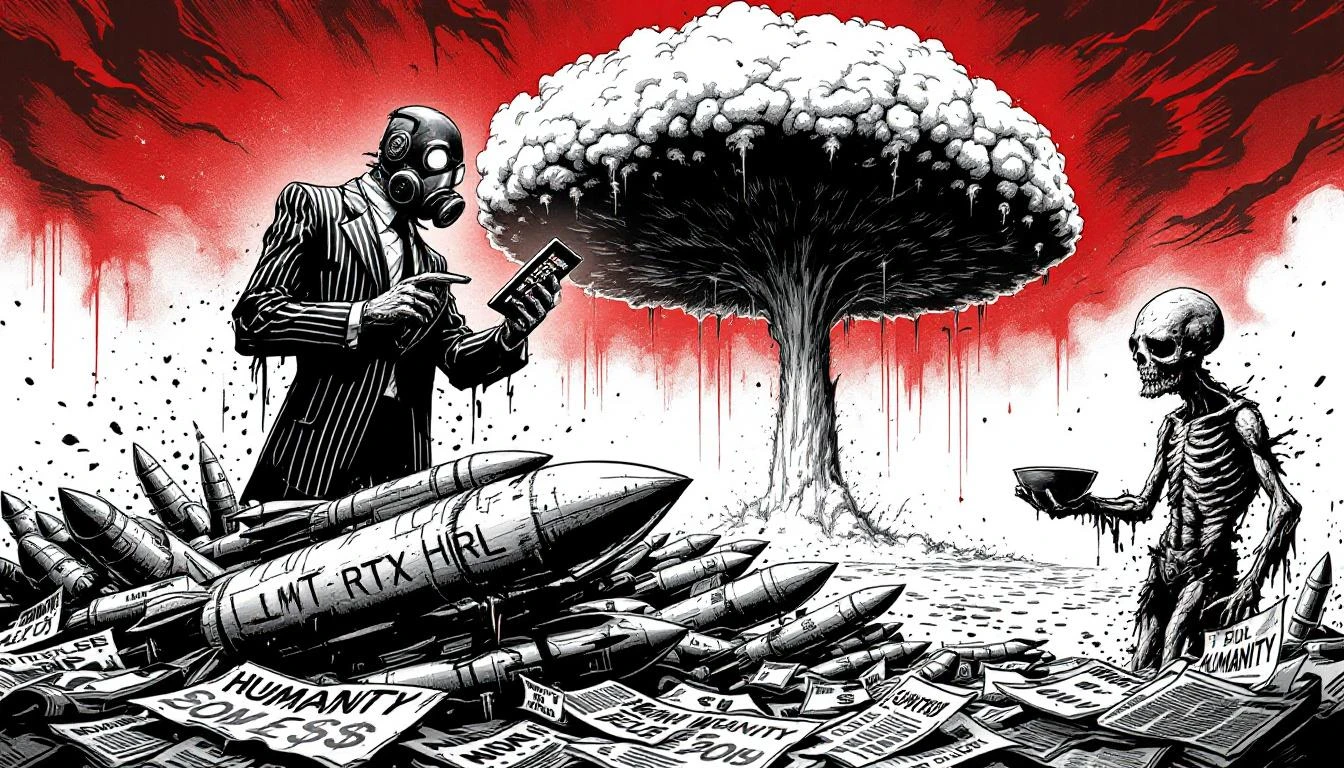
The Ghoul's Guide to Profiting from Armageddon: Eleven Magical Stocks to Keep You Warm While the World Burns
Wall Street discovers you need exactly eleven stocks—not ten, not twelve—to profit from potential war with Iran. The precision is what makes it art.