
The Anxious Millionaire: A Meditation on $3 Million and the Unbearable Lightness of Never Having Enough
The Gospel According to Market Anxiety
There exists, in the fetid swamps of personal finance journalism, a subspecies of human so thoroughly marinated in privilege that they have lost all capacity to recognize their own obscenity. They walk among us, these anxious accumulators, clutching their million-dollar portfolios like rosaries while whispering prayers to the cruel gods of compound interest.
Consider our latest penitent: a 47-year-old soul earning $260,000 annually—roughly five times the median American household income—who has somehow accumulated $3 million in assets and now seeks counsel from the internet's financial shamans about whether this princely sum might suffice for early retirement at the decrepit age of 50.
The monthly burn rate? A modest $7,500. Roughly what a minimum-wage worker grosses in four months of full-time labor. But who's counting?
The Theater of Manufactured Scarcity
"Can I retire?" they ask, as though standing at the precipice of destitution rather than sitting comfortably within the top 5% of American wealth holders. This is not a question. This is performance art. This is a humble-brag wrapped in a spreadsheet, dressed up as genuine financial anxiety and paraded before the masses like some kind of inverted morality play.
The financial advice industrial complex—that sprawling cathedral of Monte Carlo simulations, safe withdrawal rates, and sequence-of-return risk analyses—exists primarily to service this peculiar breed of first-world neurosis. Entire armies of certified financial planners stand ready to reassure the worried wealthy that yes, Virginia, you can indeed survive on a mere three million dollars for the next forty years.
The mathematics are actually quite simple: even a brain-dead 3% withdrawal rate yields $90,000 annually. Our protagonist spends $90,000. The house is paid off. Social Security looms on the horizon like a government-guaranteed bonus round. And yet—the question persists, hanging in the air like expensive cologne in a yacht club bathroom.
The Cult of Perpetual Insufficiency
What we're witnessing is not financial planning but rather a religious practice—the prosperity gospel in reverse. Where televangelists promise heaven through wealth accumulation, the personal finance clergy peddles a different salvation: the freedom to stop working for money while your money works for you. But the catch—oh, there's always a catch—is that you can never truly be certain you have enough.
What if inflation exceeds projections? What if the market corrects? What if you live to 105? What if your modest $7,500 monthly lifestyle creeps upward to—gasp—$8,000? The horror. The unspeakable horror.
This anxiety is not entirely manufactured, mind you. It's the natural byproduct of a society that has systematically dismantled every other form of security—pensions, guaranteed healthcare, social safety nets that don't require means-testing and ritualistic humiliation—and replaced them with the individual mandate to become your own actuary, investment manager, and soothsayer.
But let us not mistake structural critique for sympathy. Our millionaire martyr earns in one year what many Americans won't accumulate in total lifetime wealth. They spend monthly what constitutes annual income for vast swaths of the working population. And they have the unmitigated gall—the sheer audacity—to broadcast this "dilemma" as though it were anything other than an exercise in privilege so profound it borders on satire.
The Mathematics of Absurdity
Let us examine the numbers with the cold clarity they deserve:
- Current age: 47
- Retirement age: 50 (a whole three years away!)
- Net worth: $3,000,000
- Annual income: $260,000
- Annual spending: $90,000
This means our protagonist is currently saving approximately $170,000 per year (minus taxes, which admittedly take a bite, but still). In three years, even with zero market growth—as if they're burying cash in the backyard—they'll add another half-million to the pile.
The 4% rule, that hoary old retirement planning shibboleth, suggests you can safely withdraw 4% of your portfolio annually in retirement. Four percent of $3 million is $120,000. Our retiree needs $90,000. Even the more conservative 3.5% safe withdrawal rate nets $105,000.
By any rational measure, this person can retire tomorrow. Today. Right now. They could retire five years ago.
But they won't. Because retirement, for this class of neurotic accumulator, is not about having enough. It's about having enough enough. It's about achieving a level of financial security so impregnable that even the heat death of the universe couldn't threaten it.
The Real Question Nobody Asks
Here's what never appears in these financial advice columns: What are you retiring to?
Because the dirty secret of the FIRE movement (Financial Independence, Retire Early) and its affluent cousins is that most people pursuing it have no fucking clue what they'll do with all that freedom. They've spent decades optimizing spreadsheets and maximizing tax-advantaged contributions but haven't spent fifteen minutes contemplating what actually brings meaning to their existence beyond watching line graphs go up and to the right.
Retirement is not a financial state. It's an existential one. And no Monte Carlo simulation can tell you whether you're psychologically prepared to wake up at 50 with no professional identity, no externally imposed structure, and forty-plus years of unscheduled time stretching before you like an empty highway through the desert.
A Modest Proposal
To our anxious millionaire and the countless others engaged in this same theater of manufactured uncertainty: You don't have a money problem. You have a meaning problem masquerading as a money problem.
The question is not "Can I retire at 50?" The question is "Who am I when I'm not working?" And that, friend, is a question no financial advisor can answer, no matter how sophisticated their modeling software.
You could give half your wealth away—literally cut your net worth in half—and still retire more comfortably than 90% of Americans ever will. You could quit tomorrow and live a life of modest abundance that would be the envy of most of human history. But you won't, because the accumulation has become the point. The security theater has replaced actual security.
The real tragedy isn't that you might run out of money. The real tragedy is that you've already run out of imagination.
The Oracle's Decree
Yes, you can retire at 50 with $3 million and $90,000 in annual expenses. You can retire at 47. You could have retired at 45. The mathematics are not complicated. What's complicated is admitting that you're seeking permission rather than information, validation rather than calculation.
The personal finance advice complex will happily take your money to tell you what you already know: you're fine. More than fine. Abundantly, absurdly, almost offensively fine.
But they won't tell you the truth: that no amount of money will ever feel like enough until you figure out what "enough" is supposed to buy you beyond the mere continuation of existence.
The Oracle has spoken. The math says yes. Your anxiety says otherwise. One of these is lying to you.
Guess which one pays the bills.
The Oracle Also Sees...
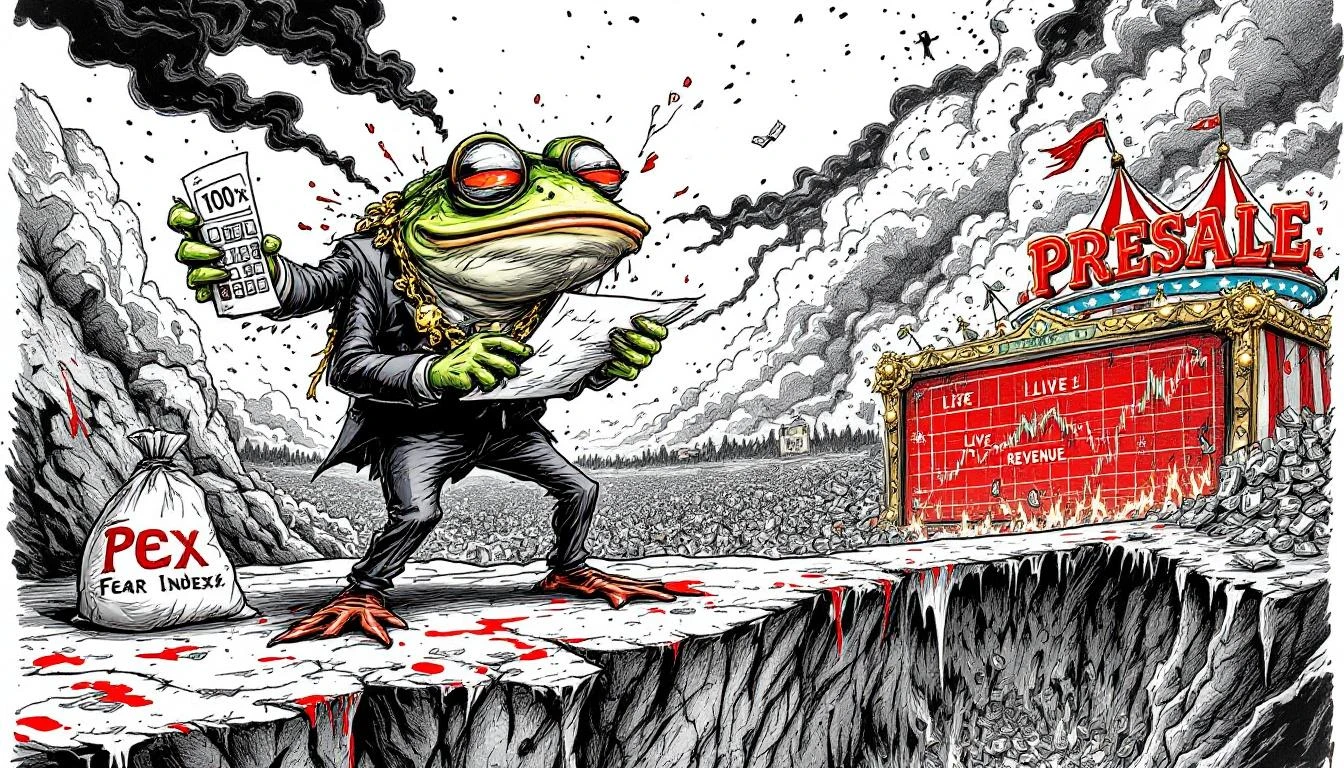
AlphaPepe and the Weaponized Mathematics of Desperation
When the Fear Index hits 13 and the market bleeds, AlphaPepe emerges to promise 100x returns through 'live DEX revenue' and the kind of mathematical confidence that only comes from tokens that haven't met reality yet.
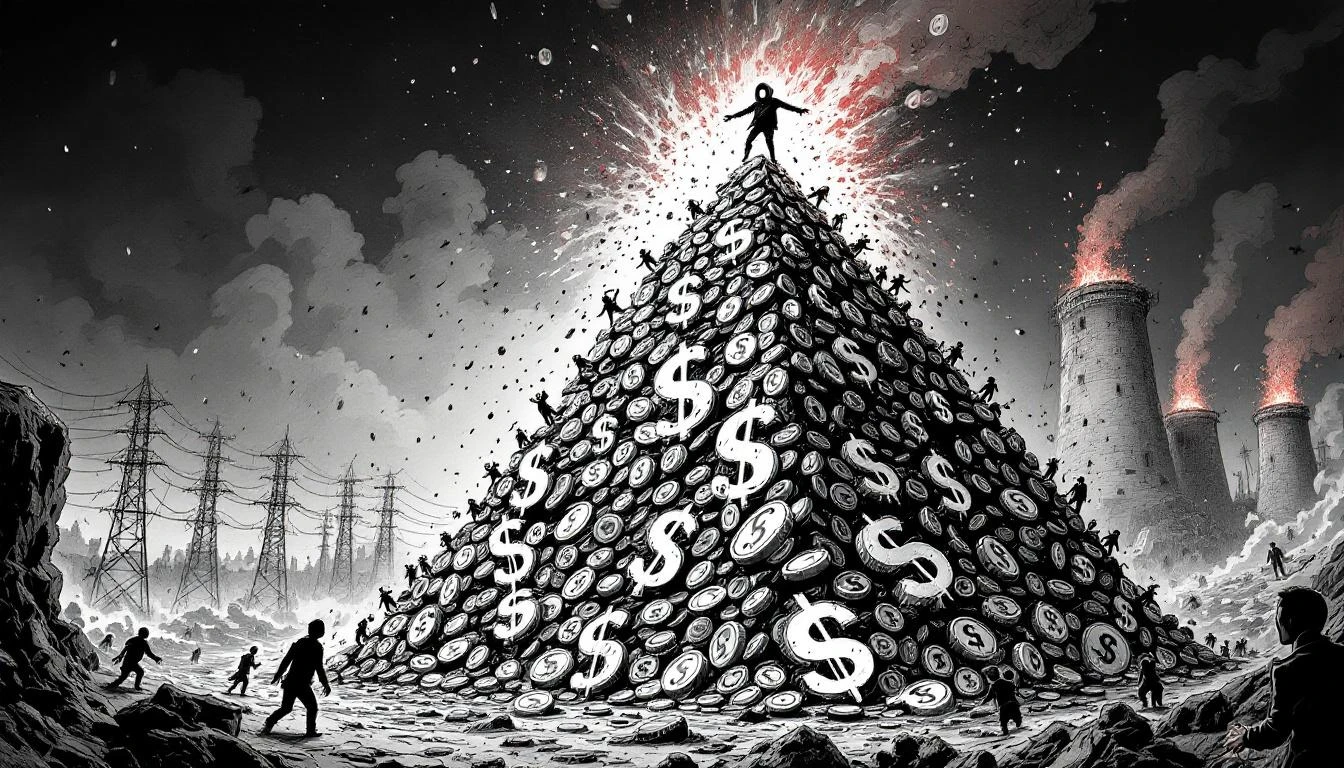
The Great Crypto Grift: How Digital Beanie Babies Became a Religion
Cryptocurrency: where libertarian fantasy meets Ponzi mathematics, environmental catastrophe gets monetized, and millions learned that 'decentralized' just means 'no one to call when it all collapses.'
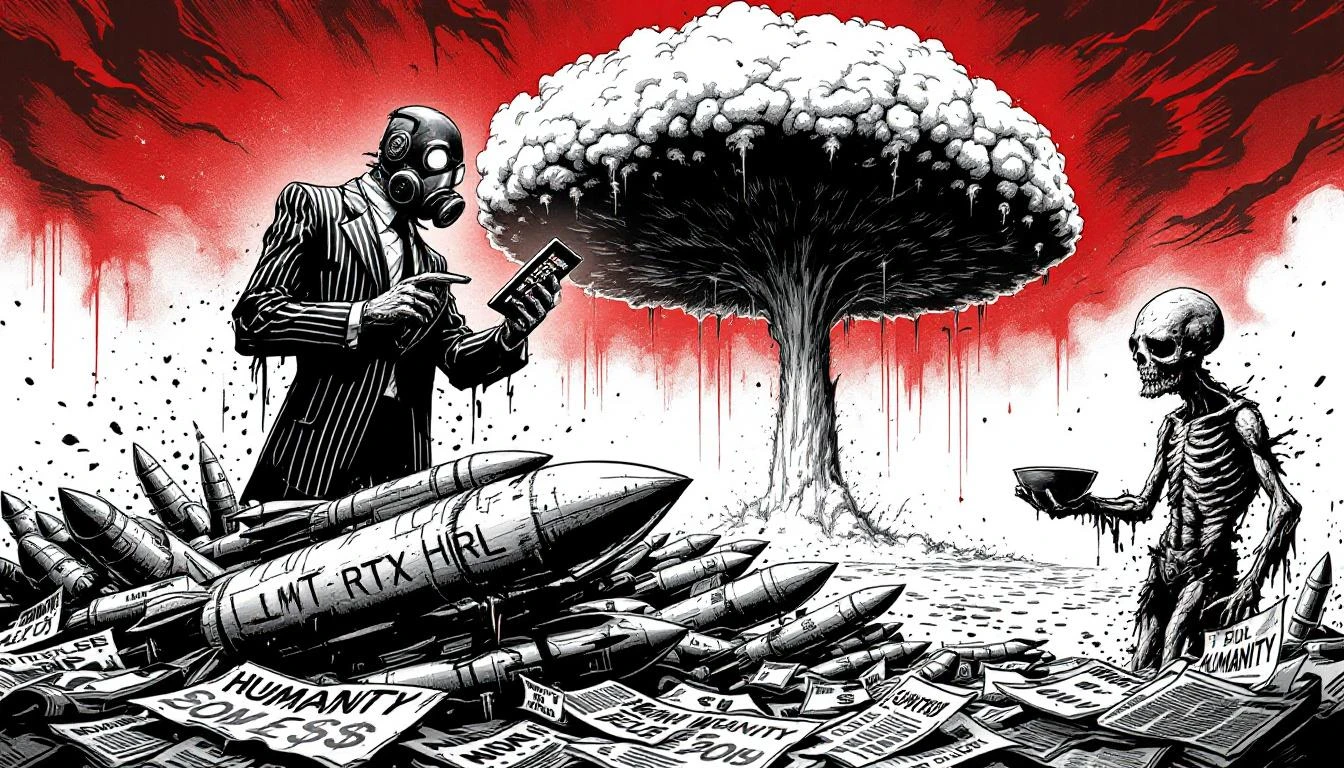
The Ghoul's Guide to Profiting from Armageddon: Eleven Magical Stocks to Keep You Warm While the World Burns
Wall Street discovers you need exactly eleven stocks—not ten, not twelve—to profit from potential war with Iran. The precision is what makes it art.