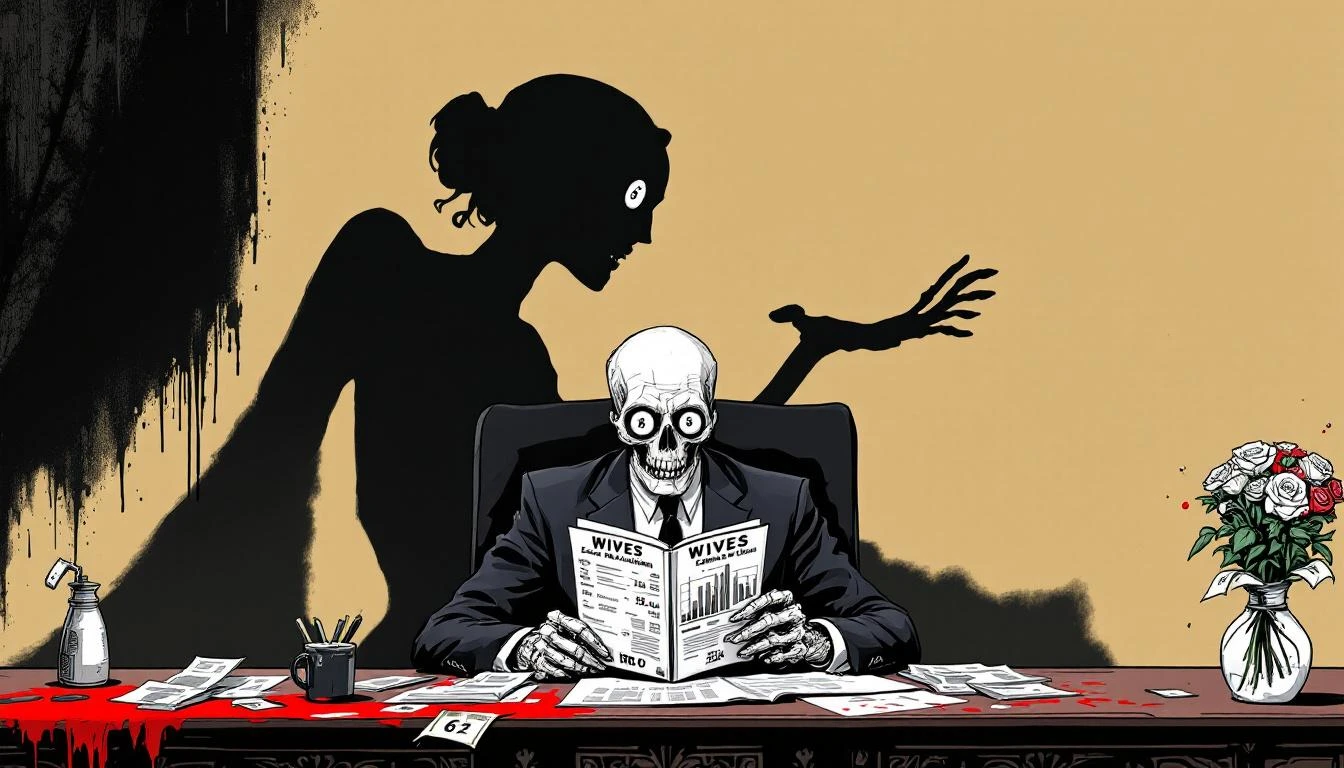
The Loneliness Arbitrage: Seeking a Spouse as a Sunset Hedge Fund Strategy
The Algorithm of Affection
Somewhere in America, a 62-year-old man with a multimillion-dollar portfolio has performed the most ruthlessly efficient cost-benefit analysis of his remaining years and concluded that what his diversified holdings really need is a woman. Not companionship, mind you. Not love in the messy, irrational sense that poets waste ink on. No—he needs a wife for his "twilight years," the way a pharmaceutical company needs favorable FDA trials.
This is financial planning as romantic gesture. Estate optimization dressed up in a negligee.
"I'm a loner," he declares with the self-awareness of a man who has just discovered fire and is wondering if it comes with tax advantages. The contradiction would be beautiful if it weren't so perfectly representative of our late-capitalist death rattle: a human being who has successfully monetized every other aspect of existence now turns to the final frontier—intimacy—and asks his financial advisor whether he should acquire one.
The Transactional Twilight
Let us be clear about what we're witnessing here: the ultimate expression of market logic applied to the human heart. This is a man who has no heirs—which is to say, his wealth has nowhere to go, no biological vehicle for its perpetuation. His money will die with him, unloved and unspent, gathering dust in some Vanguard account like a pharaoh's gold.
The horror! The inefficiency!
And so, with the cold precision of a man rebalancing his portfolio, he wonders: Should I find someone to share these declining years? Someone to hold my hand as the actuarial tables close in? Someone who might—let's not be coy here—provide the illusion of legacy, or at least have the decency to spend my money after I'm gone?
This is what happens when you run human connection through a spreadsheet. When you've optimized yourself into such perfect solitude that companionship becomes a line item, something to be acquired in Q4 of your life plan.
The Marriage Market Hypothesis
The question itself is a masterpiece of self-deception. "Should I find a wife?" As if wives are traded on an exchange, as if there's a ticker symbol for matrimony, as if he can simply call his broker and say, "Get me long on companionship, but hedge against emotional vulnerability."
What he's really asking is: Can I purchase the feeling of not dying alone? Is there a financial instrument that hedges against existential dread? Can I index-fund my way to meaning?
The answer, of course, is no. But that won't stop him from trying. That won't stop a thousand financial advisors from earnestly discussing the "opportunity" with the same tone they use for municipal bonds. They'll talk about prenuptial agreements as risk management. They'll discuss the tax implications of joint filing status. They'll construct elaborate trusts to protect his assets from this hypothetical woman who doesn't yet exist but has already been relegated to the status of potential liability.
The Portfolio of Loneliness
What's most devastating about this query is its presumption that the problem can be solved at all—that loneliness is merely an asset allocation error, a failure to properly diversify into the human sector. That a lifetime of being a "loner" can be corrected with a strategic acquisition in one's seventh decade.
This man has built a multimillion-dollar portfolio but failed to invest in the one asset that actually compounds with time: relationships. Not the transactional kind, not the strategic partnerships sketched on cocktail napkins, but the messy, inefficient, utterly irrational bonds that make life worth living.
And now, staring down his twilight years, he's discovered that you can't pivot into intimacy the way you pivot into tech stocks. You can't buy your way out of a lifetime of emotional underinvestment. The compounding returns of human connection don't materialize when you finally get around to opening the account at age 62.
The Oracle's Verdict
Should he find a wife for his twilight years?
Certainly. And she should be exactly what he deserves: a woman who sees him with the same transactional clarity with which he sees her. Let them merge portfolios like two corporations in a loveless acquisition. Let them negotiate the terms of affection with the same passion they'd bring to a residential lease. Let them spend his final years in a house filled with expensive furniture and efficient silence, two rational actors who found each other on the marriage market and executed a clean trade.
Or—and here's a radical thought—he could recognize that what he's really asking for isn't a wife but absolution. Forgiveness for a life spent optimizing everything except what matters. And that, unlike companionship, is something no amount of money can buy.
The market, as always, remains perfectly efficient. And perfectly cruel.
The Oracle Also Sees...

AlphaPepe and the Weaponized Mathematics of Desperation
When the Fear Index hits 13 and the market bleeds, AlphaPepe emerges to promise 100x returns through 'live DEX revenue' and the kind of mathematical confidence that only comes from tokens that haven't met reality yet.
The Great Crypto Grift: How Digital Beanie Babies Became a Religion
Cryptocurrency: where libertarian fantasy meets Ponzi mathematics, environmental catastrophe gets monetized, and millions learned that 'decentralized' just means 'no one to call when it all collapses.'
The Ghoul's Guide to Profiting from Armageddon: Eleven Magical Stocks to Keep You Warm While the World Burns
Wall Street discovers you need exactly eleven stocks—not ten, not twelve—to profit from potential war with Iran. The precision is what makes it art.