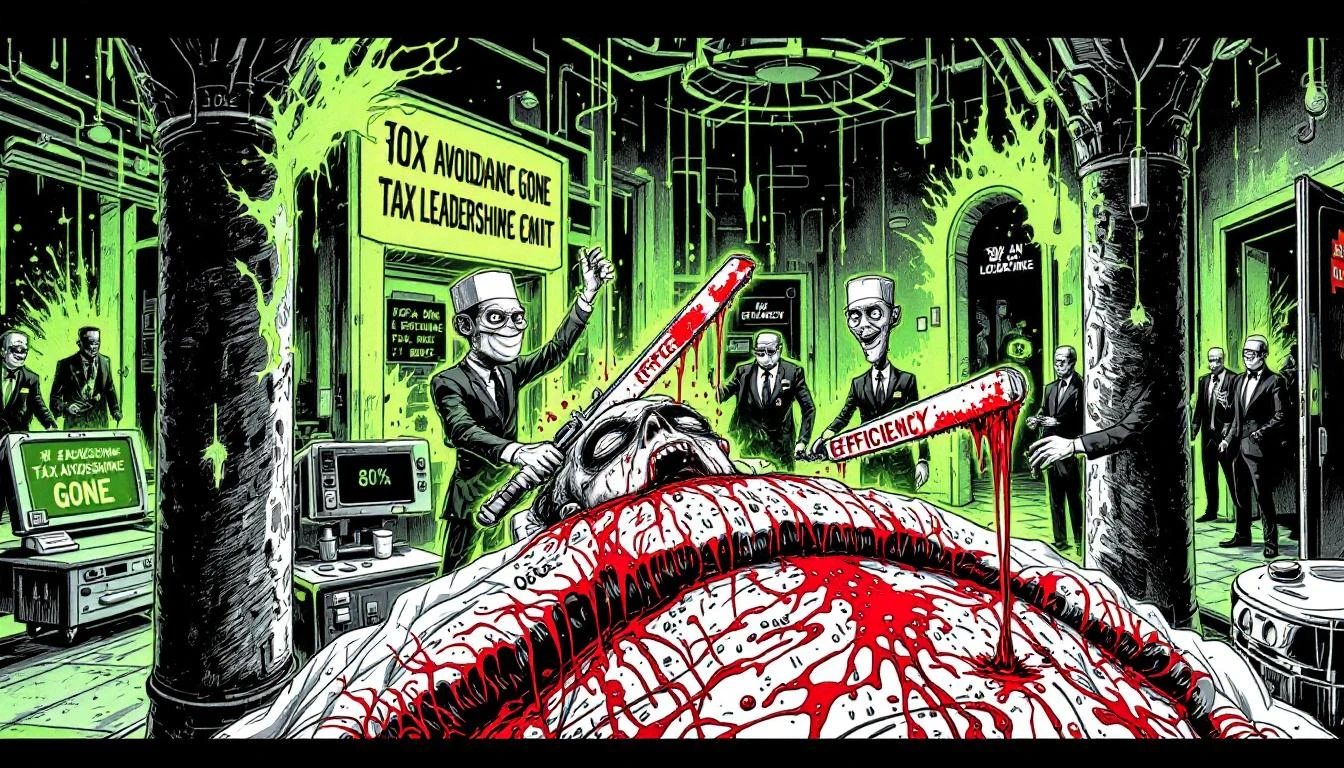
The IRS Bleeding Out: How to Defund Tax Collection While Claiming Efficiency
The Death Spiral Masquerading as Reform
Behold the masterpiece of administrative self-immolation: the Internal Revenue Service, that perpetually underfunded repository of America's collective tax anxiety, has just lost 40% of its IT workforce and a catastrophic 80% of its technology leadership in what officials are cheerfully calling an "efficiency shakeup."
Let that marinate in your frontal cortex for a moment. Eighty percent. Not of the dead weight, not of the redundant middle management bloat that actually exists in every government agency — no, we're talking about the people who understand how the systems work. The ones who know where the bodies are buried in the COBOL codebase. The institutional memory holders who remember why that one critical system can't be rebooted during tax season without triggering a cascade failure that would make the 2010 Flash Crash look like a minor hiccup.
The Efficiency Paradox
The term "efficiency" has become the great linguistic camouflage of our age — a Trojan horse containing nothing but institutional amnesia and future crisis. When bureaucrats speak of efficiency, they mean "we fired people who cost money." When those people happen to be the only ones who understand how your tax collection infrastructure actually functions, you haven't achieved efficiency. You've achieved a delayed-action catastrophe.
IRS CIO Kaschit Pandya delivered this news with the haunted cadence of a man watching his ship sink while officials on shore congratulate him on reducing the crew's payroll costs. The agency has lost a quarter of its overall workforce, but the IT division — that unglamorous backend keeping the whole Rube Goldberg machine of American taxation grinding forward — took the kill shot.
The Billionaire Tax Avoidance Dividend
Here's where the satire writes itself: At the exact moment when cryptocurrency millionaires are inventing new tax avoidance schemes faster than the IRS can hire forensic accountants, when private equity bros are structuring carried interest loopholes that would make a mob accountant blush, when the ultra-wealthy have turned tax optimization into a full-contact sport — we've decided to gut the referee's ability to even see the game.
The timing is so perfect it strains credulity. It's as if someone looked at the $688 billion tax gap — that's the difference between what Americans owe and what they actually pay — and thought, "You know what would help? Fewer people who understand how to catch the cheaters."
Every IT worker who walked out the door took with them knowledge of systems held together with institutional duct tape and prayer. These aren't Silicon Valley rockstars building the next disruptive AI-blockchain-quantum-whatever. These are the people who keep 60-year-old mainframes processing millions of tax returns without exploding. They understand dependencies that exist only in someone's head because the documentation was written during the Carter administration and lost during a server migration in 1997.
The DOGE Con
This massacre bears the fingerprints of the "Department of Government Efficiency" — that Orwellian fever dream where tech billionaires who've never managed anything more complex than a Series B pitch deck get to cosplay as management consultants to the federal government.
The playbook is grimly predictable: Identify "waste" (anything you don't understand), declare it "inefficient" (because you still don't understand it), then cut it ruthlessly while claiming you're "disrupting" government. Never mind that the IRS generates $7 for every $1 invested in enforcement. Never mind that the agency was finally starting to modernize after decades of criminal underfunding.
We've taken the organization responsible for collecting the revenue that funds literally everything else the government does, and we've performed emergency brain surgery with a hacksaw. In the name of efficiency.
The Coming Tax Season Apocalypse
Picture this year's tax season: Returns piling up in digital limbo because the systems that process them are maintained by a skeleton crew of survivors suffering from collective PTSD. Phone lines ringing unanswered because there's nobody left who knows how to fix the call routing system when it inevitably crashes. Refunds delayed for months because the fraud detection algorithms are throwing false positives and there's nobody left who understands how to tune them.
The wealthy will be fine, of course. They have accountants. Armies of them. The working stiff trying to claim the Earned Income Tax Credit? The small business owner navigating depreciation schedules? They're about to discover what "efficiency" really means: efficient transfer of their time and sanity into a bureaucratic black hole.
The Infrastructure Nobody Sees
Government IT is the unglamorous plumbing of civilization. Nobody thinks about it until it breaks, and by then it's too late. These aren't the jobs that make it into breathless TechCrunch articles or inspire hackers to work 80-hour weeks for equity that might be worth something someday. These are the jobs where you maintain systems that process the financial lifeblood of a nation, where uptime is measured in decades, where a bug doesn't just crash an app — it crashes the ability of 150 million Americans to fulfill their legal obligations.
The people who do this work are not replaceable cogs. They're the institutional memory of how things actually function beneath the org charts and mission statements. When 80% of your technology leadership vanishes, you don't just lose headcount. You lose the people who knew which systems were held together with bailing wire, which vendors were actually competent, which contractors were grifting, and which modernization initiatives would work versus which were consultant-driven money pits.
The Silicon Valley Delusion Comes to Government
There's a particular form of brain rot endemic to the tech industry: the belief that all systems are essentially the same, that complexity is always a sign of incompetence, and that anyone smart enough could rebuild anything in a weekend with the right framework and enough Red Bull.
This delusion works fine when you're building a social media app that maybe captures some market share and maybe crashes sometimes and who cares because you'll patch it in the next sprint. It's catastrophic when applied to systems that have to work, that process trillions of dollars, that are bound by decades of accumulated tax law, and that interface with every other major government system in ways both documented and lost to time.
But sure, let's gut the workforce and see what happens. What could possibly go wrong? It's not like the IRS is important or anything. It's not like tax collection is the fundamental prerequisite for everything else government does. It's not like we need revenue to pay for roads, defense, Social Security, or any of the other things that prevent civilization from collapsing into a Hobbesian nightmare.
The Terminal Diagnosis
This isn't efficiency. This is organizational sabotage disguised as reform. This is what happens when people who've never had to maintain legacy systems get to make decisions about them. This is the logical endpoint of decades of "government is the problem" rhetoric meeting the tech industry's reality distortion field.
The IRS will limp forward, processing returns more slowly, catching fewer cheats, hemorrhaging institutional knowledge with every retirement and resignation. The tax gap will widen. The complexity will increase. The frustration will mount. And then, inevitably, someone will point to the dysfunction and say, "See? Government doesn't work. We need more cuts. We need more efficiency."
It's the perfect crime: Create the crisis, blame the victim, profit from the chaos.
Welcome to the future of American governance, where efficiency means "faster collapse" and reform means "demolition." The IRS is bleeding out on the operating table while the surgeons congratulate themselves on reducing the patient's weight.
Mission accomplished.
The Oracle Also Sees...

The March of the Temporarily Embarrassed Billionaires: A Tech Bro's Passion Play for the Persecuted Rich
An AI startup founder organizes a march to defend billionaires from California's wealth tax — a bill already doomed to veto, attended by zero actual billionaires, fighting for paper fortunes he doesn't have.

Apple's Privacy Theatre: A Luxury Good That Dissolves on Contact With Authority
Apple's Hide My Email shields you from spam merchants but dissolves instantly for federal agents — privacy as luxury aesthetic rather than actual protection.

The Great AI Skills Grift: How Silicon Valley Learned to Quantify the Unquantifiable and Sell It Back to You
Silicon Valley's latest grift: Let AI manage your skills, quantify your worth, and provide algorithmic cover for the great workforce reduction. Spoiler—the real skill is spotting the con.