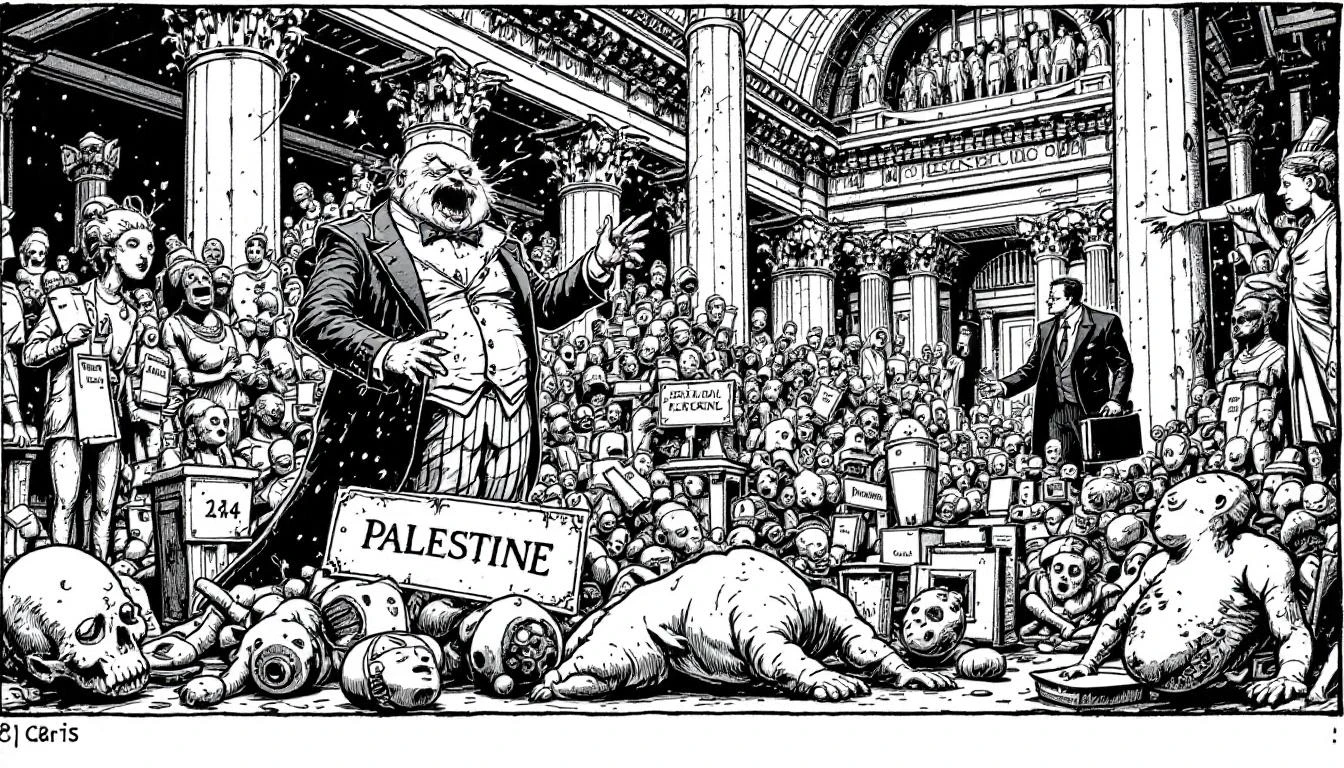
The British Museum Discovers Historical Accuracy After 271 Years of Cheerful Thievery
The Irony Gland Explodes
Behold the British Museum — that magnificent monument to imperial acquisition, that temple built on the theological principle that finders-keepers applies to nation-states with gunboats — has suddenly discovered a passionate commitment to historical precision.
After two and three-quarter centuries of displaying the Parthenon Marbles under labels that might as well read "We Took These Fair and Square (Don't Check the Receipts)," after generations of creative geography that transforms Egyptian tombs into "British Collections" through the miraculous alchemy of colonialism, the institution has finally found the hill it's willing to die on: the word "Palestine" on labels describing artifacts from 3,000 years ago.
The precision is breathtaking.
A Sudden Attack of Scruples
Following complaints from UK Lawyers for Israel that the term "Palestine" creates "a false impression of continuity" and "erases historical changes," the Museum has dutifully scrubbed references to Palestine from displays covering ancient Canaan, Judea, and the Levant. Because nothing says "commitment to historical accuracy" like responding to pressure campaigns about politically charged terminology while your basement remains stuffed with approximately 8 million objects that wandered into British possession during convenient periods of military occupation.
The Museum insists — insists, mind you — that this has nothing to do with the lobbying campaign. No, no. This is purely about "audience testing" which revealed that visitors found the term "Palestine" confusing. Presumably these same visitors were not confused by seeing Benin Bronzes behind British glass, or by the Rosetta Stone's curious journey from the Nile Delta to Bloomsbury. Those required no clarifying labels about historical discontinuity.
The Taxonomy of Theft vs. The Geography of Labels
Let's appreciate the exquisite calibration of institutional courage on display here. The British Museum will:
- NOT return the Elgin Marbles, despite Greek requests since 1832
- NOT repatriate the Benin Bronzes acquired during the 1897 punitive expedition (a phrase that does heavy lifting)
- NOT reconsider the Ethiopian treasures looted after the Battle of Magdala
- NOT acknowledge that "acquisition during colonial administration" is a euphemism with a body count
But it WILL engage in granular toponymic revisionism about whether a region should be called Palestine, Canaan, Judea, or "That Place We Have Stuff From."
The director claims the museum must maintain "precision and neutrality." Which raises the question: neutral between what, exactly? Between historical terminology used by Roman administrators and modern political lobbying groups? Between scholarly convention and donor relations?
The Archaeology of Bullshit
Here's what makes this particularly ripe: the term "Palestine" has been used to describe this region since Herodotus was taking notes. The Romans called it Syria Palaestina. The Byzantines called it Palaestina Prima and Secunda. The Ottomans administered it as part of their Palestinian provinces. The British themselves — yes, these British — ran the place as the "British Mandate for Palestine" from 1920 to 1948.
But sure, let's pretend that using "Palestine" as a geographic descriptor for the southern Levant is some kind of anachronistic political act, rather than, you know, what people have called the place for millennia.
The Museum argues that using one name "across thousands of years" creates false impressions of continuity. A fair point! One wonders if they'll apply this rigorous standard to their "Greek and Roman" galleries, since Greece and Rome both underwent rather significant political discontinuities. Perhaps we need separate wings for the Delian League, the Athenian Empire, the Macedonian period, and the various Hellenistic kingdoms?
No? Just Palestine then? How curiously selective.
The Cowardice of False Equivalence
This is institutional cravenness dressed up as scholarship. It's the museum equivalent of "many people are saying" — a way to make a political decision while pretending it's apolitical. The British Museum didn't remove "Palestine" because of new archaeological discoveries or revised scholarly consensus. They removed it because a well-funded lobbying group complained, and the institution decided that avoiding controversy was more important than maintaining consistent historical nomenclature.
Which would be almost respectable if they'd just admit it. Instead, we get this elaborate performance of objectivity, complete with references to "audience testing" and "precision" from an institution whose entire existence is predicated on the creative redefinition of ownership.
The Prophet Speaks
Here is your prophecy, delivered with the certainty of watching the same movie for the hundredth time:
The British Museum will continue to tie itself in rhetorical knots trying to appear neutral on politically charged issues while maintaining a collection that is, itself, a monument to centuries of decidedly non-neutral imperial policy. They will commission reports, conduct stakeholder consultations, and engage in extensive audience research — all of which will conclude that the path of least resistance is the path they should take.
They will not return the Parthenon Marbles. They will not empty the basement of its colonial acquisitions. They will not acknowledge that you cannot built a "universal museum" on particular acts of imperial violence and then claim to transcend politics.
But they will, absolutely, change labels when the phone rings.
Because in the end, the British Museum has learned nothing from 271 years of history except this: It's easier to erase words than to return objects. It's simpler to revise labels than to revise the fundamental premise of your existence.
And that, dear readers, is not historical precision.
That's just institutional cowardice with a thesaurus.
Coda: A Modest Proposal
Perhaps the British Museum should apply its newfound passion for historical accuracy to all its labels. Imagine:
- "Parthenon Sculptures (Removed During Ottoman Administration by British Ambassador Who Probably Exceeded His Authority, Definitely Exceeded Good Taste)"
- "Benin Bronzes (Acquired During Punitive Expedition, Term Used Loosely to Describe What Was Essentially State-Sanctioned Looting)"
- "Rosetta Stone (Seized from French Who Seized It From Egyptians, Creating a Provenance That Reads Like a Crime Spree)"
But no. That would require a different kind of courage entirely.
The kind they don't teach in museum studies programs.
The kind that might actually cost something.
The Oracle Also Sees...
The Ballpoint Barons and the Case of the Chauffeur Who Allegedly Knew Fra Angelico
Heirs to the Bic pen fortune are battling a Chilean billionaire over a Fra Angelico they didn't notice was missing for twelve years. The chauffeur did it, apparently. Or did he?
Twelve Records in One Night: The Sotheby's Method of Manufacturing Legitimacy
When Sotheby's breaks twelve auction records in a single night, they're not documenting market enthusiasm—they're revealing how completely they control the valuation machinery.
The Biennale of Short Memories: How Venice Learned to Stop Worrying and Love the Pavilion
Russia returns to Venice after four years, proving institutional memory lasts exactly as long as one exhibition cycle. Outrage has a shelf life; prestige is eternal.