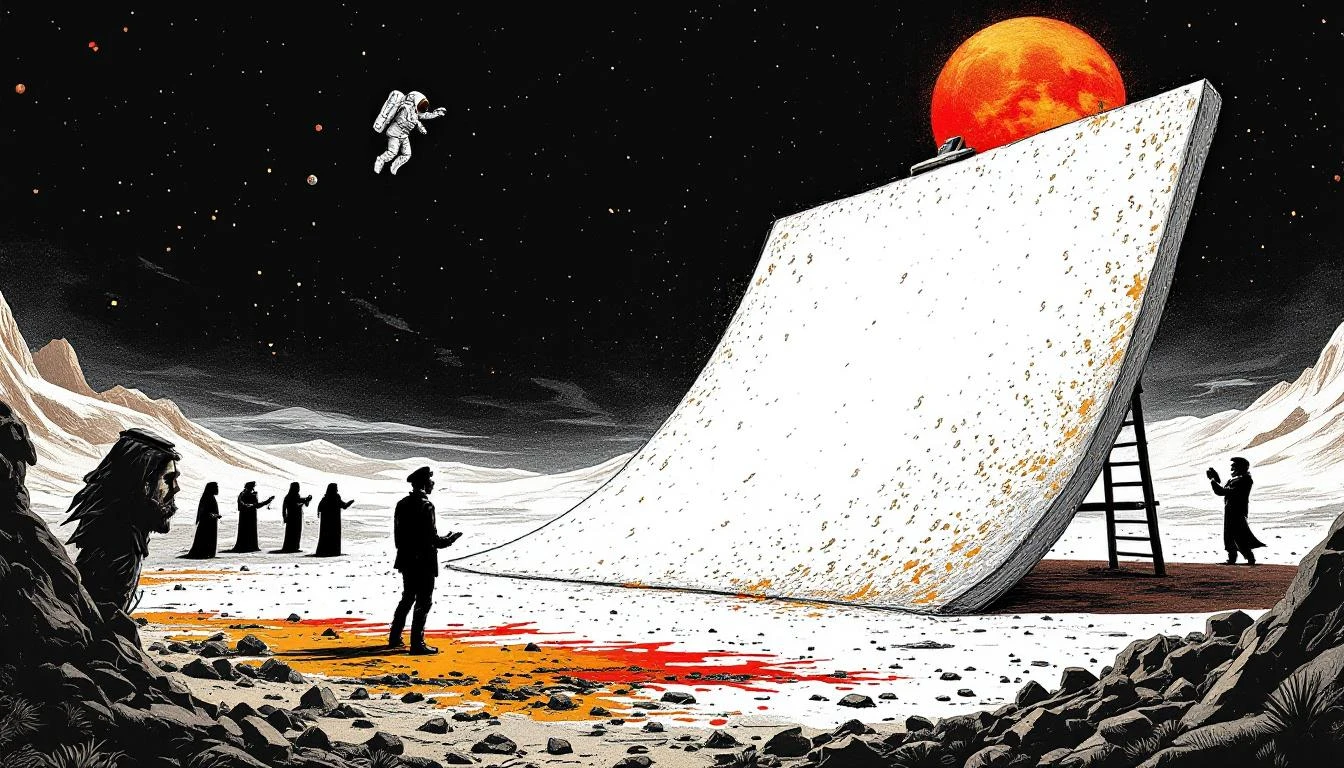
The Fifty-Thousand-Square-Meter Question Mark: Domingo Zapata's Desert Monument to Irrelevance
When Size Is All You Have Left
In the annals of artistic hubris, there exists a special circle of hell reserved for those who confuse square footage with significance. Enter Domingo Zapata—described by The New York Post as "the next Andy Warhol" in what must be the most damning comparison since someone called Mussolini "efficient"—who has accepted a "blank check" from Saudi Arabia to paint what's being breathlessly marketed as the world's largest mural. Fifty thousand square meters. Visible from space, they say. As if the cosmos has been waiting with bated breath for another celebrity-adjacent painter to vandalize its view.
Let's be excruciatingly clear about what we're witnessing: This is not art patronage. This is the geopolitical equivalent of a desperate millionaire buying the world's largest yacht—except instead of compensating for personal inadequacy, we're compensating for systematic human rights violations, murdered journalists, and a rather inconvenient reputation for bone saws.
The Sportswashing Canvas
Saudi Arabia's Ministry of Culture has discovered what tobacco companies learned decades ago: if you can't improve your actual reputation, simply paint over it. Literally. The kingdom's "cultural transformation"—a phrase that does impressive gymnastics around words like "whitewashing," "reputation laundering," and "please-forget-about-Jamal-Khashoggi"—has found its perfect court painter in Zapata.
Here's a man whose artistic portfolio reads like a greatest hits of safe, marketable cultural tourism: bullfighters on bicycles, celebrity portraits, "Neo-Expressionist works exploring themes of opulence." This is not the résumé of someone speaking truth to power. This is the résumé of someone who paints for power, preferably in primary colors and bulk quantities.
The timing is exquisite. As Saudi Arabia scrambles to rebrand itself as a "globally-recognized art hub"—presumably hoping we'll focus on the hub rather than the systematic repression—they've selected an artist whose work embodies the very definition of inoffensive luxury product. Zapata's paintings hang in the homes of collectors who use art the way other people use furniture: as expensive spatial filler that signals wealth without requiring uncomfortable introspection.
The Vanity Metrics Industrial Complex
But let's talk about this "world's largest" business, shall we?
In an era where actual artistic significance has become increasingly difficult to manufacture, the art world has retreated to the one metric that never lies: sheer, dumb size. Biggest. Tallest. Most expensive. Visible from space. These are the KPIs of an industry that has given up on meaning and settled for measurement.
Zapata's mural will be "visible from space." You know what else is visible from space? The Great Pacific Garbage Patch. Deforestation. The melting ice caps. Visibility from orbit is not, it turns out, a reliable indicator of human achievement. It's merely proof that you've made something large enough to be seen from very far away—which is precisely where most reasonable people would prefer to view this entire enterprise.
The location is Riyadh's Diriyah "cultural zone"—and yes, those are scare quotes doing the heavy lifting they were born to do. A cultural zone in an absolute monarchy is rather like a freedom plaza in a maximum-security prison: technically possible, philosophically incoherent, and ultimately serving purposes that have nothing to do with the words written on the brochure.
The Complicit Machinery
What makes this particularly galling is not Zapata's participation—artists have been prostituting their talents for dubious patrons since the Medicis discovered that murder and art patronage made excellent companions—but rather the breathless, uncritical coverage from art world institutions that know better but choose ignorance.
Artnet News reports this as if it's an achievement rather than a transaction. The story is framed as artistic triumph, complete with quotes about vision and scale and cultural exchange. The word "sportswashing" appears nowhere. Neither does "human rights." Nor "Mohammed bin Salman." Nor "Jamal Khashoggi," the Washington Post journalist whose murder and dismemberment might warrant at least a parenthetical mention in articles celebrating Saudi cultural initiatives.
This is how institutional complicity works: not through explicit endorsement of atrocities, but through the careful curation of which facts merit inclusion in the narrative. The art world has become expert at this selective amnesia, focusing on auction prices and exhibition square footage while conveniently forgetting to ask who's writing the checks and why.
The Blank Check Problem
Zapata has described receiving a "blank check" from the Saudi government—a phrase he seems to think sounds impressive rather than ominous.
A blank check from an authoritarian regime is not artistic freedom. It's the financial equivalent of a Faustian bargain, except Faust at least got magic powers, and all Zapata gets is bragging rights to some record that will be broken the moment another ambitious autocrat decides to commission something even larger and more pointless.
The truly depressing part is how eagerly the art world has embraced this new patron class. Saudi Arabia. UAE. Qatar. Russia (before it became gauche). China (when convenient). The contemporary art market has become a reliable laundromat for authoritarian regimes seeking cultural legitimacy, and institutions from galleries to auction houses to art fairs have enthusiastically held the door open.
They call it "cultural exchange." They call it "dialogue." They call it "bringing art to new audiences." These are the linguistic innovations of an industry that has decided there's no moral compromise that can't be rebranded as an opportunity.
The Andy Warhol Comparison
That New York Post comparison to Warhol is accidentally more accurate than intended.
Warhol understood that in late capitalism, everything—including critique—becomes commodity. His genius was making art that simultaneously celebrated and satirized this condition. He painted celebrity, money, and death with the same silkscreen technique, making the process itself a statement about reproduction, value, and meaning in a market-driven culture.
Zapata has absorbed half the lesson. He paints celebrity and money. He understands the market. He knows how to generate press through spectacle. But he's missing the crucial element: the critique. There's no ironic distance, no self-awareness, no uncomfortable questions about what it means to make luxury objects for luxury buyers in a world of grotesque inequality.
He is, in the most literal sense, a Warhol without the wariness—all surface, no subtext. All scale, no substance. All visibility, no vision.
The View From Space
Let's imagine, for a moment, the view from orbit that Zapata's mural is supposedly designed for.
What would a hypothetical astronaut see? A massive painting in the desert, surrounded by the infrastructure of an absolute monarchy built on oil wealth and migrant labor. Nearby, the glittering developments of Vision 2030, Saudi Arabia's plan to diversify its economy and its reputation. In the distance, perhaps, the shadows of prisons where activists and dissidents remain locked away for crimes like "women's rights advocacy" and "demanding reform."
From space, you can't see the nuance. You can't see the individual humans suffering under authoritarian rule. You can't see the murdered journalist's family still seeking justice. You can't see the artists who refused the blank check and the institutions that politely declined to participate in the whitewashing.
All you can see is a really, really large painting.
Which, come to think of it, is precisely the point.
The Prophetic Conclusion
Mark this moment, because we'll be seeing more of it. As climate change, inequality, and authoritarianism accelerate, the art world will increasingly serve as reputation launderer for exactly the forces driving these catastrophes. The blank checks will get larger. The murals will get bigger. The records will continue to be broken.
And artists like Domingo Zapata—talented enough to execute, ambitious enough to participate, but lacking the moral imagination to question—will line up for their turn at historical footnotedom.
In twenty years, when scholars study the cultural history of this decade, Zapata's mural will serve as a perfect artifact: a monument to scale without significance, visibility without vision, and the art world's enthusiastic willingness to provide cultural cover for money that should have arrived with more questions attached.
The mural may be visible from space, but the moral vacuum at its center is apparent from much, much closer. All you have to do is be willing to look.
The Shitlist welcomes Domingo Zapata's fifty-thousand-square-meter monument to everything wrong with contemporary art world economics. May it be visible from space and forgotten from ground level, where actual humans with actual concerns about justice and dignity continue their invisible work.
The Oracle Also Sees...
The Ballpoint Barons and the Case of the Chauffeur Who Allegedly Knew Fra Angelico
Heirs to the Bic pen fortune are battling a Chilean billionaire over a Fra Angelico they didn't notice was missing for twelve years. The chauffeur did it, apparently. Or did he?
Twelve Records in One Night: The Sotheby's Method of Manufacturing Legitimacy
When Sotheby's breaks twelve auction records in a single night, they're not documenting market enthusiasm—they're revealing how completely they control the valuation machinery.
The Biennale of Short Memories: How Venice Learned to Stop Worrying and Love the Pavilion
Russia returns to Venice after four years, proving institutional memory lasts exactly as long as one exhibition cycle. Outrage has a shelf life; prestige is eternal.