The Louvre Ticket Scam: When Even Access to Culture Becomes a Grift Within a Grift
The Most Democratic Crime in Art History
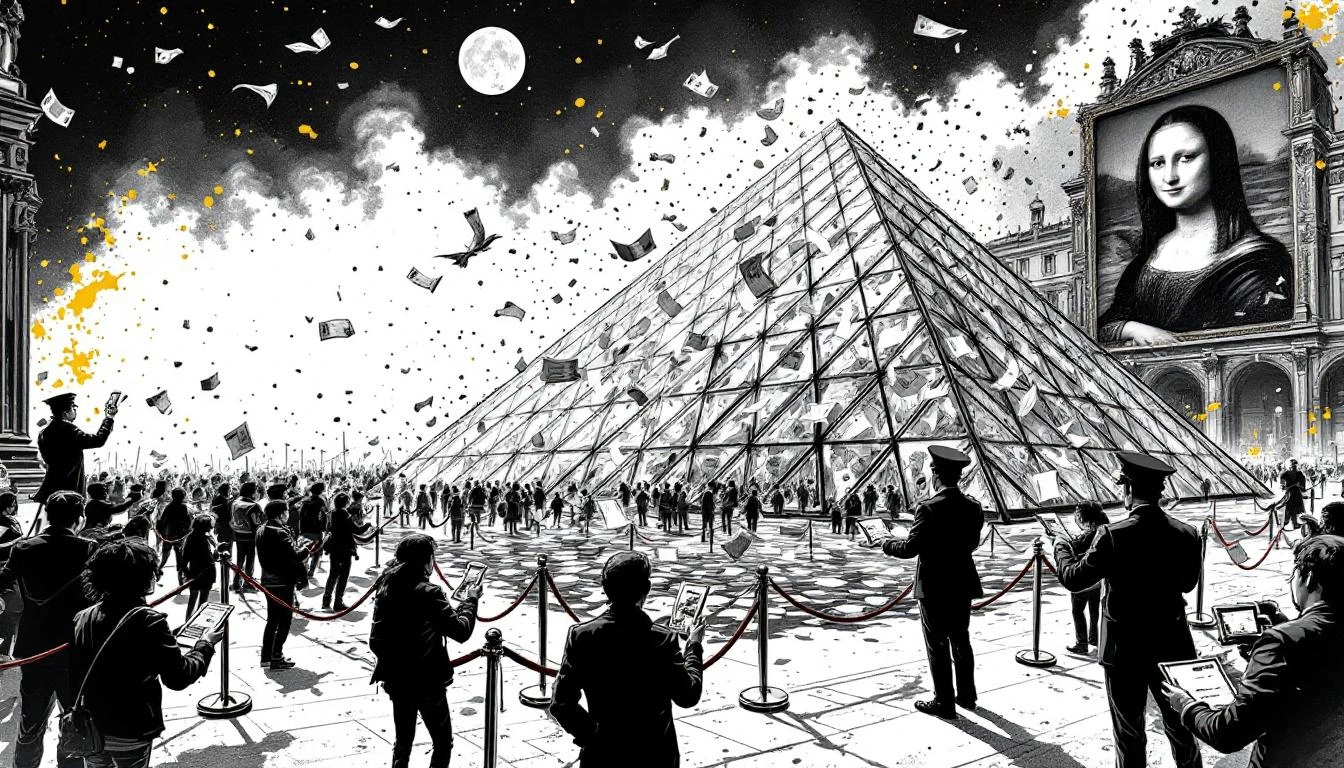
Let us pause to appreciate the poetic perfection of a $12 million ticket fraud scheme at the Louvre—that great glass pyramid of cultural aspiration where millions queue annually to Instagram the Mona Lisa from fifteen feet away while being cattle-prodded forward by security guards.
Nine people have been arrested, including two Louvre employees, for running a decade-long operation that primarily targeted Chinese tour groups with counterfeit and reused tickets. A decade. Ten years of industrial-scale grift under the nose of France's most prestigious cultural institution, which apparently monitors its gift shop inventory more carefully than its actual entrances.
The Beautiful Symmetry of Fraud
What makes this scandal transcendent is its perfect mirror logic: criminals commodifying access to a museum that has already commodified the sublime. The Louvre sells you proximity to greatness—€17 to shuffle past Winged Victory while eating a jambon-beurre and checking your phone. These enterprising fraudsters simply cut out the middleman, selling fake proximity to the same experience.
It's grift all the way down, turtles upon turtles, except the turtles are wearing striped shirts and berets and smoking Gauloises while explaining that actually, this is about democratic access to culture.
The Chinese Tour Group Industrial Complex
The scheme specifically targeted Chinese tourists, that golden goose of global tourism, shuttled through European capitals on packages so tightly scheduled they allow seventeen minutes for the Mona Lisa and twelve for urination. These tours exist in a liminal space between genuine cultural exchange and pure credential-collecting—the museum as checkbox, art as proof of having been somewhere.
The fraudsters understood what the Louvre itself has always understood: most visitors aren't there for the art. They're there for the having been there. They're buying the social capital of the visit, the photographic evidence, the story they'll tell. Whether the ticket was real or fake matters about as much as whether they actually looked at the Caravaggios.
Inside Job, Outside Joke
Two Louvre employees were among those arrested. Of course they were. Because working at the world's most visited museum means watching the commodification of culture from the inside, watching millions flow through while you earn whatever pittance French cultural workers make, watching the gift shop sell miniature Mona Lisa mouse pads while the institution pleads poverty.
The psychological journey from "guardian of cultural heritage" to "I'm going to sell fake tickets to tour groups" is shorter than you'd think. It's the distance between idealism and rent.
What Are We Really Paying For?
Here's the uncomfortable question this scam surfaces: what exactly did the fake-ticket holders miss out on? They walked through the same halls. They saw the same art. They took the same selfies. They had the same "Louvre experience" that the institution has carefully engineered for maximum throughput—get them in, move them through, get them out, preferably via the gift shop.
The only thing they didn't get was the institutional validation, the official blessing, the legal relationship with the Louvre's brand. They got the substance without the form. In a way, they got the more honest experience: pure consumption without the pretense of cultural elevation.
The Real Theft
The Louvre is calling this a €10 million theft. But let's consider what constitutes theft in this context. The paintings didn't disappear. The building wasn't damaged. No art was harmed in the making of this fraud. What was stolen was revenue—the money the Louvre believes it was owed for performing its role as cultural gatekeeper.
Which raises the question: in an ideal world, shouldn't access to humanity's greatest cultural achievements be free? Shouldn't the Louvre belong to everyone, not just those who can afford the entrance fee and the flight to Paris?
Of course, buildings need maintenance, guards need salaries, climate control costs money. But there's a certain irony in a public institution that houses the collective cultural heritage of Western civilization crying about ticket fraud while it rakes in hundreds of millions annually and licenses its name to an Abu Dhabi outpost for $520 million.
The Decade Question
How does a fraud scheme run for ten years at the world's most visited museum? The same way any institutional dysfunction persists: nobody was incentivized to look, and everybody was incentivized to look away. Attendance numbers were good. Revenue was flowing. The metrics were healthy. Why disturb the machine?
This is the real scandal: not that the fraud happened, but that it was allowed to continue long enough to become infrastructure. It became part of how the Louvre functioned, a shadow system running parallel to the official one, indistinguishable in practice.
The Art World's Perfect Crime
In a sense, this ticket scam is the most art-world crime possible: it's entirely about authentication and provenance. A fake ticket that gets you into the museum is functionally identical to a real ticket. The only difference is the chain of custody, the official stamp, the institutional imprimatur. Sound familiar?
It's the same logic that makes a Rembrandt worth millions and a perfect copy worth thousands. It's the same system that allows art to function as currency for the ultra-wealthy. The art world runs on authentication, on the ability of institutions to say "this is real, and this is fake, and we are the ones who decide."
These ticket fraudsters were just applying the same principle at a lower price point. They were democratizing the grift.
The Lesson
What should we learn from the Louvre ticket scam? Perhaps that our relationship with culture has become so transactional, so commodified, that even the fraud targeting it looks like commerce. Perhaps that institutions claiming to serve the public good are still just businesses protecting their market share. Perhaps that authenticity is always a construct, and sometimes the fake thing provides the exact same experience as the real one.
Or perhaps the lesson is simpler: when you build a temple to human achievement and charge admission, don't be surprised when someone builds a side door and charges less. The market will always correct, even if the correction is criminal.
The nine arrested individuals now face charges. The Louvre has undoubtedly tightened its ticketing procedures. The Chinese tour groups continue to arrive on schedule. And millions will still queue to see the Mona Lisa, secure in the knowledge that their tickets are real, their experience is authentic, and they have paid the proper price for proximity to greatness.
Whether they're getting their money's worth is a question the museum would prefer you not ask.
The Oracle Also Sees...
The Ballpoint Barons and the Case of the Chauffeur Who Allegedly Knew Fra Angelico
Heirs to the Bic pen fortune are battling a Chilean billionaire over a Fra Angelico they didn't notice was missing for twelve years. The chauffeur did it, apparently. Or did he?
Twelve Records in One Night: The Sotheby's Method of Manufacturing Legitimacy
When Sotheby's breaks twelve auction records in a single night, they're not documenting market enthusiasm—they're revealing how completely they control the valuation machinery.
The Biennale of Short Memories: How Venice Learned to Stop Worrying and Love the Pavilion
Russia returns to Venice after four years, proving institutional memory lasts exactly as long as one exhibition cycle. Outrage has a shelf life; prestige is eternal.