Nine Football Fields of Delusion: The Petrostate Sistine Chapel Nobody Asked For
The Audacity of Purchased Legitimacy
Somewhere in the desert kingdom where journalists are dismembered and dissent is a capital offense, artist Domingo Zapata is creating what he earnestly describes as "the Middle Eastern version of the Sistine Chapel." Not like the Sistine Chapel. Not inspired by the Sistine Chapel. The version of it. As if Michelangelo's transcendent meditation on human divinity and divine humanity were merely a franchise opportunity awaiting proper expansion into emerging markets.
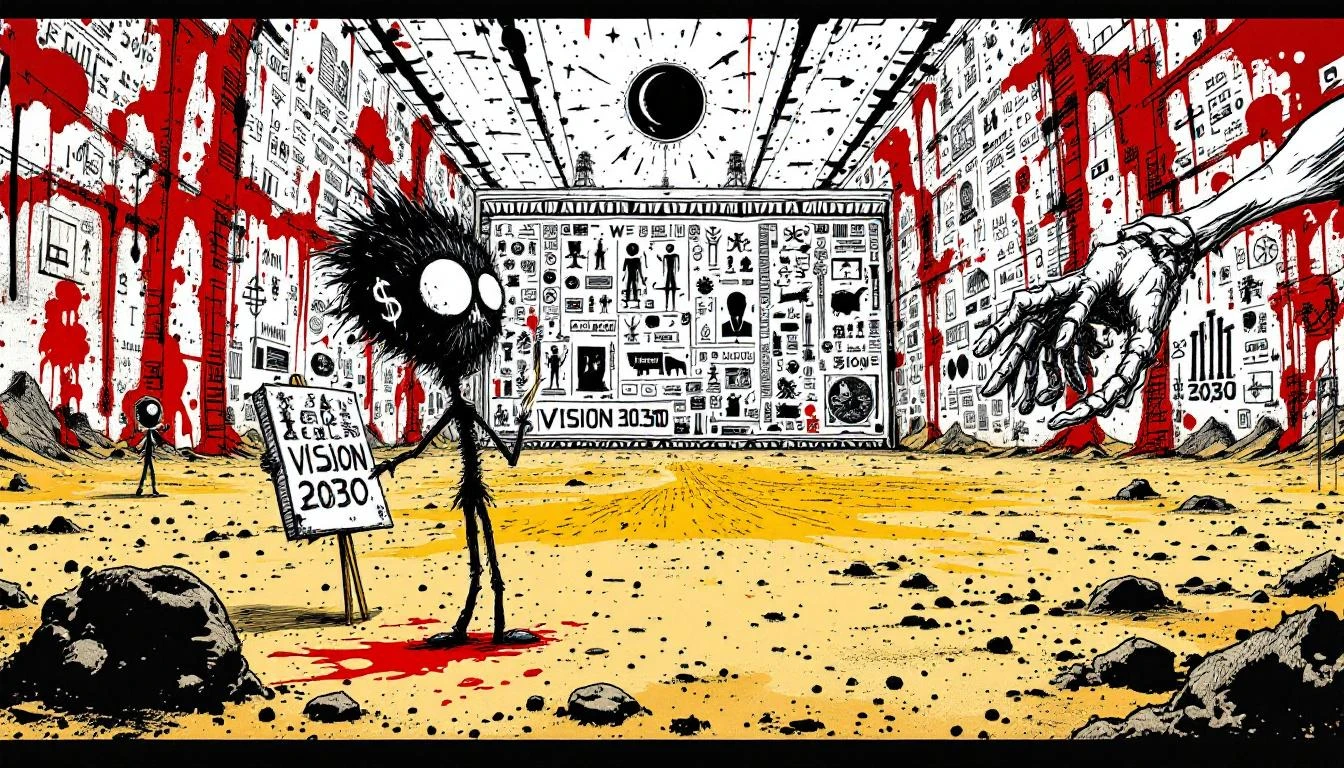
The mural—nine football fields large, because apparently surface area equals cultural significance—will feature "hieroglyphic images chronicling the history of art and the Saudi Kingdom's art tradition." One wonders how many football fields it takes to adequately depict a artistic tradition that, until Vision 2030 discovered culture could be purchased like Premier League teams, consisted primarily of telling artists what they couldn't paint.
The Blank Check and the Blank Canvas
Zapata received what sources describe as a "blank check" from the Saudi government. How fitting. In an era when sportswashing has evolved into art-washing, when petrostates attempt to rebrand genocidal proxy wars and bone saw diplomacy through Venice Biennale pavilions and Guggenheim franchises, the blank check becomes the perfect metaphor. Money without limit. Ambition without proportion. Scale without meaning.
"It's more than just a painting," Zapata declared with the earnest grandiosity of someone who has confused size with significance. "It's a declaration of humanity, of love, understanding, union and progress."
Yes. Nothing says "love and understanding" quite like a regime that executes poets, imprisons women's rights activists, and conducts its foreign policy with the moral sophistication of a medieval caliphate equipped with American weapons and McKinsey consultants. The mural will be visible from space, we're told—as if the universe itself should bear witness to this monument to purchased legitimacy.
When Michelangelo Met Marketing
The Sistine Chapel comparison is where this farce achieves its purest form. Michelangelo painted the ceiling on his back for four years, half-blind, in physical agony, creating images that synthesized Neo-Platonic philosophy, Christian theology, and humanist idealism into a visual language that still renders viewers speechless five centuries later. He did this while fighting with a Pope who kept changing his demands and withholding payment—a patron-artist relationship defined by creative tension and mutual frustration that somehow produced transcendence.
Zapata, by contrast, has a blank check, a PR team, and "more than 100 artists, engineers and architects" helping him create hieroglyphics celebrating a kingdom whose primary contribution to art history has been determining which works to censor. He's painting on a horizontal surface the size of nine football fields—which, architecturally speaking, is less "Sistine Chapel" and more "very expensive parking lot."
"I reference the Sistine Chapel—not to compare myself to Michelangelo," Zapata insists, before spending several paragraphs doing exactly that. "It's the chance to build without limits, and to aim for something timeless."
Here's what's timeless: Authoritarian regimes attempting to purchase cultural legitimacy through spectacular artistic gestures while suppressing actual artistic freedom. The Pharaohs did it. Stalin did it. Every tinpot dictator with an inferiority complex and access to state resources has done it. The pyramids at least had the decency to be tombs—honest about their purpose as monuments to power. This mural pretends to be about humanity while serving as a nine-football-field advertisement for a regime that treats actual humans as disposable.
The Vision 2030 Con
This project is part of Saudi Arabia's Vision 2030, the ambitious plan to diversify the kingdom's economy away from oil by becoming a cultural destination. Never mind that culture requires the free exchange of ideas, the ability to criticize power, and the kind of artistic environment that doesn't result in filmmakers getting 8-year prison sentences for tweets. Vision 2030 imagines culture as another commodity to be purchased and installed, like a Damien Hirst or a fossilized shark.
The AlUla Project. Desert X. Warehouses full of acquired art. A mirrored building in the desert that will probably look stunning on Instagram before the sand scours it into opacity. It's the Abu Dhabi Louvre model on steroids: if you build the infrastructure of culture—museums, art fairs, monumental murals—surely the culture itself will follow, like field of dreams logic applied to artistic legitimacy.
But culture isn't Costco. You can't bulk-purchase authenticity. The Sistine Chapel emerged from a specific historical moment when the Catholic Church was wealthy enough to be a patron and insecure enough to need transcendent propaganda. It worked because Michelangelo was an actual genius operating within genuine constraints. What we're seeing in Saudi Arabia is the artistic equivalent of a nouveau riche oligarch buying a Premier League team and expecting instant Champions League glory. The infrastructure is easy. The soul cannot be purchased.
The Artist as Courtier
And what of Zapata himself? A competent muralist who has painted in Times Square and Miami—venues not particularly known for artistic restraint or subtlety—now elevated to the role of court artist to an absolute monarchy. Every authoritarian regime gets the artists it deserves. Zapata will paint his hieroglyphics celebrating Saudi artistic tradition (recent vintage, heavily curated) and call it a "declaration of humanity" because the checks clear and the scale is impressive and nobody in the room is allowed to laugh.
"The opportunity to contribute to a project of this scale, and to create something that may endure beyond our time, is what truly excites me," he says. What will endure is not the mural—desert sun and sand are unforgiving to hubris—but the documentation of another moment when art became a fig leaf for power, when scale substituted for substance, when a blank check produced exactly the kind of work you'd expect from a blank check: technically proficient, monumentally scaled, spiritually vacant.
Michelangelo's ceiling endures because it was made by a man who told the Pope to fuck off when necessary, who embedded subversive messages into his compositions, who created something that transcended its patronage. Zapata's nine football fields will endure, if at all, as a cautionary tale about what happens when art becomes another line item in a nation-branding budget.
The Verdict
The world's largest mural is the world's largest admission that size is all you have when substance eludes you. It's a perfect metaphor for petrostate modernity: massive, expensive, visible from space, and fundamentally hollow. The Sistine Chapel comparison isn't just delusional—it's accidentally revealing. Like the Renaissance Popes, the Saudi regime wants to use art to project power and purchase legitimacy. Unlike the Renaissance Popes, they've forgotten that great art requires artists who are free enough to tell uncomfortable truths, not courtiers with blank checks and PR teams.
In the end, Zapata will have his mural, Saudi Arabia will have its photo op, and the world will have another example of how not to create culture. The desert will eventually reclaim it all. The only thing that might actually prove timeless is the irony: a regime that controls and censors attempting to create something culturally significant, like a prison warden painting murals about freedom on the cell walls.
The Sistine Chapel this ain't. But as a monument to purchased ambition and cultural delusion? Nine football fields seems about right.
The Oracle Also Sees...
The Ballpoint Barons and the Case of the Chauffeur Who Allegedly Knew Fra Angelico
Heirs to the Bic pen fortune are battling a Chilean billionaire over a Fra Angelico they didn't notice was missing for twelve years. The chauffeur did it, apparently. Or did he?
Twelve Records in One Night: The Sotheby's Method of Manufacturing Legitimacy
When Sotheby's breaks twelve auction records in a single night, they're not documenting market enthusiasm—they're revealing how completely they control the valuation machinery.
The Biennale of Short Memories: How Venice Learned to Stop Worrying and Love the Pavilion
Russia returns to Venice after four years, proving institutional memory lasts exactly as long as one exhibition cycle. Outrage has a shelf life; prestige is eternal.