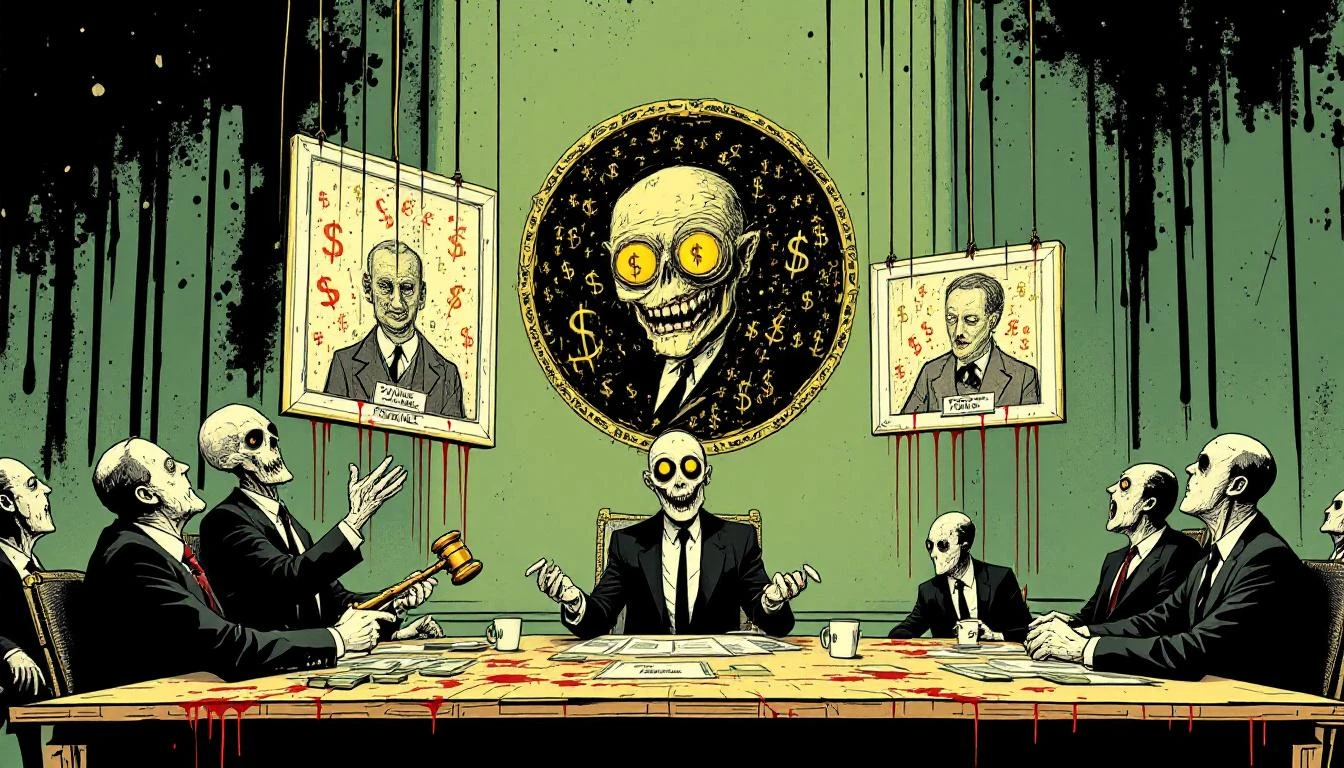
The Pedophile's Art Advisory: How Jeffrey Epstein Became the Art World's Favorite Money Launderer
The Pedophile as Connoisseur
Turns out the art world's dirty little secret wasn't so secret after all. While the rest of civilization was busy being horrified by Jeffrey Epstein's industrial-scale sexual predation, the blue-chip galleries, white-glove auction houses, and museum trustees were responding to his emails with the alacrity normally reserved for actual human beings.
Six hundred and seventy-three times Jack Lang's name appears in the Epstein files. The former French culture minister—architect of France's contemporary art establishment—was corresponding with a convicted sex offender with the frequency of a teenage girl texting her crush. Lang finally resigned from the Arab World Institute in February 2024, presumably after someone explained to him that "I didn't know he was that kind of monster" doesn't play well when the monster was literally convicted in 2008.
But Lang is merely the most spectacular crash. The real story is how Epstein functioned as the art world's favorite fixer for half a decade after his conviction—arranging billion-dollar deals, orchestrating private sales, managing Leon Black's $2.8 billion art portfolio like some demented combination of Larry Gagosian and Meyer Lansky.
The Billionaire's Laundromat
Leon Black—Apollo Global Management titan and collector extraordinaire—paid Epstein $158 million for "tax advice" between 2012 and 2017. Let's be clear about what "tax advice" means when you're parking $2.8 billion in Cézannes and Picassos: it means converting liquid assets into illiquid masterpieces, then using those masterpieces as collateral for loans that somehow avoid triggering capital gains, all while the art appreciates in climate-controlled storage facilities that double as offshore tax shelters.
The emails reveal Epstein's sophisticated orchestration of shared ownership schemes between Black and Ronald Lauder—the Estée Lauder heir and MoMA chairman—where paintings would ping-pong between their collections in precisely timed intervals. Not because they wanted to stare at Cézanne's "Château Noir" for two-and-a-half years before getting bored, but because the transfer schedules aligned perfectly with tax optimization strategies that would make a Cayman Islands hedge fund manager weep with envy.
Black estimated it would "be that long before his new townhouse is ready," wrote his art counsel to Epstein in 2014, as if the primary function of owning a $100 million painting is figuring out which climate-controlled vault to store it in while you wait for your Manhattan palazzo to be renovated.
The Gallery as Pawn Shop
Epstein wasn't just moving money—he was creating it. The emails show him strategizing about buying directly from artists, cutting out galleries and fairs entirely. This isn't revolutionary; it's what drug cartels do when they eliminate middlemen. Vertical integration of the supply chain.
He consulted with Simon de Pury, the Swiss auctioneer who once ran Phillips and Sotheby's Europe, on valuations and market timing. He corresponded with art advisors about Leonardo's "Salvator Mundi"—the $450 million question mark that may or may not be a Leonardo, may or may not be hanging in a Saudi yacht, and definitely represents everything wrong with the contemporary art market's transformation into a speculative asset class for kleptocrats and oligarchs.
Most tellingly, Epstein felt comfortable enough with journalist Landon Thomas Jr. to float theories about diffusing media attention on his sex crimes. The same journalist he was pumping for art market intelligence. Because in the art world, the Venn diagram between "respected cultural commentator" and "useful idiot for a sexual predator" apparently has significant overlap.
Jeff Koons Showed Up for Dinner
Of course Jeff Koons attended Epstein's 2013 dinner party. Why wouldn't he? Koons—the artist who turned kitsch into high concept and high concept into nine-figure auction results—embodies the art world's transformation from cultural institution to luxury goods manufacturer. His presence at Epstein's table, years after the 2008 conviction, is less scandal than symptom.
The art world doesn't care about your criminal record if you're rich enough, connected enough, or useful enough. It cares about liquidity, provenance, and whether you can move inventory at Art Basel. Epstein could do all three.
The Institutional Complicity
What the emails really reveal is how thoroughly financialized the art market has become. We're not talking about collectors who love art. We're talking about portfolio managers who've discovered that Modigliani nudes appreciate faster than municipal bonds and offer better tax advantages than real estate.
The auction houses, galleries, and advisors who entertained Epstein's inquiries weren't naive. They were complicit. They knew exactly who he was—the conviction was public record, the victims' testimony was searing—and they responded to his emails anyway because he represented billions in potential transactions.
This is the rot at the center of the contemporary art world: the complete erasure of any pretense that art exists for culture, beauty, or human expression. It's a storage mechanism for illicit wealth, a money-laundering operation dressed up in Artforum rhetoric and MFA credentials.
Who Are We Making Art For?
Hyperallergic's Hrag Vartanian asks the question everyone should be asking: "Who are we making art for?" The Epstein files provide the answer in brutal clarity: We're making it for tax shelters. For billionaires who need to park wealth in assets that appreciate while avoiding capital gains. For collectors who trade masterpieces like baseball cards, timing their acquisitions and sales to optimize their balance sheets.
We're making it for people who attend dinner parties with convicted pedophiles because the networking opportunities outweigh the moral hazard.
The art world likes to present itself as the conscience of civilization—the keepers of beauty, the guardians of culture, the sophisticated arbiters of meaning in a barbarous age. But strip away the catalog essays and the institutional prestige, and you find the same structures that enable every other form of elite criminality: selective blindness, motivated ignorance, and an ironclad commitment to never asking questions that might interrupt the money flow.
The Reckoning That Won't Come
Jack Lang resigned. Leon Black "stepped down" from MoMA's board in 2021. The art world will make solemn pronouncements about learning from this episode and implementing better vetting procedures.
Nothing will change.
Because the art market's entanglement with Epstein wasn't an aberration—it was a feature. The same opacity that allowed him to operate his advisory business is what makes the art market attractive to every other form of dirty money. The same discretion that protects collector privacy protects money launderers, sanctions evaders, and kleptocrats.
The galleries will keep selling. The auction houses will keep hammering. The advisors will keep advising. And somewhere, in a climate-controlled vault in Geneva or Singapore, a $100 million Picasso will serve as collateral for a loan that helps some billionaire avoid paying taxes while they wait for their townhouse renovation to finish.
Jeffrey Epstein understood the art world perfectly: It's not about the art. It never was. It's about the structures that allow wealth to move invisibly, appreciate reliably, and maintain plausible deniability about where it came from and where it's going.
He was the perfect art advisor because he understood that in the contemporary art market, beauty is just the wrapper on the bond. And the bond always pays.
The Oracle Also Sees...
The Ballpoint Barons and the Case of the Chauffeur Who Allegedly Knew Fra Angelico
Heirs to the Bic pen fortune are battling a Chilean billionaire over a Fra Angelico they didn't notice was missing for twelve years. The chauffeur did it, apparently. Or did he?
Twelve Records in One Night: The Sotheby's Method of Manufacturing Legitimacy
When Sotheby's breaks twelve auction records in a single night, they're not documenting market enthusiasm—they're revealing how completely they control the valuation machinery.
The Biennale of Short Memories: How Venice Learned to Stop Worrying and Love the Pavilion
Russia returns to Venice after four years, proving institutional memory lasts exactly as long as one exhibition cycle. Outrage has a shelf life; prestige is eternal.