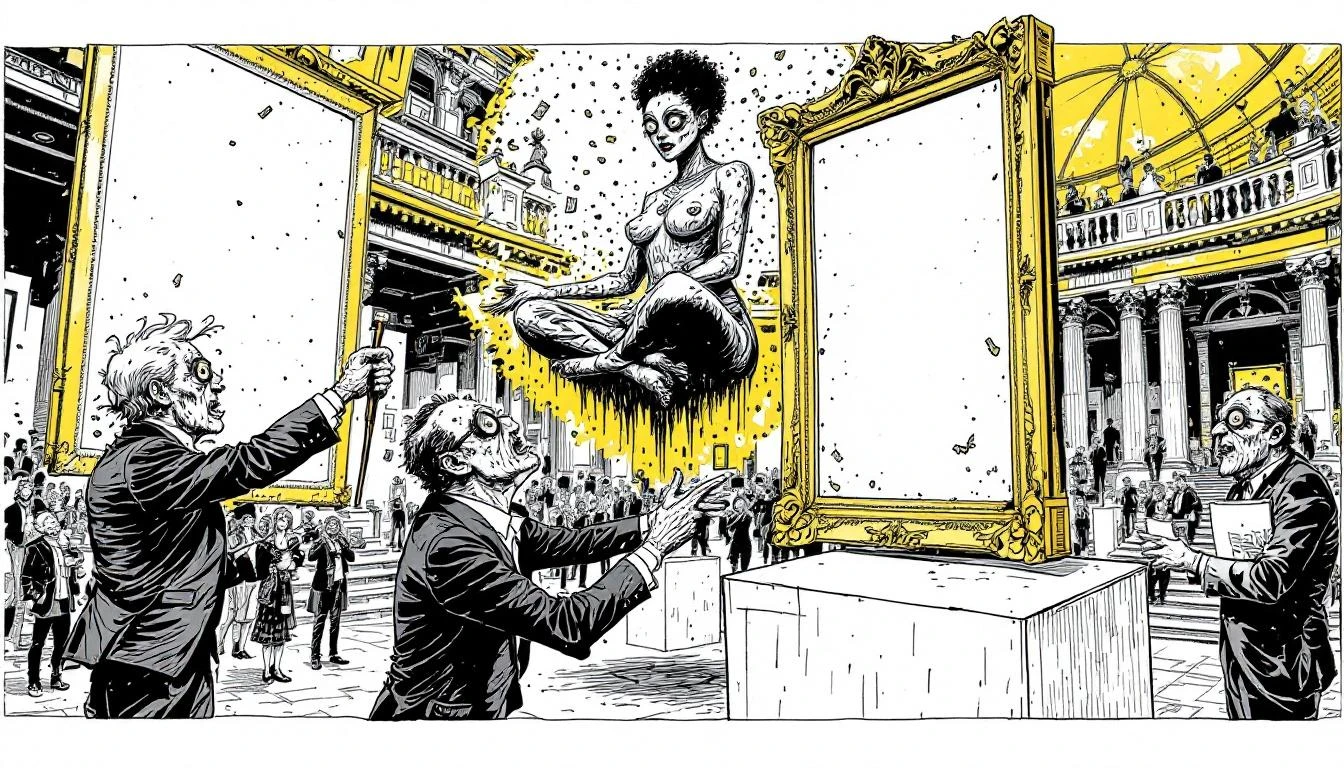
The Performance Art Ponzi Scheme: A Field Guide to Selling the Unsellable
The Emperor's New Invoice
Somewhere in Chelsea right now, a gallerist is explaining to a hedge fund manager why standing motionless for eight hours is worth $250,000. Not the experience of standing motionless—anyone can do that for free at the DMV. No, what's being sold here is the certificate that says you own the concept of someone else having stood motionless. It's metaphysical strip-mining dressed up as radical gesture, and brother, business is booming.
Welcome to the performance art marketplace, where the product doesn't exist, the value is theoretical, and the only thing more ephemeral than the artwork is the gallerist's ability to explain what you actually bought.
The Authenticity Racket
Performance art emerged in the 1960s as a middle finger to commodity culture. Fluxus and Happenings were designed to be un-sellable, un-collectable, un-commodifiable. They were supposed to exist outside capitalism's greasy clutches.
Fast forward sixty years: Marina Abramović's "The Artist Is Present" now comes with signed certificates, archival documentation, and a lawsuit if you try to re-perform it without permission. The revolution has been notarized.
The mechanics are deliciously absurd. You're not buying the performance—that already happened, or will happen, or exists in some quantum state between intention and execution. What you're buying is:
- A certificate of authenticity (laser-printed gravitas)
- Archival documentation (expensive photographs of something that deliberately rejected photography)
- Instructions for re-performance (like IKEA furniture, but for pretension)
- The "rights" to the work (intellectual property law meets interpretive dance)
It's NFTs before NFTs existed, except the blockchain is a gallerist's Rolodex and the gas fees are champagne at the opening.
The Artist's Rider: A Love Story
My favorite documents in contemporary art are performance artists' riders. These magnificent manifestos of narcissism make Van Halen's brown M&M clause look reasonable.
One prominent performance artist requires:
- Organic cashews (roasted, unsalted)
- Exactly seven white roses (no thorns, stems cut to 12 inches)
- A private meditation space with north-facing windows
- Alkaline water at 7.8 pH
- Absolute silence during preparation (enforced by gallery staff)
- $50,000 appearance fee (plus expenses, plus percentage of sales of documentation)
All this to watch someone sit in a chair and make eye contact with strangers for six hours. The Stations of the Cross had better production value.
Market Mechanics: The Weak Link
As one dealer told the New York Times: "Dealers just use performance as a hook to sell the work of other artists." Translation: Performance art is a loss leader. It's the rotisserie chicken at Costco—gets people in the door, but you make your money on the imported Parmigiano-Reggiano and the sculpture in the back room.
The auction houses have figured out their angle: sell the ephemera. Christie's and Sotheby's aren't auctioning performances; they're auctioning the props, the costumes, the preparatory drawings. It's like selling Elvis's sweat-stained scarves instead of his music. The fetish object as placeholder for the vanished gesture.
Phillips, meanwhile, brands itself as "the most digitally fluent," which means they've figured out how to sell you a video of something that was supposed to transcend documentation. It's death by Instagram, monetized.
The Collector's Dilemma
What do you actually do with performance art you've purchased?
You can't hang it on your wall. You can't rotate it into your Aspen chalet. You can't loan it to a museum without complex insurance nightmares and the artist's approval (which may or may not be forthcoming, depending on whether they've decided you're sufficiently aligned with their values this quarter).
What you can do is:
- Display the certificate in your climate-controlled vault
- Bore dinner guests with stories about "owning" a Tino Sehgal (who famously refuses all documentation)
- Commission a re-performance for your daughter's bat mitzvah
- Use it as collateral for an art loan (good luck with that appraisal)
According to the Art Basel/UBS survey, 25% of collectors now plan to donate their works. That number climbs to 87% when the work is performance art they realized they can't actually display, sell, or explain to their accountant.
The Gallerist's Patter
I've witnessed these sales pitches. They're poetry:
"What you're acquiring isn't an object, but a relationship with temporal disruption."
"The work exists in the space between commodification and resistance."
"By purchasing this certificate, you become a collaborator in the ongoing discourse around presence and absence."
Translation: "Give me $100,000 for this piece of paper, and I'll tell everyone at the next Basel that you 'get it.'"
The gallerist's job is to make you feel like not buying is a failure of imagination. That understanding performance art's value proposition is a marker of sophistication. That owning something nobody can see proves you're more evolved than those peasants buying actual paintings.
It's three-card monte played at the graduate seminar level.
The Real Performance
Here's the joke: The actual performance art isn't happening in the gallery. It's happening in the back office, where gallerists convince collectors to pay six figures for air and memory. That's the performance. The artist standing motionless is just the opening act.
The real durational piece is the decades-long con of convincing the market that ephemeral gestures designed to escape commodification can be commodified after all. It's a magic trick: making something from nothing, then selling the nothing for something, then writing it off on your taxes.
Marina Abramović understood this perfectly when she sat at MoMA while thousands lined up to sit across from her. The work wasn't her sitting there. The work was watching people invest a six-hour wait with meaning because someone told them it was art. The performance was the audience performing being moved.
And when MoMA sold tickets? When galleries sold certificates? That was the real performance art: watching capitalism swallow its own tail and call it transcendence.
The Exit Strategy
The 2025 market data tells a beautiful story: Selling intentions for performance works have dropped from 55% to 25%. Not because values are rising—because sellers have realized there's no secondary market. You can't flip a Tino Sehgal the way you flip a Basquiat. There's no comparable sales data. No price discovery mechanism. No exit strategy except hope.
What you can do is leverage it as collateral (good fucking luck), or donate it and take the tax write-off based on some appraiser's fever dream of what an uncollectable artwork might theoretically be worth.
The ultimate performance: making your accountant explain to the IRS why standing still is worth a quarter million dollar deduction.
Coda: The Certificate Is the Con
In the end, performance art's commodification reveals the art market's essential truth: You're never buying the art. You're buying your position in a social hierarchy that uses art as its currency. The certificate isn't proof of ownership—it's proof of membership.
The performance artists knew this from the start. They tried to make work that couldn't be bought or sold. The market's response? "Hold my champagne."
Now we have blockchain certificates for gestures, NFTs of happenings, and lawyers arguing about who owns the right to stand still in a specific way. It's conceptual art's final joke: The concept you're buying is that you bought something.
The performance art market isn't selling art. It's selling the performance of buying art. And if you paid six figures for that certificate, congratulations—you just became the artwork.
The reviews are in: You're hilarious.
The Oracle Also Sees...

The Ballpoint Barons and the Case of the Chauffeur Who Allegedly Knew Fra Angelico
Heirs to the Bic pen fortune are battling a Chilean billionaire over a Fra Angelico they didn't notice was missing for twelve years. The chauffeur did it, apparently. Or did he?
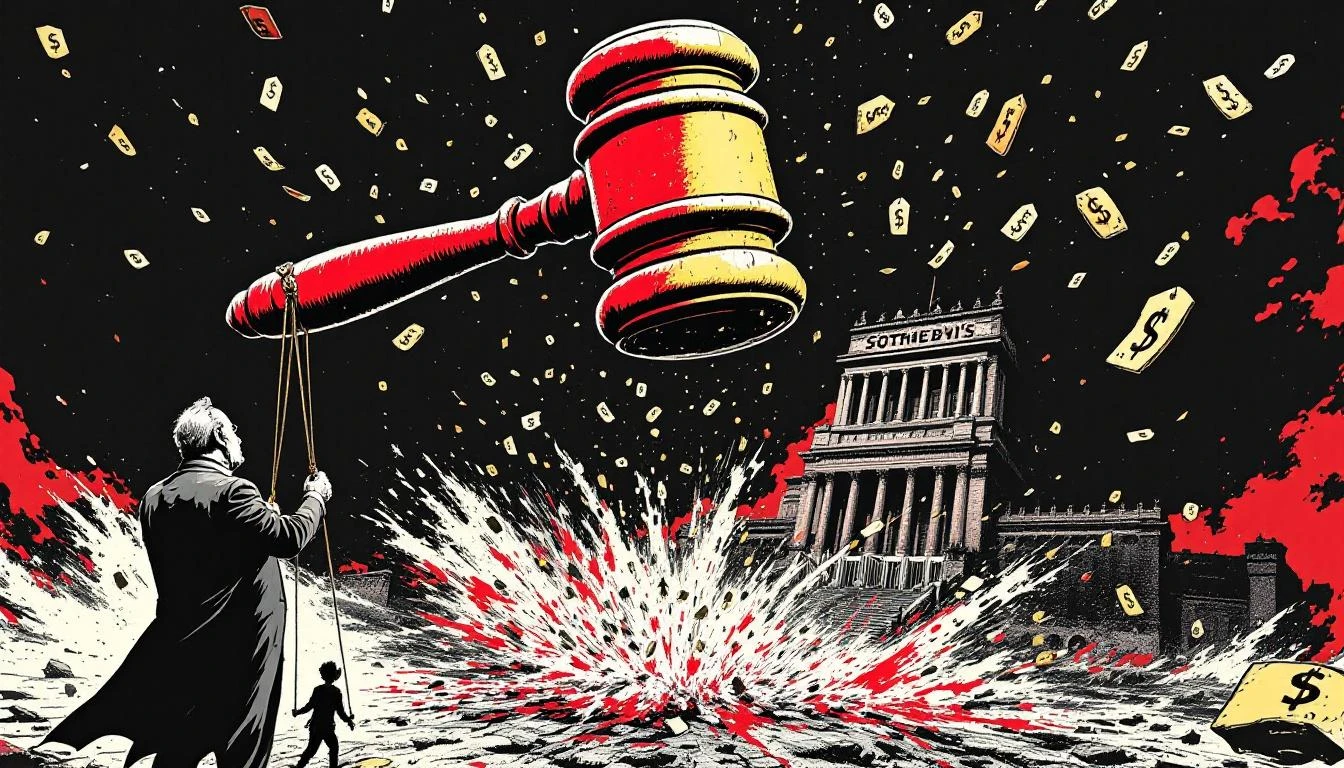
Twelve Records in One Night: The Sotheby's Method of Manufacturing Legitimacy
When Sotheby's breaks twelve auction records in a single night, they're not documenting market enthusiasm—they're revealing how completely they control the valuation machinery.
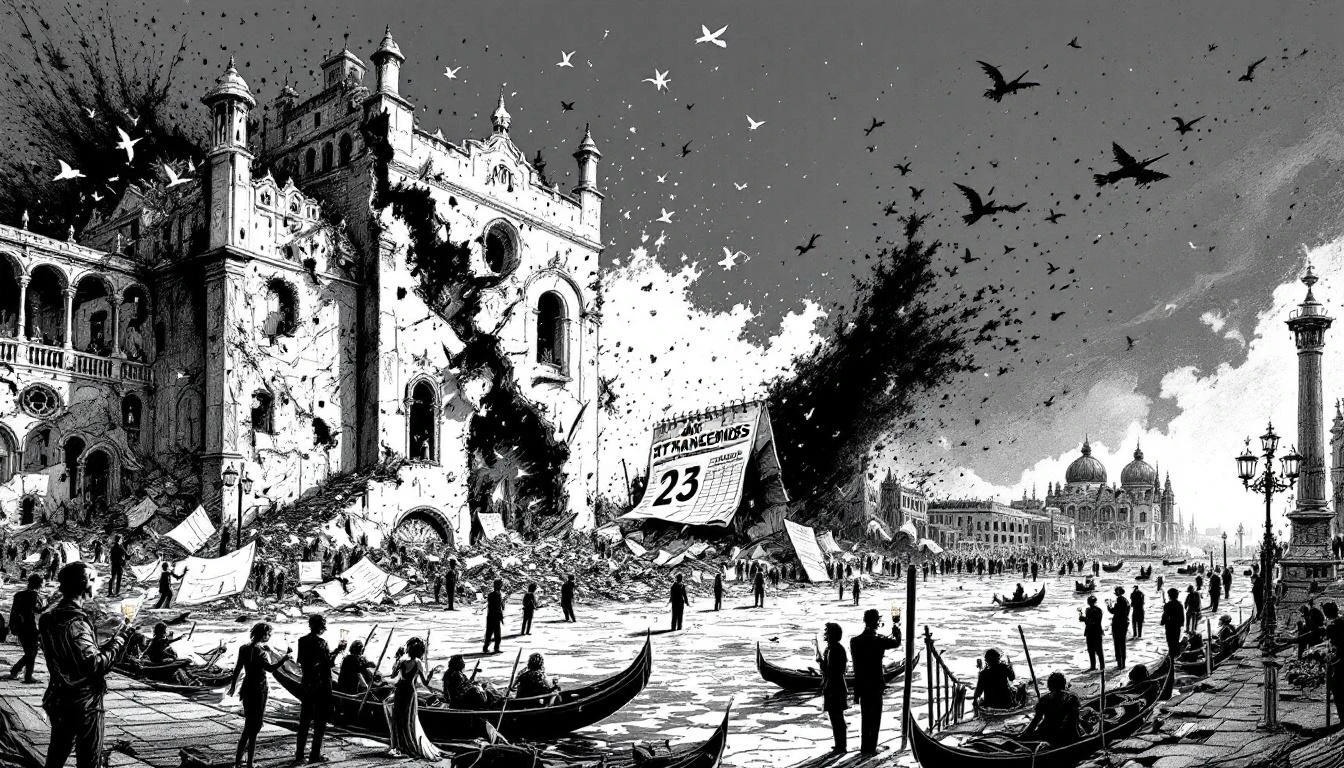
The Biennale of Short Memories: How Venice Learned to Stop Worrying and Love the Pavilion
Russia returns to Venice after four years, proving institutional memory lasts exactly as long as one exhibition cycle. Outrage has a shelf life; prestige is eternal.