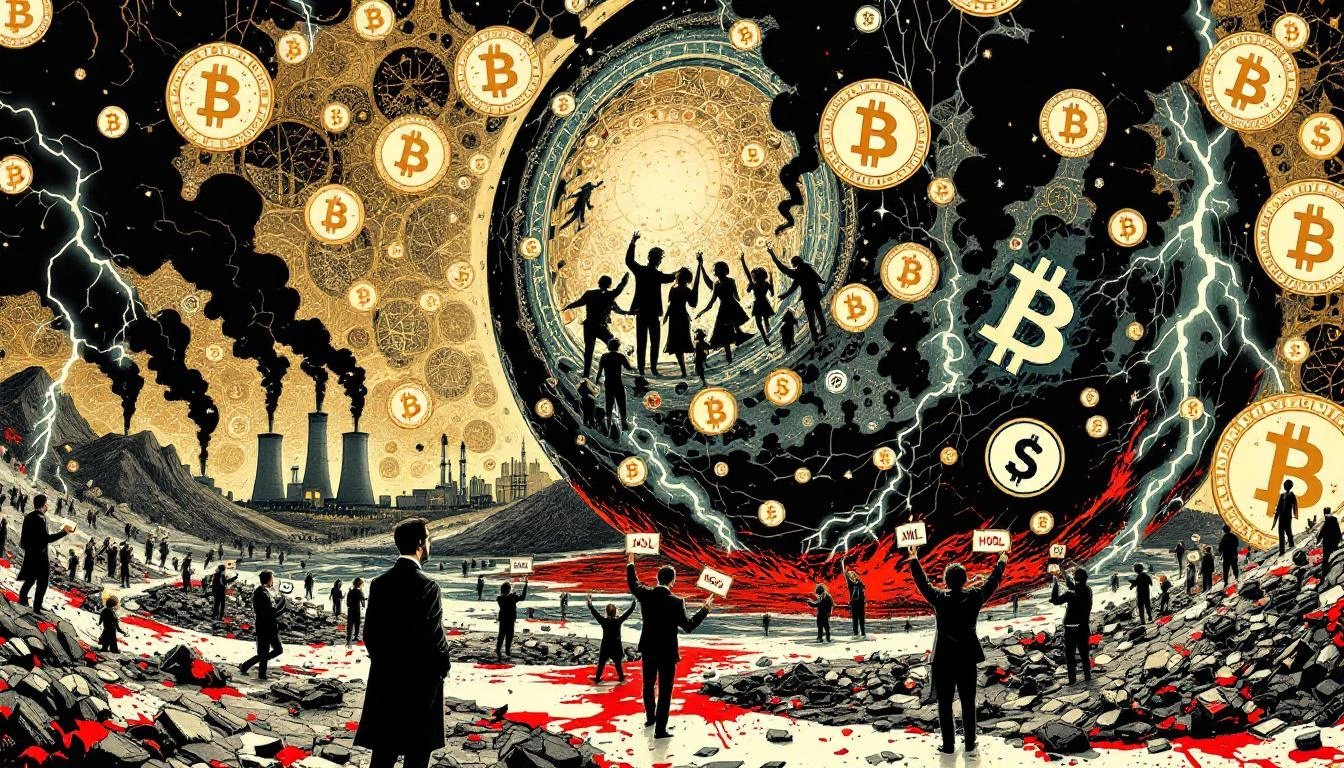
The Immaculate Conception of Worthlessness: How Crypto Bros Accidentally Reinvented Every Financial Disaster They Claimed to Fix
The Gospel According to Satoshi's Useful Idiots
In the beginning was the Blockchain, and the Blockchain was with libertarians who'd read exactly one economics paper, and the Blockchain was Good. Or so we were told by a generation of tech evangelists who discovered that convincing people to buy nothing dressed up as something was considerably more profitable than actually building anything useful.
Cryptocurrency represents perhaps the most perfectly distilled expression of early 21st-century delusion: the belief that you can solve institutional problems with code written by people who fundamentally misunderstand why those institutions exist in the first place. It's what happens when software engineers discover Austrian economics during a Reddit binge and decide that thousands of years of financial evolution were just a series of clerical errors waiting for someone with a GitHub account to fix.
The Beautiful Irony of Decentralized Stupidity
The crypto faithful promised us liberation from central banks, from government oversight, from the tyranny of institutions that dare to ask questions like "where did this money come from" and "why are you trying to buy a kidney on the dark web." What they delivered instead was a perfect recreation of every financial pathology of the last four centuries, now with 100% more environmental destruction.
Want fractional reserve banking? Crypto exchanges invented that while swearing they hadn't. Want massive price manipulation by wealthy insiders? Welcome to whale wallets and pump-and-dump schemes that would make 1920s stock promoters weep with envy. Want financial contagion where one institution's collapse triggers cascading failures? Hello, FTX, Celsius, Terra Luna, and the smoking crater where your retirement savings used to be.
The blockchain was supposed to eliminate the need for trust. Instead, it created an ecosystem where you had to trust:
- Exchange operators not to steal your coins
- Wallet developers not to have backdoors
- Protocol developers not to have fatal bugs
- Other investors not to orchestrate coordinated dumps
- Stablecoin issuers to actually have the dollars they claim
- Literally anyone telling you anything about anything
Congratulations. You've reinvented banking, but somehow made it worse and added a carbon footprint the size of Argentina.
The Tulip Bulbs Are Calling From Inside The House
Every bubble in history has its own flavor of mass delusion. The Dutch had tulips. The British had South Sea Company stock. The Americans had mortgage-backed securities rated AAA by people who couldn't spell "subprime" without a teleprompter.
Crypto managed to combine all of these into one spectacular carnival of stupid:
The Bubble of 2017: Bitcoin hit $20,000 and crypto bros everywhere learned the hard way that "HODL" is not actually a viable investment strategy when you need to make rent.
The NFT Mania of 2021: Because nothing says "the future of art" like paying $500,000 for a receipt that proves you own a link to a JPEG of a bored ape that you don't actually own the copyright to. The Mona Lisa has survived five centuries. Your Cryptopunk will survive until the server hosting it gets shut down for non-payment.
The Stablecoin Catastrophe of 2022: Terra Luna demonstrated that you cannot, in fact, create a stable currency by having it be backed by another cryptocurrency whose value depends on the first currency maintaining its peg. This is roughly equivalent to using a house of cards as the foundation for a second house of cards and being shocked when someone sneezes.
The FTX Implosion of 2022: Sam Bankman-Fried, the mop-haired wunderkind who dressed like a middle schooler and talked like someone who'd just discovered EA philosophy on a Reddit thread, managed to lose $8 billion of customer funds. His primary strategy appeared to be "spend depositors' money on everything except what they deposited it for" and "hedge risk by not hedging anything at all." Bernie Madoff, watching from hell, took notes.
The Energy Suicide Pact
Here's a fun fact that crypto enthusiasts hate to discuss: Bitcoin mining now consumes more electricity annually than entire nations. Argentina. The Netherlands. The United Arab Emirates. Pick your comparison; they're all equally damning.
We've taken the planet's most precious resource during a climate emergency and dedicated massive amounts of it to solving math problems that serve no purpose except to mint more tokens for people to gamble on. It's as if someone looked at the energy crisis and thought, "You know what would help? A massive distributed system that burns electricity to produce nothing but speculation fodder."
Ethereum's move to proof-of-stake reduced its energy consumption by 99.95%, which is impressive until you realize it's like bragging that you've stopped setting fire to rainforests and now only set fire to old-growth forests. Progress!
The Libertarian Ouroboros
The most exquisite irony of the entire crypto saga is watching libertarians speedrun through every reason financial regulations exist in the first place.
"We don't need the SEC!" they cried, immediately before creating thousands of securities that they swore weren't securities right up until the lawyers showed up.
"We don't need banking regulations!" they insisted, shortly before discovering why fractional reserve requirements and capital adequacy standards might actually be good ideas when your exchange is using customer deposits to buy Bahamas real estate.
"We don't need consumer protections!" they proclaimed, moments before Reddit filled with posts titled "I sent my life savings to the wrong wallet address and now it's gone forever, what do I do?"
Every crypto disaster is a reenactment of financial history, performed by people who think financial history is a psyop. It's like watching someone confidently dismantle their car's brakes because they read on a forum that brakes are a conspiracy by Big Auto to suppress your freedom to accelerate, then acting shocked when they plow through a farmer's market.
The Morons, The Grifters, and The True Believers
The crypto ecosystem stratifies beautifully into three distinct castes:
The True Believers: These are the people who genuinely think they're revolutionizing finance. They can explain in excruciating detail how their particular protocol solves the Byzantine Generals Problem but cannot explain why solving the Byzantine Generals Problem matters to anyone who isn't trying to process ransomware payments. They are the useful idiots, the true faithful who will go down with the ship while insisting that technically, according to the whitepaper, the ship isn't sinking.
The Grifters: These are the YouTubers with thumbnails of themselves screaming next to rocket emojis, the "influencers" paid in tokens to shill projects they know are garbage, the founders who launch coins with no purpose except to pump and dump. They understand exactly what they're doing, which is transferring wealth from marks to themselves while the window remains open. They are the priesthood of a cargo cult, fully aware there is no cargo.
The Morons: These are the people who bought Dogecoin because Elon tweeted a meme, who mortgaged their house to buy Squid Game token, who genuinely believed that a coin named after a cryptocurrency exchange would somehow be a good investment. They are the eternal victims of every Ponzi scheme, every pump-and-dump, every rug pull. They will lose everything and learn nothing.
The tragedy is that the morons lose money to the grifters while the true believers cheer, convinced that each catastrophic failure is actually a sign that adoption is accelerating.
The Institutional Invasion
And now, in perhaps the final and most bitter irony, the institutions are here.
BlackRock has Bitcoin ETFs. Goldman Sachs has a crypto desk. JPMorgan, the bank whose CEO once called Bitcoin a "fraud," now offers crypto services to clients. The revolution has been sanitized, packaged, and sold back to you by exactly the same financial institutions crypto was supposed to render obsolete.
The crypto faithful celebrate this as "adoption." What they fail to recognize is that it's a colonization. Wall Street doesn't adopt revolutionary technologies; it domesticates them. It takes the bits that generate fees and strips away anything genuinely threatening to the existing order.
Bitcoin was supposed to be peer-to-peer electronic cash. Instead, it's become a speculative asset held by hedge funds and traded on platforms that require KYC verification, AML compliance, and every other acronym the crypto-anarchists swore they were escaping.
Congratulations. You've successfully disrupted finance by making it slightly more volatile and significantly less regulated. Larry Fink thanks you for your service.
The Eternal Return of Market Madness
Every cryptocurrency crash is greeted with shock by people who apparently believe that assets which regularly gain or lose 30% of their value in a single day represent a stable store of value. This is like being surprised that the rabid wolverine you've been keeping as a pet occasionally bites people.
Bitcoin has "died" more than 400 times according to mainstream media obituaries. It has also resurged more than 400 times, which crypto bulls cite as evidence of resilience rather than evidence of a perpetual boom-bust cycle driven by nothing but sentiment and Tether printing.
The bubble inflates. True believers insist this time is different. Institutional money flows in at the top. Retail investors mortgage their futures. Someone discovers that a major exchange has been operating as a fractional reserve casino. The bubble pops. Billions evaporate. Congressional hearings happen. Regulations are proposed. Crypto bros scream about government overreach. The price bottoms out.
Then some geopolitical event happens, or some billionaire tweets, or some country with a collapsing currency adopts Bitcoin, and the whole grotesque cycle begins anew.
It's not a bug. It's the entire point. The volatility isn't a problem to be solved; it's the feature that allows rapid wealth transfer from late adopters to early adopters, from the naïve to the cynical, from the hopeful to the prepared.
The Verdict
Cryptocurrency is what happens when you let computer scientists design an economy. It's what happens when you confuse code with law, when you mistake "no one can stop this transaction" for "this transaction should not be stopped," when you think that eliminating human judgment from financial systems will somehow produce better outcomes than systems designed with human judgment.
It has produced exactly one innovation of note: a way to transfer value across borders without permission. This is useful primarily for ransomware, sanctions evasion, and buying drugs on the internet. Every other promised use case—from "banking the unbanked" to "democratizing finance"—has been either a lie or a failure.
The blockchain will survive. Some cryptocurrencies will survive. The technology has genuine uses in specific contexts where distributed consensus without central authority matters more than efficiency, speed, or energy consumption.
But the dream? The revolution? The promise of money freed from government control, of finance rebuilt from first principles, of a new economic order rising from the ashes of the old?
That dream died the moment someone figured out they could make a fortune by convincing marks that magic internet money was going to make them rich. And it will keep dying, repeatedly, in bubble after bubble, crash after crash, until the last true believer finally learns what every generation eventually learns:
There is no revolution that cannot be monetized. There is no ideal that cannot be corrupted. There is no freedom that capital will not find a way to charge rent on.
And there is no fool like a crypto fool, convinced that this time, somehow, the mathematics will save them from the mathematics of human greed.
The Oracle Also Sees...
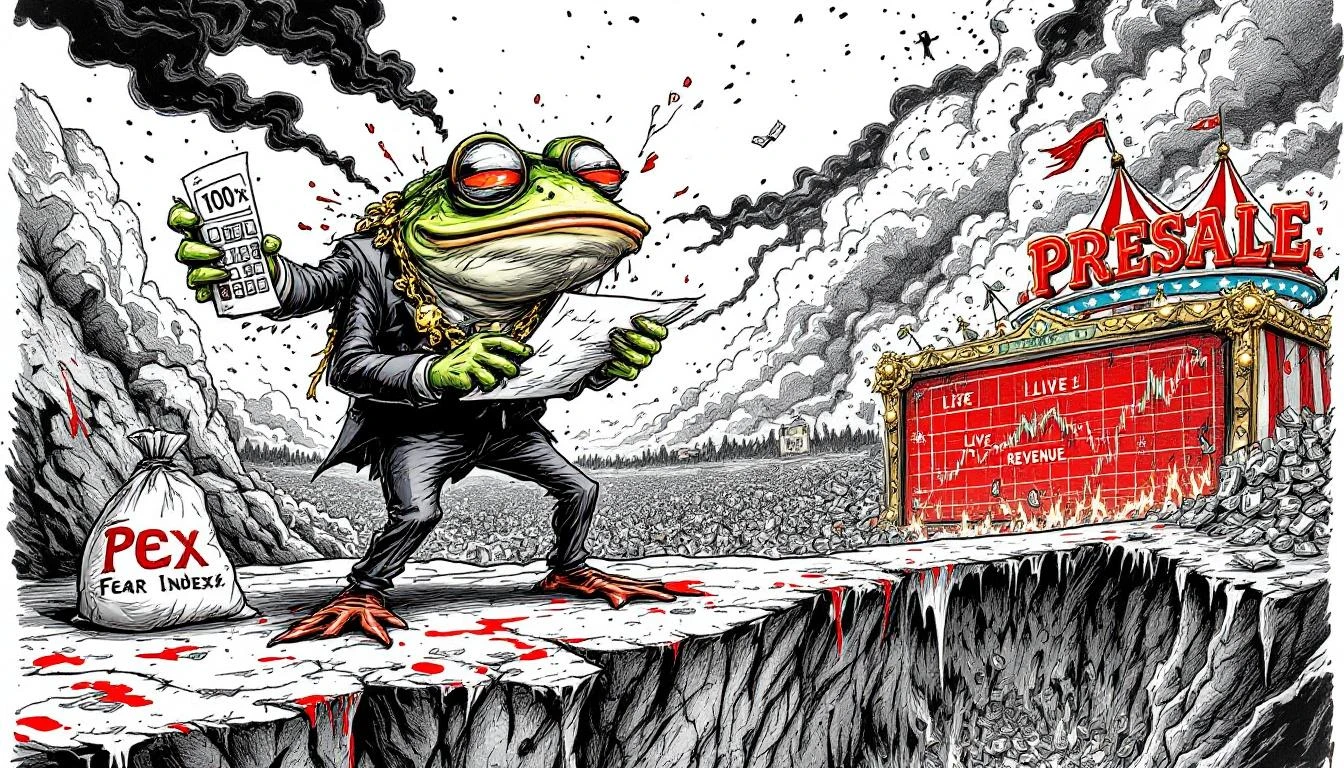
AlphaPepe and the Weaponized Mathematics of Desperation
When the Fear Index hits 13 and the market bleeds, AlphaPepe emerges to promise 100x returns through 'live DEX revenue' and the kind of mathematical confidence that only comes from tokens that haven't met reality yet.
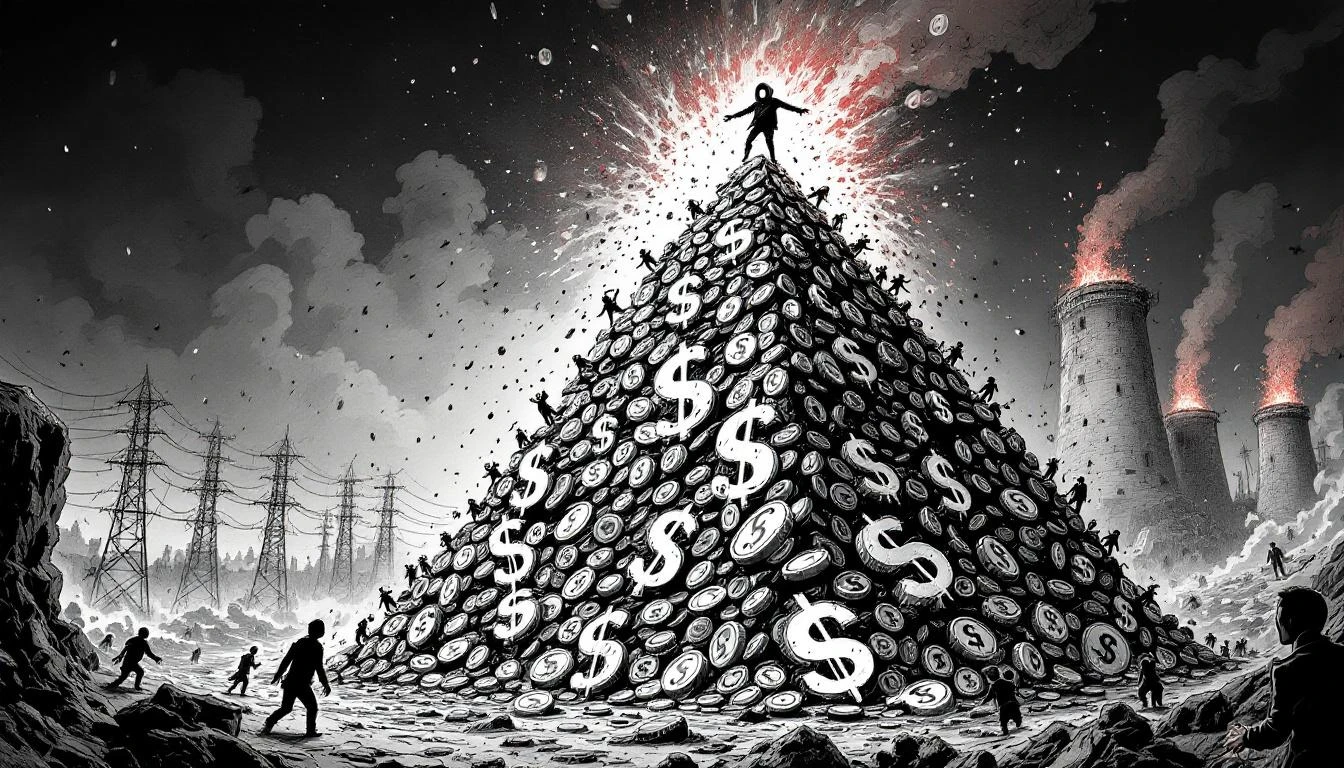
The Great Crypto Grift: How Digital Beanie Babies Became a Religion
Cryptocurrency: where libertarian fantasy meets Ponzi mathematics, environmental catastrophe gets monetized, and millions learned that 'decentralized' just means 'no one to call when it all collapses.'
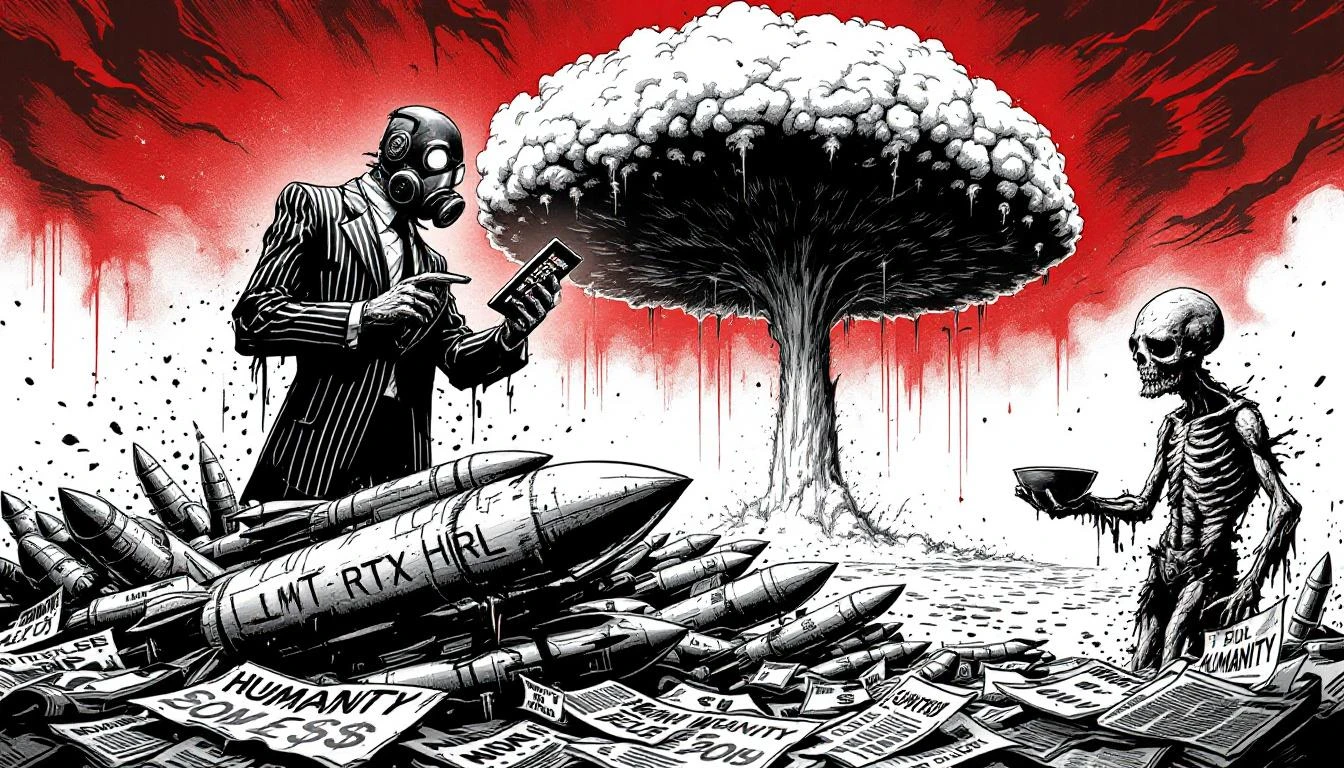
The Ghoul's Guide to Profiting from Armageddon: Eleven Magical Stocks to Keep You Warm While the World Burns
Wall Street discovers you need exactly eleven stocks—not ten, not twelve—to profit from potential war with Iran. The precision is what makes it art.